Table of Contents
- The Six Stages of a Modern Content Workflow
- ChatGPT: General-Purpose Generative AI Assistant
- Claude: Long-Form Writing and Document Analysis
- Surfer SEO: Content Optimization and AI Search Visibility
- Midjourney: AI Image Generation for Creative Work
- ElevenLabs: Text-to-Speech and Voice Cloning
- Runway: AI Video Generation and Editing
- Descript: Transcript-Based Audio and Video Editing
- The Bottom Line
A friend of mine recently told her group chat that AI was going to replace writers. Three minutes later she asked the same group what “rephrase this so it sounds less robotic” meant. Nobody answered, because everyone was busy asking ChatGPT the exact same question.
That is roughly where most creators are in 2026. ChatGPT alone now serves 900 million weekly active users (OpenAI, February 2026), and Salesforce reports 87% of marketers use generative AI in at least one workflow, up from 51% in 2024. The differentiator is no longer access. According to Averi’s State of AI Content Marketing 2026, only 23% of teams have AI properly integrated into a connected system. The rest are using disconnected tools and calling it a strategy.
This guide walks through the seven tools that make up the modern creator workflow, with verified pricing, platform ratings, real capabilities, and honest trade-offs. No filler.
Why the Workflow Beats the Tool
Digital Applied’s Content Operations Statistics 2026 captures the shift in one number: teams that paired AI adoption with proper approval workflows ship in 1.8 days. Teams using the same tools without rebuilding their process sit at 4.7 days. McKinsey’s Global AI Survey reports AI content drafting now delivers an average 3.2x ROI, but the returns only materialize when the tools work as a system rather than in isolation.
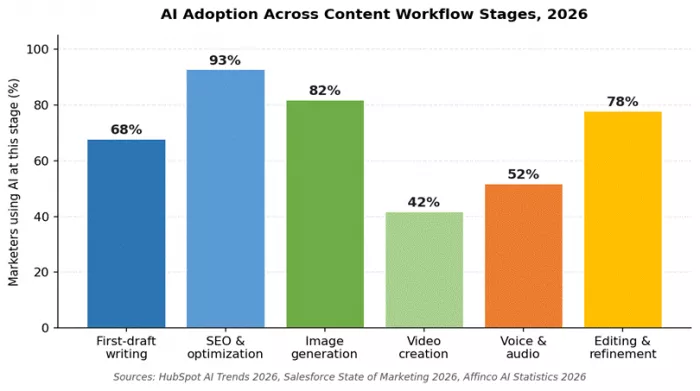
Figure 1. AI adoption across the six core workflow stages, 2026.
The Six Stages of a Modern Content Workflow
•Research and ideation, where you mine angles and build a brief.
•Drafting and structure, where the long-form text gets produced.
•Search and AI visibility optimization, tuned for both Google and AI answer engines.
•Visual production, where images and graphics are generated.
•Voice and video, where audio narration and short-form video are created.
•Editing and polish, where everything gets cut, captioned, and assembled.
The seven tools below cover all six stages.
ChatGPT: General-Purpose Generative AI Assistant
ChatGPT, built by OpenAI on the GPT-5.4 model family, is the most widely used AI assistant in the world. As of February 2026, OpenAI confirmed 900 million weekly active users and 50 million paying subscribers, making January and February 2026 the largest months for new subscriber signups in the company’s history. Codex, the agentic coding tool, crossed 3 million weekly users on April 8, 2026. Approximately 92% of Fortune 500 companies use ChatGPT in some capacity, with over 7 million enterprise workplace seats deployed.
For creators, ChatGPT consolidates ideation, research, image generation through GPT Image 2, video through Sora 2, and voice through Advanced Voice Mode into a single interface. Custom GPTs let creators turn repeatable prompts into reusable tools. Memory persists across sessions. Microsoft 365 Copilot integration extends the same model into Word, Excel, and PowerPoint.
Core capabilities
GPT-5.4 with five reasoning effort levels. Deep Research with multi-source synthesis. GPT Image 2 for native image generation. Sora 2 for short-form video. Advanced Voice Mode. Canvas for collaborative document editing. Custom GPTs. Codex for agentic coding. Persistent memory. Live web browsing.
Platform ratings
| G2 | CAPTERRA | REVIEW VOLUME | SCALE OF USE |
|---|---|---|---|
| 4.7 / 5 | 4.6 / 5 | 15,000+ reviews | 900M weekly users |
Pros and cons
| PROS | CONS |
|---|---|
• Broadest feature set across writing, image, video, voice, and code • Largest plugin and Custom GPT ecosystem in the market • Native multimodal handling without switching tools • Memory and persistent personalization improve over time • Microsoft 365 Copilot integration for enterprise users | • Writing quality is more formulaic than Claude on long-form work • Usage caps tightened in April 2026 • Hallucinations on niche topics still require fact-checking • Free tier introduced ads in February 2026 • 128K standard context window is smaller than Claude’s |
Pricing
| Plan | Monthly Cost | Best For |
|---|---|---|
| Free (with ads) | $0 | Casual exploration |
| Go | $8 | Light personal use |
| Plus | $20 | Most independent creators |
| Pro (mid-tier) | $100 | Heavy Codex and reasoning users |
| Pro (top tier) | $200 | Power users running daily workflows |
| Business | $25 / user | Small teams |
Claude: Long-Form Writing and Document Analysis
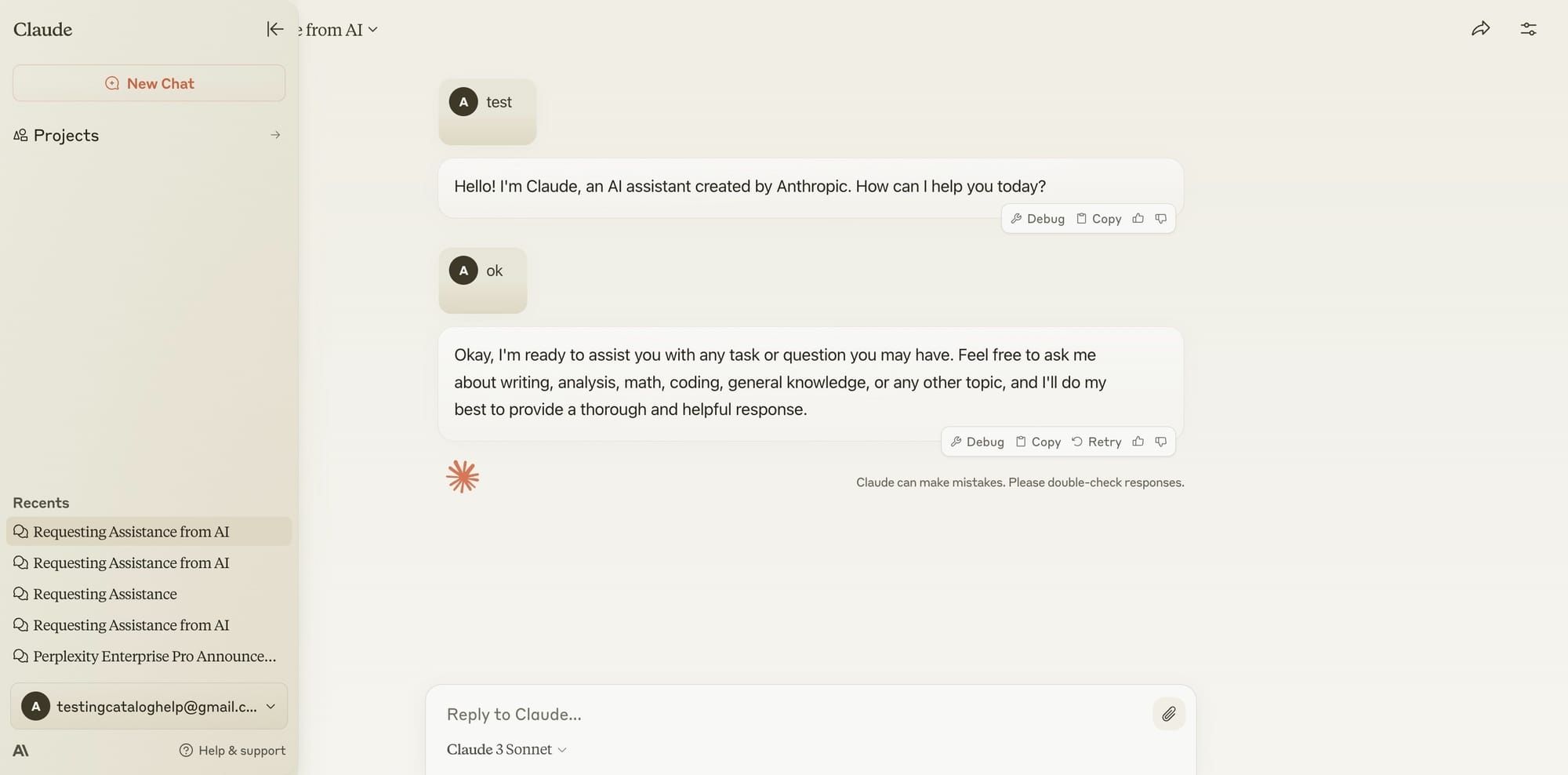
Claude, developed by Anthropic, runs on the Claude 4 model family (Opus 4.7, Sonnet 4.6, Haiku 4.5). Sonnet 4.6 supports a 1 million token context window through the API, roughly four times what GPT-5.4 offers at the standard tier. According to Zapier’s April 2026 Claude vs ChatGPT comparison, Anthropic owns approximately 54% of the enterprise coding market, and growth in early 2026 was particularly strong on the API side.
For creators producing long-form text, the practical difference is two things: writing that sounds less generated, and Projects, a feature that lets you load brand guidelines, prior articles, and research files into a persistent workspace. Artifacts renders documents, code, and HTML previews live alongside the conversation. Computer Use lets Claude operate software directly when given access.
Core capabilities
Opus 4.7, Sonnet 4.6, and Haiku 4.5 model tiers. 1M token context on Sonnet 4.6 via API. Projects for persistent context. Artifacts for live preview rendering. Computer Use API. Claude Code for terminal-based coding. File and PDF analysis. Image input. Web search.
Platform ratings
| G2 | CAPTERRA | REVIEW VOLUME | SCALE OF USE |
|---|---|---|---|
| 4.7 / 5 | 4.6 / 5 | 120+ reviews | 54% enterprise coding share |
Pros and cons
| PROS | CONS |
|---|---|
• Industry-leading long-form writing quality • 1M token context window on Sonnet 4.6 API • Lower hallucination rate than competing models • Projects feature maintains brand voice across sessions • Artifacts feature renders documents and code live | • No native image, video, or voice generation • Smaller plugin and integration ecosystem than ChatGPT • Daily usage caps frustrate heavy users on Pro plan • Occasionally over-cautious with refusals on edge cases • No persistent memory at the chat level on free tier |
Pricing
| Plan | Monthly Cost | Best For |
|---|---|---|
| Free | $0 | Light usage with daily caps |
| Pro | $20 | Most individual writers |
| Max 5x | $100 | Heavy daily writing |
| Max 20x | $200 | Production-grade volume |
| Team | $30 / user | Small content teams |
Surfer SEO: Content Optimization and AI Search Visibility

Surfer SEO is a Polish-built content intelligence platform serving more than 150,000 paying customers across 159 countries, including Bolt, FedEx, ClickUp, Lenovo, Opera, Square, Shopify, and FreshBooks. Content Editor analyzes 500-plus on-page signals from currently ranking competitors and produces a real-time Content Score from 0 to 100 with structured guidance on keywords, headings, and entity coverage.
The 2026 strategic shift was AI Tracker, which monitors brand mentions across ChatGPT, Perplexity, Google AI Mode, Google AI Overview, and Gemini. Per Surfer’s own data, 25% of new customers in 2026 came from AI assistants citing their content rather than from traditional Google search. Native integrations with Google Docs, WordPress, Jasper, and Contentful keep it inside existing workflows.
Core capabilities
Content Editor 3.0 with live SERP-aware feedback. AI Tracker for visibility across five AI platforms. Topical Map for content cluster planning. Surfer AI Writer. Audit for refreshing existing content. Custom Tone Humanizer. Unlimited keyword research on paid plans.
Platform ratings
| G2 | CAPTERRA | REVIEW VOLUME | SCALE OF USE |
|---|---|---|---|
| 4.8 / 5 | 4.9 / 5 | 500+ reviews | 150,000+ customers |
Pros and cons
| PROS | CONS |
|---|---|
• Real-time Content Score is the industry standard for on-page SEO • AI Tracker monitors brand visibility in ChatGPT, Perplexity, Gemini • Native Google Docs and WordPress integration • Used by 150,000+ paying customers including Fortune 500 brands • 7-day money-back guarantee on Essential and Scale plans | • Premium pricing relative to Frase or NeuronWriter • Content Score correlates with rankings but does not cause them • AI Tracker prompts cost extra at $95/month per 25 prompts • Surfer AI article quality less reliable than the Editor • Spanish and non-English NLP weaker than English |
Pricing
| Plan | Monthly Cost | Best For |
|---|---|---|
| Essential | $99 ($79 annual) | Solo creators, small teams |
| Scale | $219 ($175 annual) | Agencies and content teams |
| Enterprise | Custom | Large operations and SSO needs |
Midjourney: AI Image Generation for Creative Work

Midjourney is an independent research lab of about 60 people, founded by David Holz (formerly co-founder of Leap Motion) and famously self-funded with no outside investors. Version 7 became the default model on June 17, 2025. Version 8.1, released April 30, 2026, is now the fastest model in the lineup. Independent reviewers across PXLPeak, Coda One, and the Midjourney TechCrunch coverage agree it produces the highest aesthetic ceiling of any consumer AI image generator.
Style Reference (--sref) locks a consistent visual style across generations, which is what makes brand-consistent image production feasible. Character Reference (--cref) keeps characters recognizable across scenes. Vary Region performs targeted in-painting. Stealth Mode (Pro and Mega tiers only) keeps generated images out of the public Midjourney gallery, which matters for client work.
Core capabilities
V7 default with V8.1 available. Style Reference, Character Reference, Vary Region, Pan, Zoom Out. Draft Mode for fast iteration. Web interface and Discord. Commercial rights on all paid plans. Niji models for anime styles. GPU-hour-based generation system with Fast and Relax modes.
Platform ratings
| G2 | CAPTERRA | REVIEW VOLUME | SCALE OF USE |
|---|---|---|---|
| 4.5 / 5 | 4.4 / 5 | 300+ Product Hunt | Self-funded, 60 staff |
Pros and cons
| PROS | CONS |
|---|---|
• Highest aesthetic ceiling of any consumer AI image tool • Style Reference enables consistent brand visuals • Character Reference for narrative consistency • Commercial rights on every paid plan • Self-funded, stable long-term outlook | • No free tier since late 2024 • GPU hour pricing system confuses new users • Stealth Mode requires Pro plan or higher • No public API for automation workflows • Customer support is community-driven and limited |
Pricing
| Plan | Monthly Cost | Capacity | Notable |
|---|---|---|---|
| Basic | $10 | ~200 images | No Relax mode |
| Standard | $30 | ~900 fast + unlimited Relax | Sweet spot for most |
| Pro | $60 | ~1,800 fast + unlimited Relax | Adds Stealth privacy |
| Mega | $120 | ~3,600 fast | Heavy production volume |
ElevenLabs: Text-to-Speech and Voice Cloning
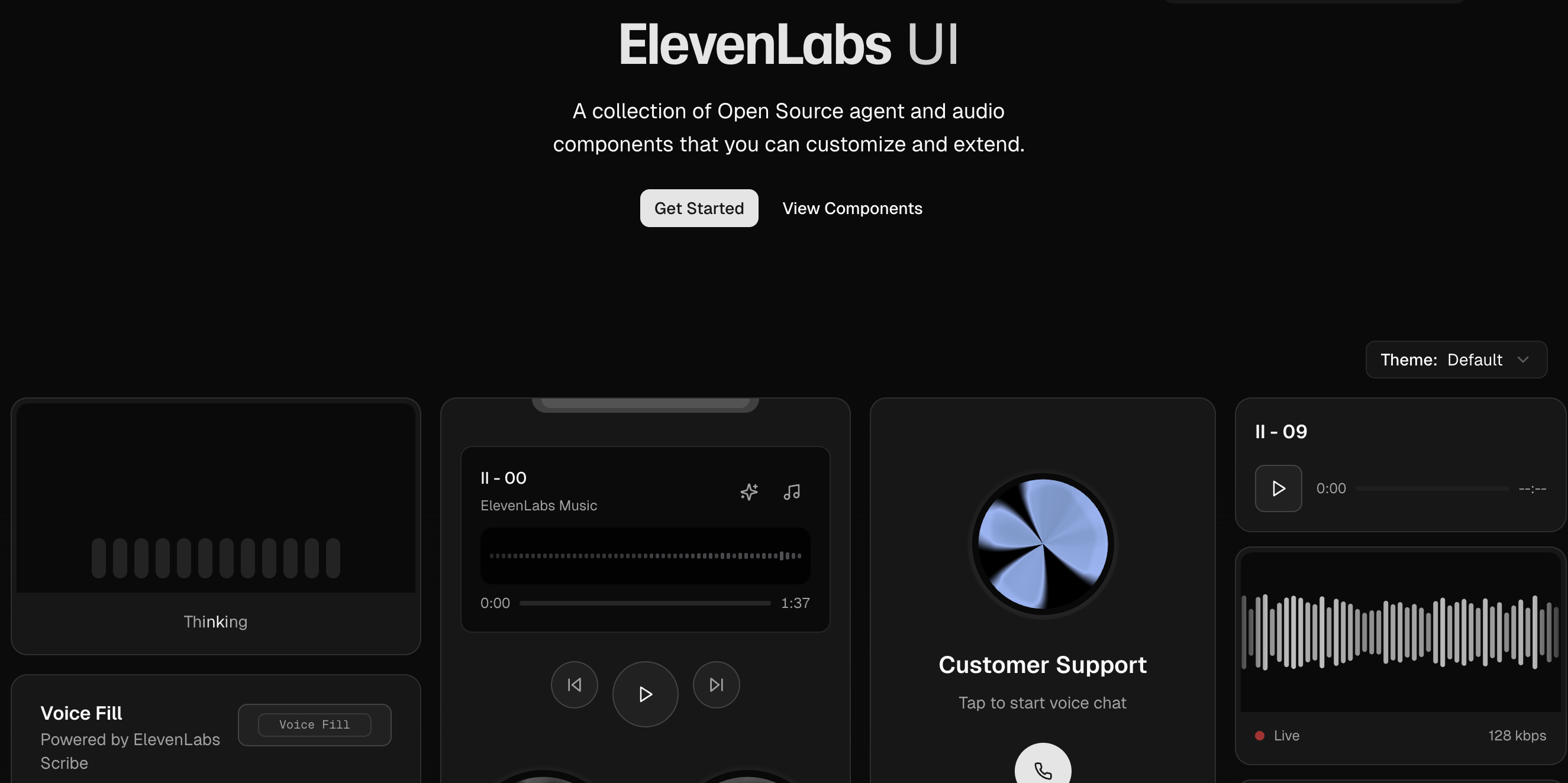
ElevenLabs, founded in 2022 by Piotr Dabkowski and Mati Staniszewski, is the market-leading AI voice platform. Per ElevenLabs’ own published figures, the platform is used by 41% of Fortune 500 companies and recently crossed $330 million in annual recurring revenue. The current model lineup includes Eleven v3 alpha (highest quality with emotional control), v2.5 Multilingual, and Flash and Turbo for lower-latency real-time use, supporting 32+ languages.
Two voice cloning paths matter for creators. Instant Voice Cloning generates a usable clone from roughly one minute of source audio. Professional Voice Cloning, available on Creator tier and above, uses longer training samples to produce results that hold up across long-form narration. AI Dubbing handles multilingual translation with lip-synced output, opening international audiences without re-recording.
Core capabilities
Eleven v3 alpha, v2.5 Multilingual, Flash, and Turbo models. 32+ supported languages. Instant Voice Cloning and Professional Voice Cloning. AI Dubbing with lip-sync. Sound Effects generation. AI Music. Studio for long-form audio assembly. Conversational AI agents with telephony via Twilio and Vonage. Voice Library with 5,000+ pre-made voices. SOC 2 Type II and HIPAA compliance on Enterprise.
Platform ratings
| G2 | CAPTERRA | REVIEW VOLUME | SCALE OF USE |
|---|---|---|---|
| 4.5 / 5 | 4.6 / 5 | 1,140+ reviews | 41% of Fortune 500 |
Pros and cons
| PROS | CONS |
|---|---|
• Industry-leading voice naturalness and emotional range • 32+ language support with lip-synced AI Dubbing • Professional Voice Cloning produces broadcast-quality output • Sub-100ms latency on Flash model for real-time agents • Strong API with SDKs in JS, Python, Swift, React | • Credit system creates unpredictable monthly costs • Free tier excludes commercial use • Pricing escalates quickly for high-volume production • Pronunciation issues with proper nouns and acronyms • No native dashboard for production agent monitoring |
Pricing
| Plan | Monthly Cost | Credits | Best For |
|---|---|---|---|
| Free | $0 | 10,000 | Testing only, no commercial |
| Starter | $5 | 30,000 | Minimum for monetized work |
| Creator | $22 | 100,000 | Most working creators |
| Pro | $99 | 500,000 | Agencies and high volume |
| Scale | $330 | 2,000,000 | Studios and platforms |
Runway: AI Video Generation and Editing

Runway, a New York-based research company founded in 2018 by Cristóbal Valenzuela, Alejandro Matamala-Ortiz, and Anastasis Germanidis, has raised $860 million in total funding. The Series E in February 2026 brought the valuation to $5.3 billion. The platform is used by CBS’s Late Show for composites, KPF Architects for animated renders, and Adobe through a multi-year strategic partnership that gave Adobe early API access starting with Gen-4.5 in Firefly.
Two features released in 2025 changed what creators can do with the platform. Aleph, launched in July 2025, is an in-video editing system that allows post-generation modifications through text prompts (“add rain to this scene”, “change lighting to golden hour”) without regenerating clips. Act-Two captures performance from a reference video, transferring expressions and movement to AI-generated characters. The 2026 platform also operates as a multi-model marketplace, with subscriber access to Google Veo 3.1, Kuaishou Kling 3.0 Pro, ByteDance Seedance, and Black Forest Labs FLUX from one dashboard.
Core capabilities
Gen-4, Gen-4.5, and Gen-3 Alpha models. Aleph for in-video editing. Act-Two for performance capture. Third-party model access (Veo 3.1, Kling 3.0 Pro, Seedance, FLUX). Image-to-video and text-to-video. 4K upscaling. iOS app. API access on Pro and Unlimited.
Platform ratings
| G2 | CAPTERRA | REVIEW VOLUME | SCALE OF USE |
|---|---|---|---|
| 4.6 / 5 | 4.7 / 5 | Limited G2 sample | $5.3B valuation |
Pros and cons
| PROS | CONS |
|---|---|
• Highest cinematic quality of any AI video platform • Multi-model marketplace under one subscription • Aleph allows post-generation edits without regenerating • Act-Two enables performance capture from reference clips • Adobe partnership gives early model access in Firefly | • Credits expire monthly and do not roll over • Premium pricing relative to Kling AI or Pika • Character consistency across long sequences still imperfect • Free plan limited to 125 one-time credits with watermark • Trustpilot reviews flag credit waste on failed generations |
Pricing
| Plan | Monthly Cost (annual) | Credits | Best For |
|---|---|---|---|
| Free | $0 | 125 (one-time) | Quality evaluation only |
| Standard | $12 ($15 monthly) | 625 | Solo creators |
| Pro | $28 ($35 monthly) | 2,250 | Regular production work |
| Unlimited | $76 ($95 monthly) | 2,250 + Explore Mode | Heavy iteration |
Descript: Transcript-Based Audio and Video Editing
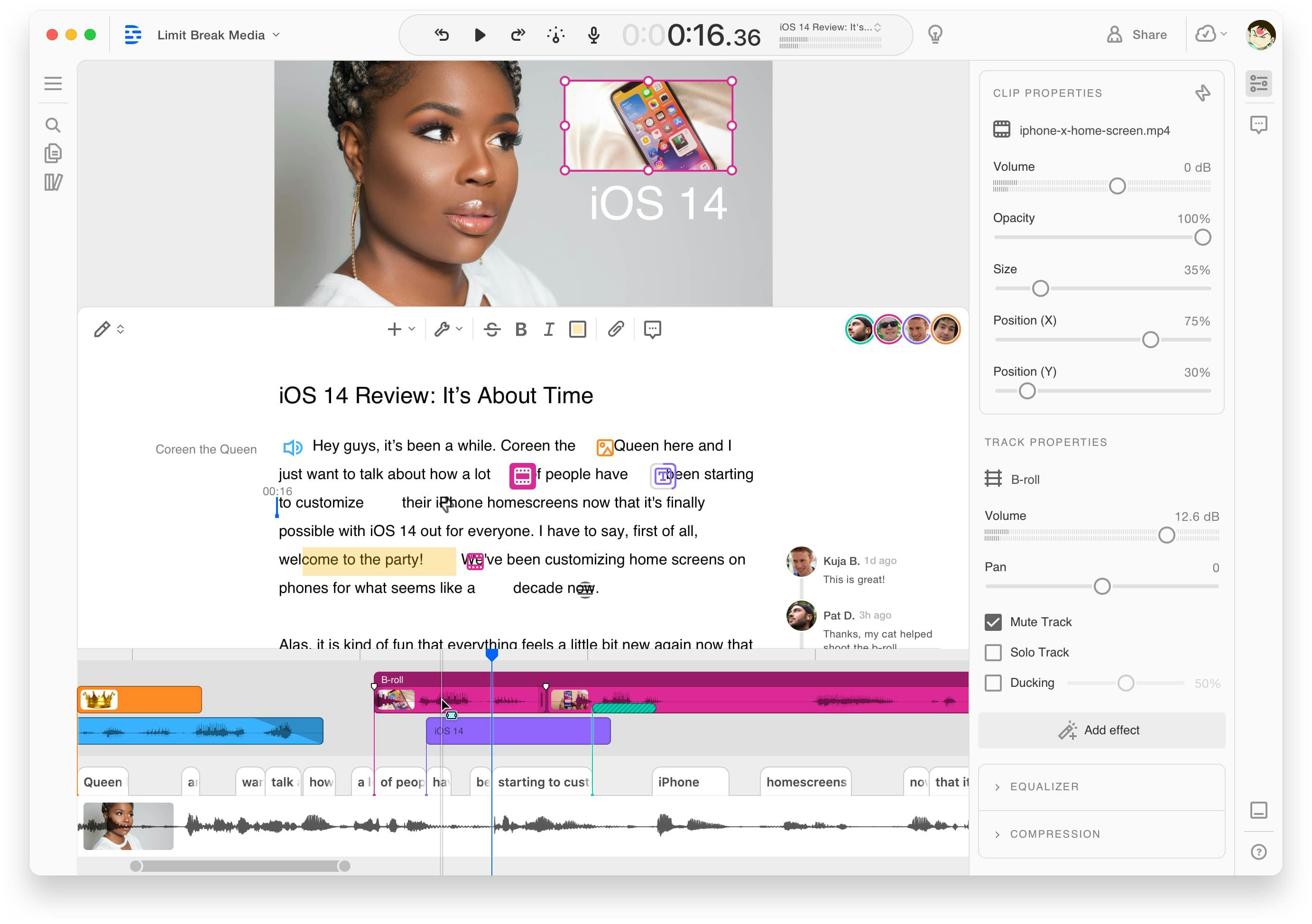
Descript was founded in 2017 by Andrew Mason, the former CEO and founder of Groupon. The platform now serves 6 million-plus creators, reports $55 million in annual recurring revenue with 75% year-over-year growth, and is backed by the OpenAI Startup Fund and Andreessen Horowitz. Its core innovation is transcript-based editing: spoken-word media is treated like a Google Doc, where deleting a word from the transcript removes the corresponding audio or video.
Underlord, the agentic AI co-editor, runs on a model layer that includes Claude Opus 4.6, Claude Haiku 4.5, GPT-5.2, and Gemini 3.0 Pro depending on the task. Studio Sound cleans audio to broadcast quality with one click. Eye Contact subtly adjusts gaze direction for camera-facing reads. Filler word removal eliminates filler words in seconds. Overdub voice cloning allows in-place text corrections in the speaker’s own cloned voice.
Core capabilities
Transcript-based audio and video editing. Underlord agentic AI co-editor (multi-model). Studio Sound. Eye Contact. Filler word removal. Overdub voice cloning. Multi-track recording with separate speaker channels. Screen recording. 25+ language transcription. AI green-screen removal. Brand Studio on Business tier. Adobe Premiere Pro export.
Platform ratings
| G2 | CAPTERRA | REVIEW VOLUME | SCALE OF USE |
|---|---|---|---|
| 4.6 / 5 | 4.7 / 5 | 865+ reviews | 6M+ creators |
Pros and cons
| PROS | CONS |
|---|---|
• Transcript-based editing saves significant editing time • Underlord AI co-editor handles multi-step edit commands • Studio Sound delivers broadcast-quality audio with one click • Multi-model AI backend (Claude, GPT, Gemini) • All-in-one platform replaces multiple separate tools | • September 2025 pricing overhaul raised effective costs • Media Minutes plus AI Credits system can produce surprise bills • Reliability complaints around lost edits in 2025 • Customer support is largely AI-bot driven on lower tiers • No offline editing; requires constant internet connection |
Pricing
| Plan | Monthly Cost | Best For |
|---|---|---|
| Free | $0 | Testing the workflow |
| Hobbyist | $24 | Solo creators with light usage |
| Creator | $35 | Most working podcasters and YouTubers |
| Business | $65 | Small teams needing Brand Studio |
| Enterprise | Custom | Larger orgs needing SSO |
How to Actually Build Your Workflow
Five steps drawn from how the top-decile content teams in Digital Applied’s benchmark dataset actually operate.
•One tool per stage. Most creator burnout in 2026 comes from over-tooling. Pick one writing tool, one image tool, one voice tool, one editor. Add a second only when you have hit a real ceiling on the first.
•Use AI at the brief stage, not just the draft stage. Averi’s benchmark data shows teams that involve AI at briefing and outlining produce measurably better content than those who only use it for drafting.
•Treat human editing as a fixed step. The 2026 quality bar has risen because audiences can spot generic AI output instantly. Original research, specific examples, and a real point of view are what separate work that performs from work that gets ignored.
•Track AI-specific KPIs. Per Averi, only 19% of content teams currently track AI-specific metrics. AI citation rate in ChatGPT and Perplexity, time-to-publish, and cost per article tell you whether your workflow is actually working.
•Budget for the workflow. A practical 2026 stack runs roughly $77–$116/month: ChatGPT Plus or Claude Pro at $20, Surfer Essential at $79–$99, Midjourney Standard at $30, ElevenLabs Creator at $22, Descript Hobbyist at $24. Add Runway Standard at $12 if video matters.
The Bottom Line
AI is not the work in 2026; AI is the leverage. The work is still the angle, the research, the voice, and the judgment. What changes is how much production overhead a single creator can absorb when a few focused tools are wired into one clean, measurable pipeline. Winning teams keep a deliberately small stack, with clear handoffs between research, drafting, visuals, and editing. They also lean on focused hubs like Timtis, which map real-world workflows and tool choices, so they can refine their system instead of endlessly chasing the next “all-in-one” solution.
Comments