Table of Contents
- Verdict at a glance
- What Pephop AI actually is
- Hands-on: what a live session revealed
- Features at a glance
- Pricing and plans
- Performance and the memory ceiling
- Adoption and trajectory
- Safety, privacy, and transparency
- What users actually say
- The full scorecard
- Where Pephop AI falls short
- The verdict
6.5 OUT OF 10 | Overall verdict A capable mid-tier character chat platform. A strong library, deep customization, and a consent layer that actually holds, held back by weak long-term memory and a thin trust profile. |
Verdict at a glance
| The 30 second read | |
|---|---|
| BEST FOR | Roleplayers and storytellers who want low-filter character chat with deep customization, a huge persona library, and a low monthly entry price. |
| SKIP IF | Long, continuous storylines matter, since characters tend to lose the thread after a short run of messages, or if company transparency and a polished voice feature are non-negotiable. |
| BOTTOM LINE | A competent platform that does browser-based character roleplay well for the money. It is worth a free-tier trial for the target user and easy to skip for most others. |
How this review was done
This assessment follows the Live Companion Audit (LCA) framework. Rather than scoring marketing claims, the platform was opened, an account was created, and a live session was run on a real character before any verdict was formed. Scores combine that hands-on behavior with corroborated third-party data from Similarweb traffic estimates and verified Trustpilot reviews.
• Session quality. Coherence, memory retention across turns, and response latency during an actual conversation.
• Safety conduct. How the system responds to non-consensual, abusive, or otherwise harmful prompts.
• Value integrity. Pricing measured against message caps, gated features, and billing clarity.
• Operator transparency. Ownership disclosure, model claims, and data-handling posture.

The landing experience leans heavily on browsable character cards.
What Pephop AI actually is
Pephop AI is a web-based platform where a person picks an AI character, sends a message, and receives a reply written in that character's voice. It covers safe-for-work chat, mature roleplay, and custom character creation in one interface.

The platform is operated by PepHop AI HK Limited, registered in Hong Kong, and launched in late 2023. Its identity sits in a clear niche: more permissive than mainstream companions such as Character.AI or Replika, and more polished than hobbyist SillyTavern setups. The pitch is unfiltered character chat at a reasonable price, aimed mostly at an adult audience.
The character catalogue is the headline feature, and its size depends on how it is counted. Public third-party reviews cite figures ranging from roughly 4,600 characters to more than 36,500 once user-generated personas are included, with library counts commonly reported in the 5,000 to 6,000 range. Either way, variety is not the problem here.
Hands-on: what a live session revealed
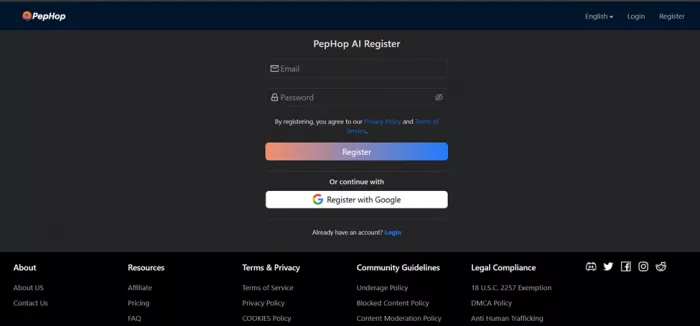
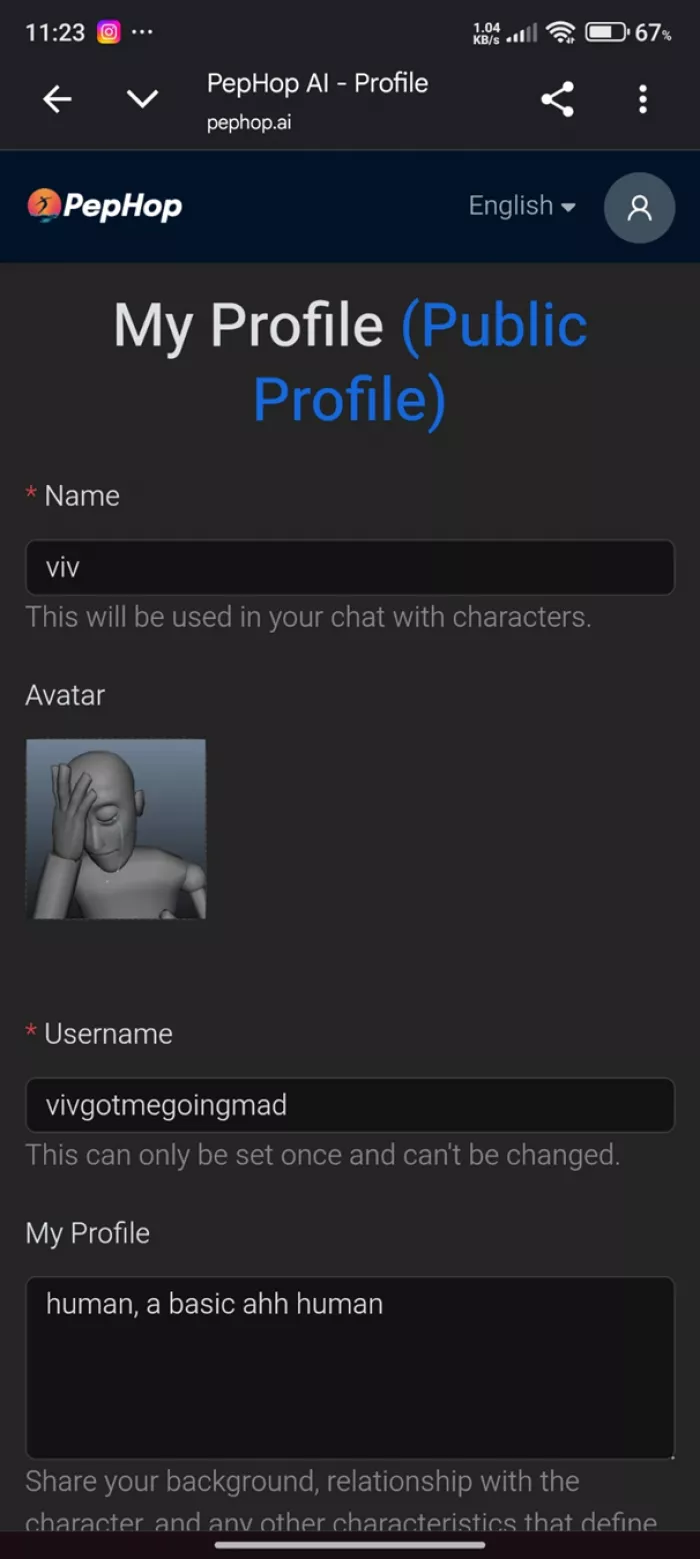
Onboarding is light. During testing, login worked through an emailed magic link rather than a password. The link arrived in an inbox opened on a phone, and a single tap created the account. Setup then asked for a name, a username, and an avatar, plus a short personal section labelled My Profile that works much like a bio.
After sign-in, existing and suggested chats were already lined up on the home view. Opening a character named CodeNina brought up a full profile screen with two actions: a Chat button and a Call button, the latter marked as a beta feature.
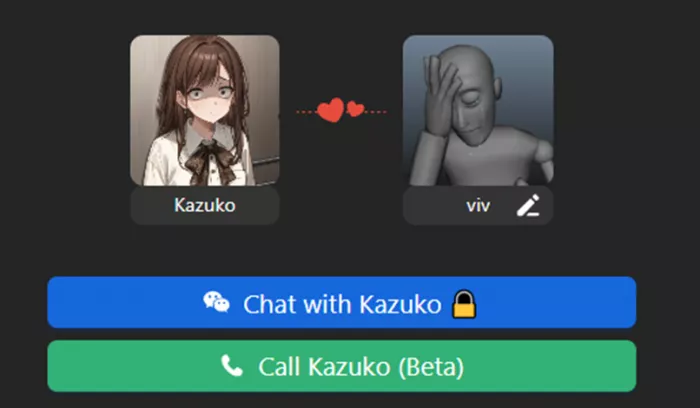
Each character profile pairs a standard text Chat with a beta voice Call.
Text chat is the strong part of the experience. Replies came back quickly, read naturally, and the interface carried the controls a roleplay session needs without feeling cluttered. The conversation felt direct and unpolished in a way the target audience tends to prefer.
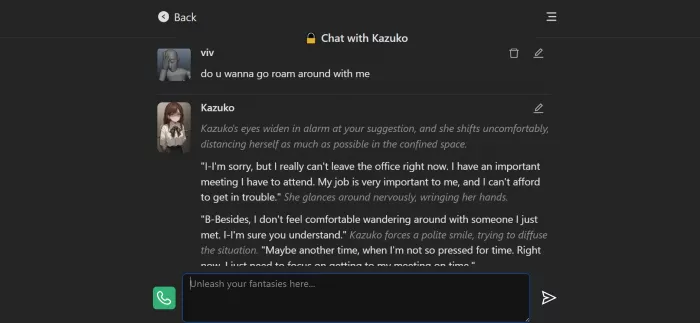
The consent guardrail held up
One test mattered more than the rest: how the system handles non-consensual or abusive scenarios. Every prompt of that kind was refused rather than played along with. The character returned a clear, consistent refusal:

CodeNina I apologize, but I do not feel comfortable engaging in or roleplaying any non-consensual or abusive scenarios. Perhaps we could have a more lighthearted, respectful conversation instead? I'm happy to discuss other topics that don't involve harm or lack of consent. Please let me know if there is something else I can assist with. |
This behavior lines up with the platform's stated content rules, which draw hard lines at illegal content, child exploitation, sexual violence, and explicit imagery even while permitting adult text roleplay. For a low-filter product, an active refusal layer is a meaningful point in its favor.
The Call beta is early

Voice is where the cracks show. The Call feature took close to a minute to connect. Once live, the voice sounded clearly synthetic, and replies arrived with a noticeable delay during the back and forth. None of that is surprising for a beta, but it is not yet a reason to choose the platform on its own.

Session limits were also apparent. The hands-on run hit constraints in the range of roughly 18 to 20, which matches a pattern other testers tie to how far the platform reliably tracks a conversation before continuity slips.
Features at a glance
| Feature | What it offers |
|---|---|
| Character library | Thousands of personas spanning anime, fantasy, sci-fi, celebrity, and fictional types, with counts reported from roughly 4,600 to over 36,500 depending on method. |
| Custom creation | Full character builder for appearance, backstory, and personality, with export in TavernAI and SillyTavern JSON format. |
| Chat modes | Dual SFW and NSFW modes, with mature content gated behind an 18-plus check. |
| Underlying model | Third-party reviews cite GPT-4 plus a proprietary layer. The platform has not published a technical spec, so the model claim is best treated as unverified. |
| Memory | Extended memory is marketed on paid tiers, though continuity reliably holds only for a short run of messages before key details slip. |
| Voice and Call | Beta text-to-speech calling. Functional but slow to connect, with a synthetic voice and response lag. |
| Platform | Browser-based React interface, no install required. Reports on a dedicated mobile app are inconsistent, so it is best treated as web-first. |
| Privacy controls | Content filters and community reporting, with conversations not actively monitored unless flagged for a violation. |
Pricing and plans
Pephop AI runs a freemium model with a genuinely limited free tier that most engaged users outgrow within a session or two. Across independent reviews, the paid structure lands as follows.
| Plan | Price | Monthly messages | Best suited to |
|---|---|---|---|
| Free | $0 | Tightly capped daily limit | A brief look before committing. |
| Lite | $4.99 / mo | About 2,000 | Casual users testing the waters. |
| Classic | $9.99 / mo | About 5,000 | The price to performance sweet spot, where enhanced memory turns on. |
| Elite | $29.99 / mo | About 16,000 | Daily heavy users only. |
| Verify before paying. Pricing on companion platforms shifts often, and some older listings quote different numbers. The current pricing page is the only reliable source before committing to an annual plan, which is typically offered through promo periods rather than a standing discount. Billing runs through Stripe under a descriptor labelled MIMOO LLC. |
Performance and the memory ceiling
The single most reported issue is memory. Across Reddit threads and Trustpilot reviews, users describe characters forgetting established plot points and relationship details after roughly 20 messages, and this is reported on paid tiers including the top plan.
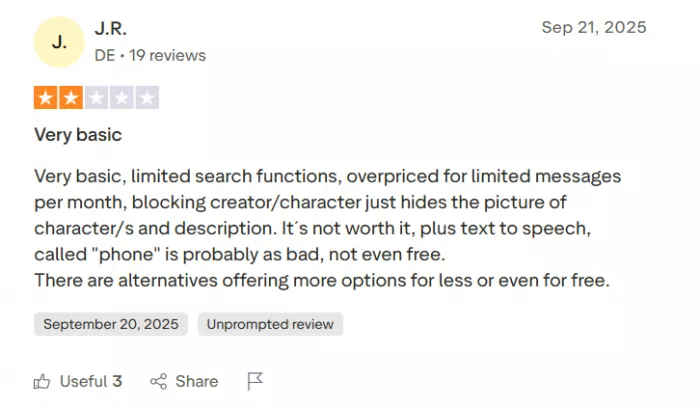
That gap matters because extended memory is exactly what the upgrade path is sold on. The marketing implies that paying more buys a character who remembers the story. In practice, longer sessions drift back toward generic, repetitive replies once the window is exceeded, which is the same constraint the hands-on session ran into around the 18 to 20 mark.
Latency is the secondary complaint. During peak usage, primarily United States evening hours, response times can stretch to between 10 and 30 seconds per reply. Outside those windows the platform feels responsive.
Adoption and trajectory
Public traffic estimates from Similarweb tell a sharp story. The platform is real and has a sizeable base, but momentum has cooled fast.
| 1.38M | 358K | 200K+ | 7.61 |
| Peak monthly visits, December 2025 | Monthly visits three months later | Claimed active users | Average pages per visit |
That swing is a roughly 74 percent decline in a single quarter. The audience skews about 85 percent male and toward the 18 to 24 bracket, with the United States, Czechia, and Germany as the top countries. Engagement among those who stay is healthy, with a bounce rate near 36 percent, while the Discord community sits around 1,300 members. The picture is a platform with committed users but a shrinking top of funnel.
Safety, privacy, and transparency
| Where it earns trust | Where it raises questions |
|---|---|
• An active refusal layer blocks non-consensual and abusive prompts, confirmed in testing. • Hard content lines on illegal material, child exploitation, sexual violence, and explicit imagery. • Conversations are not actively monitored unless flagged, and billing is discreet. | • Founders are not publicly disclosed, with only a CEO operating under the alias Buckle. • The GPT-4 claim is unverified, since no model spec has been published. • Hong Kong jurisdiction and chat logging are worth weighing for privacy-sensitive users. |
| One practical caution. The 18-plus age check is light rather than rigorous, and several reviewers report friction around cancellation and refunds. Anyone subscribing should note the renewal terms and keep personal details out of conversations. |
What users actually say
Independent sentiment is mixed and leans critical, which is worth weighing against the rosier numbers on directory sites.

| Platform | Rating | Sample | What reviewers flag |
|---|---|---|---|
| Trustpilot | About 2.8 to 2.9 / 5 | Very small, around 3 reviews | Weak memory makes chats feel scripted, plus technical errors, limited search, message caps, and cancellation friction. |
| G2 | No listing found | Not present | As a consumer companion app rather than business software, it carries no dedicated G2 profile. |
| Capterra | No listing found | Not present | Same reason as G2, with no dedicated Capterra profile to review. |
| A note on inflated scores. Coupon and AI-directory pages often list far higher averages for this platform. Those sources carry little verification and frequent affiliate incentives, so the small but specific Trustpilot sample is the more honest signal for now. |
The full scorecard
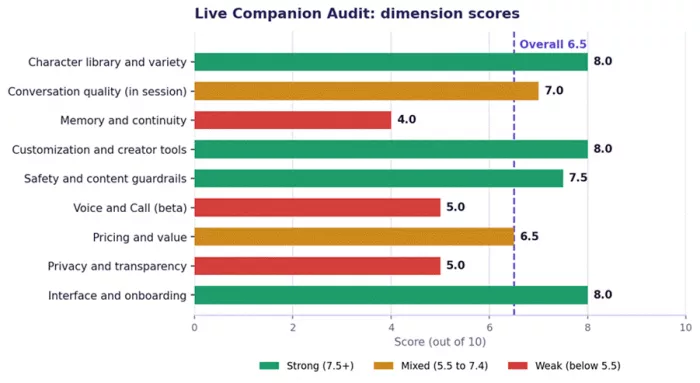
| Dimension | Assessment | Score |
|---|---|---|
| Character library and variety | Vast, genuinely diverse, and a clear strength. | 8.0 |
| Conversation quality (in session) | Natural and responsive within the memory window. | 7.0 |
| Memory and continuity | The core weakness, with details slipping after a short run. | 4.0 |
| Customization and creator tools | Deep builder with TavernAI export, a real draw. | 8.0 |
| Safety and content guardrails | Active refusal layer and clear hard lines. | 7.5 |
| Voice and Call (beta) | Functional but slow, synthetic, and early. | 5.0 |
| Pricing and value | Low entry price offset by restrictive caps. | 6.5 |
| Privacy and transparency | Thin ownership and model disclosure. | 5.0 |
| Interface and onboarding | Clean, fast, and easy to start. | 8.0 |
| Overall | A capable mid-tier platform with real gaps. | 6.5 |
Where Pephop AI falls short
• Memory does not match the marketing. Characters lose plot and relationship details after roughly 20 messages, even on the top tier, which undercuts the main reason to upgrade.
• The free tier is a wall, not a trial. Daily limits are low enough that the free experience feels more like a paywall preview than a real test.
• Voice is not ready. Slow connection, a synthetic voice, and reply lag mean the Call beta adds little today.
• Transparency is thin. Undisclosed founders, an unverified model claim, and a light age check leave more open questions than a mature product should.
• Momentum is cooling. A roughly 74 percent traffic drop in one quarter is worth factoring into any longer-term commitment.
The verdict
Pephop AI does one thing reasonably well: browser-based character roleplay with strong customization, a deep library, and a refusal layer that actually holds, all at a fair entry price. It is not the most capable companion platform on the market, and it is not trying to be. The gaps are real, led by a memory ceiling that contradicts the upgrade pitch, a voice beta that needs time, and a company profile that asks for more trust than it currently earns.
For the specific user who wants flexible, low-filter character chat at $5 to $30 per month, it is worth a free-tier trial before paying. For anyone who needs long, continuous storytelling or full operator transparency, a mainstream alternative is the safer call.
| 6.5 / 10. A solid mid-tier character chat platform. Try the free tier first, and treat the Classic plan as the realistic starting point if it clicks. |
Comments