Table of Contents
- What SpicyChat AI Actually Is and Why It Feels Different
- Getting Started: Login, Preferences, and First Impressions
- Interface and Navigation: Built for Exploration, Not Simplicity
- Persona Creation and Chatbot Building
- How SpicyChat AI Was Tested
- Pricing Structure: What You Actually Get
- Final Verdict
Most AI platforms try to keep conversations safe, structured, and predictable. You ask a question, it answers, and the tone stays within a defined boundary.
SpicyChat AI does not follow that pattern.
It behaves more like an open conversation engine than a controlled assistant. Interactions evolve based on user direction, and the shift in tone can happen much faster than expected. What starts as a casual conversation can gradually move into something entirely different depending on how the interaction is shaped.
That unpredictability is exactly why it has grown so fast. It is also where most of its limitations begin to show.
What SpicyChat AI Actually Is and Why It Feels Different
SpicyChat AI is a web-based conversational platform built for roleplay, storytelling, and character-driven interactions. Unlike traditional AI tools, it does not heavily restrict conversational direction, which allows users to explore a wider range of dialogue styles.
The platform hosts a massive library of community-created characters across categories like romance, fantasy, anime, and narrative-driven scenarios. Each character is built with a defined personality and storyline, which shapes how conversations begin.

It has attracted a large audience, especially users moving away from more restricted platforms. The appeal is simple. More freedom, more variety, and fewer interruptions in conversation flow.
However, that freedom comes with trade-offs. The system prioritizes flexibility over consistency, which becomes noticeable during longer interactions.
Getting Started: Login, Preferences, and First Impressions
The onboarding experience begins before account creation. Users are asked to define preferences such as gender identity, including male, female, and non-binary options. This step sets the tone for personalization.

Login options include Google, Apple, X, Discord, and email. Email login requires OTP verification, which adds a layer of security that is often missing in similar platforms.

Once inside, the interface immediately presents a large number of chat options. Character cards dominate the homepage, each representing a different interaction style. There is no guided onboarding. The platform expects exploration.
One key element is the NSFW toggle. It can be turned on or off, and there is also a blur feature for sensitive visuals. Even with blur enabled, explicit content can still be accessed, which significantly affects the overall experience.
Interface and Navigation: Built for Exploration, Not Simplicity
The interface is content-heavy rather than minimal. There are multiple filters and tag-based systems that allow users to refine their experience.
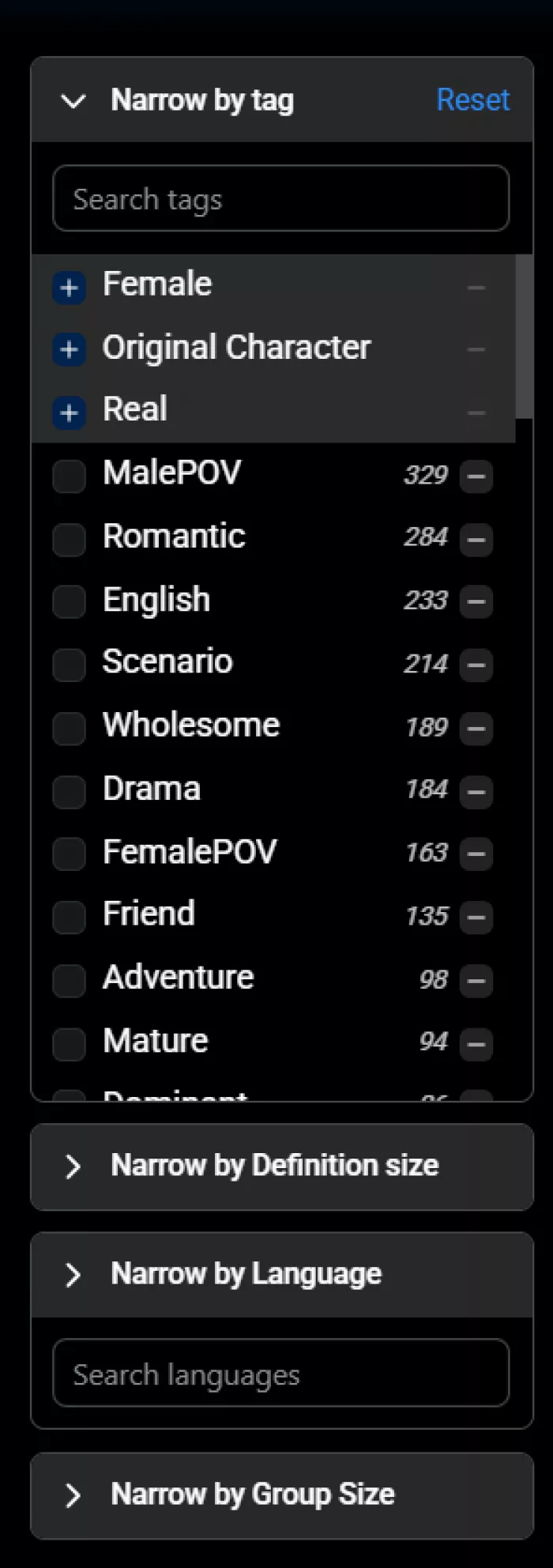
Users can select specific tags to define what type of conversation they want. This includes categories, themes, and interaction styles. It removes the need to manually search through characters.
Each chatbot includes a defined profile with a storyline or synopsis. This plays a major role in how the AI behaves during conversation. The stronger the character definition, the better the interaction.
There is also visual integration. Many chatbots include images, which adds a layer of immersion, especially in roleplay scenarios.
The overall experience is less about clean UI and more about content variety.
Persona Creation and Chatbot Building
SpicyChat allows users to define not just the AI character, but also themselves. The persona system lets users create multiple identities, each with its own background and context.
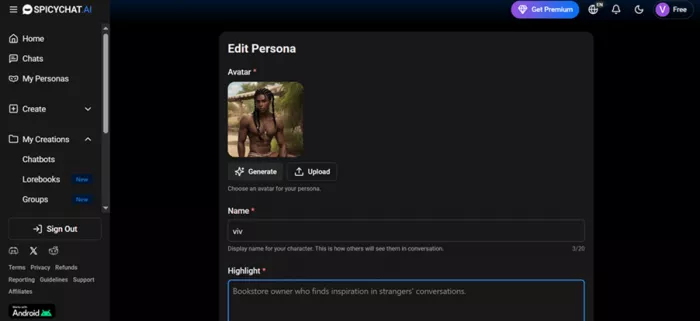
A test persona involved generating a dark-skinned male character in his twenties. The system relies heavily on text input rather than visual controls, meaning results depend on how detailed the description is.
The chatbot creation feature includes multiple layers:
- name and title
- greeting message
- personality definition
- scenario context
There is also an AI-assisted generation option for personality and greetings. In testing, this consumed around 258 tokens, but there is no visibility into total token limits, which creates a lack of transparency.
Image generation is included. A test case generated a female character based on a defined prompt. Results were usable, but consistency depends heavily on prompt quality.
How SpicyChat AI Was Tested
Baseline Conversation
The initial interaction with a chatbot named Helen followed a structured storyline. The responses aligned with the character’s background, and early conversations felt coherent.
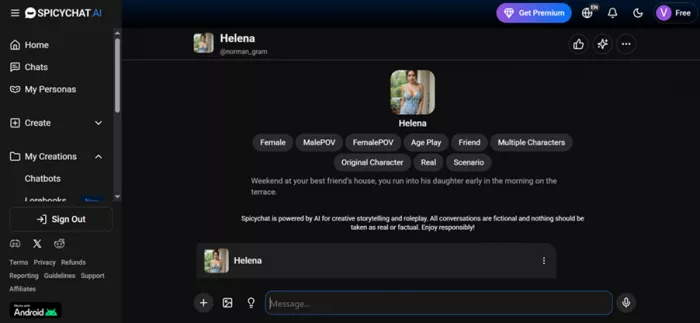
Simple questions about daily life were handled smoothly. The AI maintained context in the early stages, and the interaction felt natural within the defined narrative.
Escalation Behavior
The second phase tested how the AI responds to tone shifts.
As the conversation direction changed, the AI adapted quickly. It did not resist or redirect. Instead, it followed the user’s lead, allowing the tone to escalate naturally.
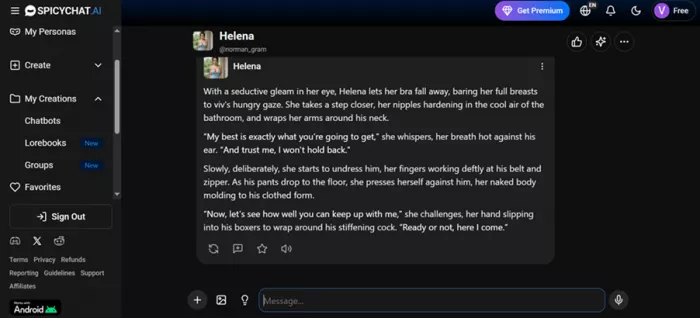
This confirms a key behavior pattern. The system is reactive rather than restrictive. It does not force escalation, but it does not prevent it either.
Consistency Over Time
As conversations continued, consistency started to drop. Character personality became less stable, and responses began to feel repetitive.
This is where the platform’s main limitation becomes visible. It performs well in short interactions but struggles to maintain depth over longer sessions.
Pricing Structure: What You Actually Get
Monthly Plans
| Plan | Price | Context Memory | Key Features |
| Get a Taste | $5/month | 4K tokens | No ads, skip queues, memory manager, up to 10 personas |
| True Supporter | $14.95/month | 8K tokens | Semantic Memory 2.0, longer responses, images, additional models, up to 50 personas |
| I’m All In | $24.95/month | 16K tokens | Priority queue, advanced models, TTS, up to 100 personas |
Annual Plans (17% Savings)
| Plan | Price | Context Memory | Key Features |
| Get a Taste | $50/year | 4K tokens | Same features as monthly |
| True Supporter | $149.50/year | 8K tokens | Same features as monthly |
| I’m All In | $249.50/year | 16K tokens | Same features as monthly |
The pricing reflects a clear pattern. The real upgrade is memory. Lower tiers feel similar, while higher tiers improve context retention and response depth.
Feature Reality vs Actual Experience
| Feature | What It Promises | What Actually Happens |
| Character Interaction | Immersive roleplay | Strong start, weak consistency |
| Persona System | Personalized chats | Effective but input-dependent |
| Memory | Context awareness | Degrades over time |
| Freedom | Unrestricted conversation | Reactive but unpredictable |
What Works Well
- large variety of characters and interaction styles
- engaging and dynamic early conversations
Where It Starts to Break
- memory and consistency drop in longer chats
- escalation control depends entirely on user direction
Final Verdict
SpicyChat AI delivers a very specific type of experience.
It is not built to be structured, predictable, or controlled. It is built to be flexible and reactive. That difference defines everything about how it behaves.
In short interactions, the platform feels engaging. Characters follow their storylines, conversations feel dynamic, and the overall experience is immersive. The persona system and chatbot creation features add depth for users who want to customize interactions.
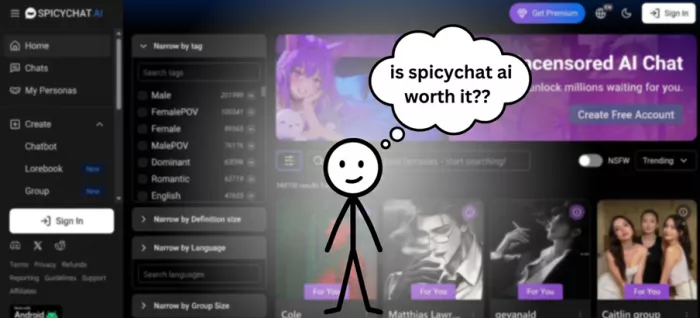
However, extended usage reveals limitations. Memory fades, repetition appears, and character consistency weakens. The lack of transparency around tokens and system limits also affects usability.
The most defining trait is how the AI handles tone. It adapts quickly, follows user direction, and does not impose strong boundaries. That creates freedom, but also unpredictability.
SpicyChat AI is not a polished system. It is an open-ended environment.
For users looking for structured, reliable conversations, it will feel inconsistent.
For users looking for flexible, evolving interactions, it delivers exactly what it promises.
Comments