Both Rytr and Copy.ai started life as cheap AI writers you would point at a blank page. In 2026, only one of them still is. Rytr stayed small and cheap unlimited writing for around nine dollars a month. Copy.ai grew up and moved out, turning into a go-to-market platform priced for sales teams, with the writing you remember now sitting at the shallow end of a much bigger, pricier product. So “which cheap AI writer is worth it” has a slightly awkward answer, and it is worth walking through why.
The short answer If you want a genuinely cheap tool to help you write short-form content blog sections, product descriptions, emails, captions Rytr is the more honest fit, and at $7.50 to $9 a month it is about the best price-to-output deal in the category. Copy.ai can still write, and its free tier and entry plan are usable, but you would be buying the cheap corner of a platform built for something else. The real decision is not “which writes better.” It is whether you want a cheap writer at all, or a team automation tool that happens to write. |
Two tools that stopped competing
The quickest way to understand this matchup is to notice that the two tools are no longer chasing the same customer. Rytr has barely changed its pitch since 2021 to be the most affordable, most accessible AI writer, and don’t try to be anything else. It is run by a tiny team, it sticks to short-form writing across 40-plus templates, and it has deliberately skipped the workflows, agents, and enterprise features that everyone else raced to add.
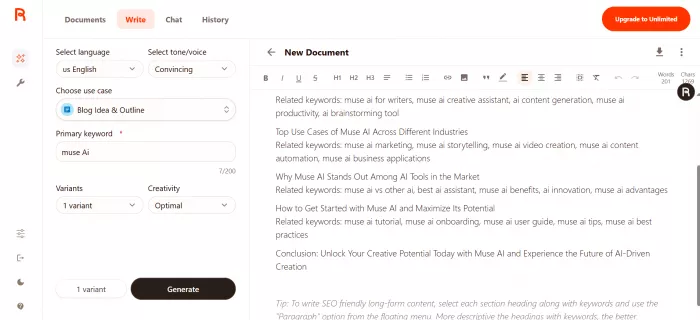
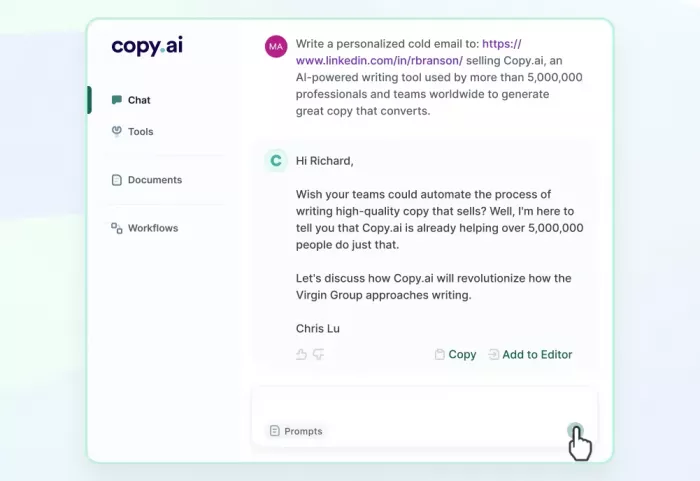
Copy.ai went the other way. In 2025 it repositioned as a “go-to-market” platform less a word processor, more an automation builder that chains research, data, and writing into repeatable workflows for sales and marketing teams. The templates and chat that made it a popular writer still exist, but they now sit at the entrance to a much larger, pricier building. So while both can still turn a prompt into a paragraph, one is a cheap pen and the other is a machine that happens to include one.
| Metric | Rytr | Copy.ai |
| Positioning | Focused, cheap short-form writer | GTM platform that also writes |
| Best for | Solo creators, freelancers, students | Teams automating sales & marketing |
| Cheapest usable price | $7.50–$9/mo (unlimited) | ~$29/mo entry (real power far higher) |
| Free tier | 10,000 chars/mo (~1,500–2,000 words) | ~2,000 words/mo + limited credits |
| Short-form quality | Clean first-pass from templates | Good, strongest with brand voice (paid) |
| Long-form | Weak turns repetitive | Generic often ~half rewritten |
| Plagiarism checker | Built in (paid quota) | Not really |
| Standout feature | Lowest price for clean short-form | Multi-step GTM workflows |
| Really built for | Individuals on a budget | Teams with a budget |
The price reality
Since the whole question is about cheapness, the pricing is where it gets settled. Rytr stays cheap from top to bottom. Copy.ai looks cheap and then, a couple of tiers in, stops being anything of the sort the entry plan sits near $29, and the automation that is the actual point jumps to $249 and then past $1,000 a month.
| Tier | Rytr | Copy.ai |
| Free plan | 10,000 chars/mo, one language, no plagiarism check | ~2,000 words/mo, limited chat & workflow credits |
| Cheapest paid | Unlimited (a.k.a. Saver) $9/mo, $7.50 annual: unlimited generation, custom tone, plagiarism quota | Chat around $29/mo: multi-model chat, 5 seats |
| Next tier up | Premium $29/mo (~$24 annual): 35+ languages, custom use cases | Advanced ~$249/mo: workflow automation, credits |
| Top / automation | Premium also covers small teams | Growth / Scale $1,000+/mo, up to custom Enterprise |
| You pay for | Characters, then unlimited | Credits (workflow runs) + seats + a platform contract |
One number that never appears on a pricing page decides whether a cheap AI writer is actually cheap: how much of the output you have to rewrite. A $9 tool that needs half its drafts reworked costs you more, in the currency that matters, than a slightly pricier tool that lands closer on the first try.
Judge these on price plus editing effort per usable piece, not the sticker alone. It is the single most useful habit when comparing budget writers, and almost nobody applies it.
The head-to-head, task by task
Sticker prices aside, the only thing that matters day to day is what comes out when you ask for something. At the cheap level, the pattern is consistent across the jobs people actually use these tools for and if you are deciding for real, run the same prompts yourself, since both have free tiers and your own results beat any summary.
Short-form blog sections and outlines
On short-form work blog sections, outlines, product descriptions Rytr’s template approach quietly wins. Give it a use case, a line of context, and a tone, and it returns a clean, structured first pass you can ship with light edits. Copy.ai reaches a similar place through chat, and having several underlying models on tap is a genuine plus, but free-form chat needs a sharper prompt to match the focus Rytr gets from a purpose-built template.
Product descriptions in particular are squarely Rytr’s home turf; Copy.ai does them well too, but its edge there is volume and brand-voice consistency, which live on the paid, team tiers rather than the cheap end you would compare against Rytr.
Ads and social captions
On ads and social captions the two are close. Rytr’s preset tones make it fast to spin variations, and Copy.ai’s short-form templates are among its best-regarded features and produce sharp copy with brand voice set. Expect similar quality at the free or cheap level; the gap is again the volume and consistency of Copy.ai gates behind higher plans.
Rewrites and paraphrasing
Rewrites and paraphrasing land in the same place both are fine on a paragraph, neither is a specialist, and quality drifts on longer passages either way.
Cold outreach is where the difference stops being about writing at all. For a single cold email the two are neck and neck. But Copy.ai’s real strength here is the automation around the message pulling in prospect data and generating personalised sequences which is a paid, platform-level feature and the entire reason the product exists now. Send one email and they tie; run outreach at scale and they are not doing the same job.
Long-form articles : the stress test
Long-form is the stress test, and it is the one place neither escapes. Rytr’s output turns repetitive and thin as length grows; it is built for short pieces, and it shows. Copy.ai’s long-form is competent but generic, and in testing it routinely needs a large share of every draft rewritten, often roughly half.
If long, original, in-depth articles are your main need, the honest answer is that a general model like ChatGPT or Claude, or a dedicated long-form platform, will serve you better than either of these.
| The job | Better pick (budget tier) |
| Short-form blog sections | Rytr |
| Product descriptions | Rytr |
| Cold emails (one-off) | Tie |
| Ads & social captions | Close slight Rytr on cost |
| Rewrites & paraphrasing | Tie |
| Long-form articles | Neither use a general model |
Where each earns its price
Put the two side by side and the value question almost answers itself. Rytr’s case is simple and real: the lowest credible price in the category for clean short-form output, with a plagiarism checker, custom tone, and a Chrome extension bundled in. If your work is a steady stream of short pieces, very little beats it on cost.
Copy.ai only earns its far higher price when you use the thing it is now built for multi-step workflows that research, personalise, and distribute content across a sales or marketing team. As a plain writer at the cheap end it is unremarkable; as a go-to-market engine for a team with the budget, it is a genuinely different proposition.
Copy.ai makes more sense once writing becomes part of a larger marketing process, especially when several people are working from the same campaigns and brand context. That same shift is easy to see when looking at Copy.ai vs Jasper, where workflow structure matters much more than basic text generation.
The reality check
Both have real limitations, and naming them plainly is the point of a comparison like this. Rytr’s are the limitations of a small, focused tool:
• Long-form is a genuine weak spot, depth and originality fall off quickly past a few hundred words.
• The free plan is limited to one language and skips the plagiarism checker, so it is really an evaluation tier, not a workflow.
• Plagiarism checks on paid plans are a monthly quota rather than unlimited.
• It is a small team, so it moves slowly on new features and its models can lag the newest releases.
Copy.ai’s are the limitations of a platform wearing a writer’s old clothes:
• Credit burn is the top complaint in reviews not output quality, but spend that is hard to forecast as workflows run.
• The go-to-market pivot made the product more complex than a solo writer needs.
• The jump from the ~$29 entry plan to $249 and then $1,000+ leaves individual users with no natural upgrade path.
• You are paying for a platform even if all you want is words, and its long-form still needs heavy editing.
The details that quietly matter
A few secondary things can still tip the decision. Rytr bundles a plagiarism checker, a Chrome extension for writing inside Gmail and other apps, custom tone training, and 30-plus languages on its paid tiers. Copy.ai brings brand voice, a company knowledge base its output pulls from, and thousands of integrations with tools like Salesforce and HubSpot all clearly aimed at teams rather than solo writers.
One point is worth pausing on. Copy.ai’s entry plan is essentially multi-model chat OpenAI, Anthropic, and Google models with templates on top. If model flexibility is what you are after, it is fair to ask whether you would get more from using ChatGPT or Claude directly for a similar price, before paying for any wrapper around them. Rytr’s counter is its 40-plus task templates, which give cleaner first-pass output than a blank chat box for people who would rather not craft prompts from scratch.
For writers who care more about natural output than a particular workflow, it is also worth looking at how AI writing tools that sound more human handle the same kind of everyday copy. The differences become much clearer once Rytr and Copy.ai are placed beside tools such as Jasper, Writesonic and Wordtune.
Rytr vs Copy.ai: User Ratings
| Review platform | Rytr | Copy.ai |
| G2 | 4.7/5 from 821 reviews | No current review score displayed |
| Capterra | 4.6/5 from 18 reviews | 4.4/5 from 67 reviews |
| Trustpilot | 4.4/5 with 2,000+ reviews | 1.8/5 from 196 reviews |
| Software Advice | 4.6/5 from 18 reviews | 4.4/5 from 67 reviews |
The numbers make the comparison more interesting than simply saying one tool is better reviewed. Rytr is consistently in the mid-to-high 4s, while Copy.ai performs well on software-review platforms but has a sharply lower Trustpilot score.
What Reviewers Actually Say
Then, immediately after the table, add this smaller section. These are paraphrased summaries rather than direct quotes, which lets the article explain the point while you place the original review screenshot underneath.
Rytr: Fast First Drafts, But Not Finished Copy
One recent Rytr reviewer described using it mainly to get past the blank page for marketing emails, product descriptions and social captions. The generated draft usually gives them enough to start editing quickly, although they felt the output could become generic and the usage limits restrictive.
Another verified reviewer uses Rytr for educational material and said it reduces the time spent creating the initial draft. They still manually review and rewrite the material afterward, which is probably a more realistic picture of where Rytr fits than expecting it to replace editing entirely.
Copy.ai: Useful for Short Copy, Less Convincing for Long Form
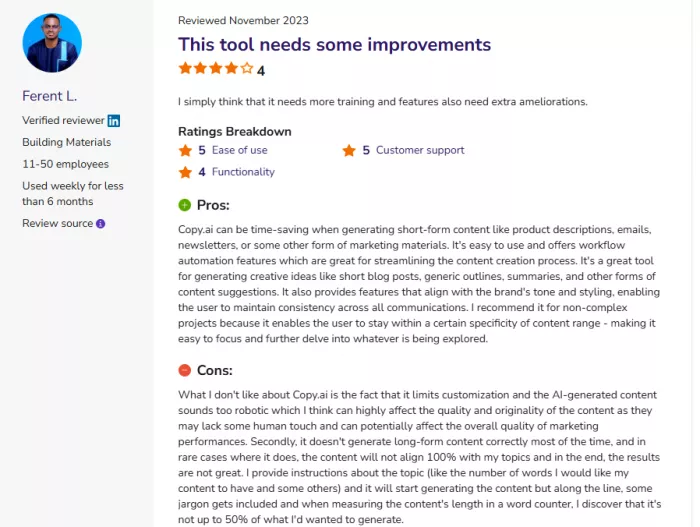
Copy.ai reviews follow a slightly different pattern. One verified reviewer found it useful for product descriptions, emails, newsletters, outlines and other short marketing material, but felt customization was limited and longer generated pieces could become robotic or drift away from the original instructions.
There is also a more recent review that describes Copy.ai as quick and beginner-friendly for blogs, social posts and emails, but says longer material requires substantial checking because awkward wording and incorrect information can appear.
So, is either one worth it?
For the person Rytr is built for a solo creator, freelancer, or student writing mostly short-form, $7.50 to $9 a month is easy to justify. It is cheap, focused, the first-pass output is clean, and the free tier proves all of that before you pay a cent; the only tier worth skipping is the $29 Premium plan, unless you specifically need many languages or custom use cases.
Copy.ai is harder to place, because the answer depends entirely on who is asking. For an individual who just wants cheap writing it is tough to justify the free tier is thin, the entry plan competes with general chatbots, and everything genuinely powerful sits behind team pricing. For a sales or marketing team that will actually run its workflows, it can be very worth the money. That is simply a different buyer answering a different question than the one in this title.
Which is right for you
Because the two now aim at different people, it is cleanest to match the tool to your situation.
A solo blogger or student on a tight budget: Rytr, starting free and moving to the $7.50 annual plan once the output earns it.
A freelancer writing short-form for clients: Rytr cheap, fast first drafts across many small jobs is exactly its strength.
A small marketing team wanting cheap volume: Rytr paid tiers, or honestly weigh a general chatbot, before you consider Copy.ai’s team pricing.
A sales or GTM team automating outreach: Copy.ai this is its actual purpose, and where its cost starts to make sense.
Someone who mostly wants model flexibility: compare either tool honestly against paying for ChatGPT or Claude directly first.
The Bottom Line
For the question this article actually asks which cheap AI writer is worth it Rytr wins, and it is not especially close. It stayed in the lane Copy.ai left: cheap, focused, and good enough at short-form that most people will not need more. Copy.ai is the better product for the narrow group it now targets, teams automating go-to-market work with a real budget, but for a person hunting a cheap way to write, it is answering a question you did not ask.
If you are that person, start on Rytr’s free plan, write a few real things, and upgrade to the $7.50 annual plan only once the output has earned it. And whichever way you lean, check both pricing pages before you commit. Copy.ai's tiers in particular have been moving, and the numbers here are a snapshot, not a promise.
Comments