Table of Contents
- How two rivals stopped competing
- Reading the team before reading the tools
- The head-to-head, where it actually differs
- Writing quality
- Workflow and automation
- Brand voice and governance
- SEO and integration gravity
- Two real tasks, one through each tool
- Turn one brief into a full campaign
- Run personalized outbound to 200 named accounts
- Where each one genuinely struggles
- What it actually costs
- Not a winner, a match
- Where both are heading
For three years, Copy.ai and Jasper sat side by side on every “best AI writing tool” roundup, close enough that most buyers chose one on price or a free trial and never revisited the decision. That era is over. By 2026 the two products have walked in opposite directions one toward the revenue engine, the other toward the content operation and they now solve different problems for different parts of a marketing organization. The choice between them stopped being a question about prose quality some time ago. It is a question about which shape a team’s workflow actually takes.
How two rivals stopped competing
Both tools climbed the same ladder from single-purpose writer to full platform but they planted their flags in different departments, and that is the whole story of this comparison.
Copy.ai
It was launched in 2020 as a template-driven copy generator: headlines, product descriptions, the usual short-form fare. Its 2026 form barely resembles that. The company now describes itself as an AI-native go-to-market platform, and for once the label is accurate.
The writing engine has become one component inside a system built to automate revenue execution end to end. Multi-step Workflows chain research, generation, and data operations into repeatable processes. A Prospecting Cockpit researches an account and its contacts, recent funding, hiring trends, company news, likely pain points before a single line of outreach is drafted. Lead enrichment, CRM sync, and agents that run narrow, defined tasks round out a product whose weight has shifted decisively toward operations. The sales pitch is consolidation: collapse a stack of point tools into one system and cut what the company calls “GTM bloat.”
Jasper
It travelled a similar arc from a different origin. After shedding its early copywriter identity in a 2022 rebrand, it spent the following years building outward from writing into orchestration, and by 2026 it presents itself as a marketing operating system. The through-line is not automation for its own sake but governance, brand safety, approvals, asset management, and measurable output. Jasper IQ codifies brand voice and audience knowledge so that a junior copywriter and a VP produce text in the same register.
Content Pipelines carry a campaign from a single brief through to a full set of channel variants. A Surfer integration folds SEO scoring directly into the drafting step, and native connectors push finished copy into Salesforce Marketing Cloud, Braze, and the CMS. Where Copy.ai reports up to a head of revenue, Jasper reports up to a CMO.
That difference in reporting line is not cosmetic. It shows up in every feature decision each company has made, and it is the cleanest predictor of which tool a given team will actually get value from.
| Metric | Copy.ai | Jasper |
| Product category | GTM / revenue-automation platform | Marketing operating system |
| Primary buyer | RevOps, sales leadership, growth | CMO, content and brand leads |
| Best single job | Personalized outreach and repeatable GTM workflows at scale | Multi-channel campaign production under brand control |
| Real competitor set | Sales-automation and workflow tools | Content-ops and MarTech workflow tools |
Reading the team before reading the tools
Most comparison guides open by ranking output quality. For these two products that instinct is a decade out of date, because the deciding variable is rarely which one writes a cleaner paragraph. It is where a team’s constraint sits. A few axes settle the question faster than any feature checklist:
• The location of the bottleneck matters more than raw capability. A team that cannot produce enough on-brand content quickly enough has a fundamentally different problem from one that produces plenty but struggles to move named accounts through a pipeline and the two tools are built for opposite ends of that divide.
• The direction the finished copy travels is a quiet but decisive signal. Content that flows outward to a broad audience through a CMS and an editorial calendar points toward Jasper; content that flows into a sales sequence aimed at specific companies points toward Copy.ai.
• Team composition predicts fit better than any spec sheet. Writers, editors, and brand managers draw more from Jasper’s governance layer, while sales-development reps and revenue-operations staff draw more from Copy.ai’s enrichment and automation.
• Governance load is routinely underestimated at purchase time. Organizations in regulated industries, or with legal review on every public asset, benefit from Jasper’s approval and brand-safety machinery in ways a lean startup never will and pay for machinery they would otherwise leave idle.
• The shape of demand matters as much as its volume. A steady editorial calendar rewards Jasper’s pipelines, whereas spiky, high-variance, heavily personalized outbound rewards Copy.ai’s workflow engine.
A large share of teams shopping for an “AI GTM tool” are misdiagnosing a data problem as a content problem.
That framing is worth holding onto through the rest of this comparison. Neither platform fixes a broken lead list, poor deliverability, or a strategy that does not exist. Both assume the audience, the pipeline, and the plan are already in place; what they automate is the execution on top of them.
The head-to-head, where it actually differs
The table below is deliberately opinionated: the final column is the point of each row, not an afterthought. The deeper differences are unpacked underneath it.
| Category | Copy.ai | Jasper | Why it matters |
| Core identity | GTM automation platform | Marketing content OS | Sets the department that owns the budget |
| Writing quality | Competent, widely noted as plateaued | Stronger; prose is a stated priority | Decides how much editing each draft needs |
| Workflow & automation | Flagship strength; multi-step, API-callable | Present via Pipelines, less open-ended | The whole case for Copy.ai lives here |
| Brand voice & governance | Brand Voice + Infobase; lighter controls | Jasper IQ, roles, approvals, multi-brand | The whole case for Jasper lives here |
| Sales & data enrichment | Prospecting Cockpit, CRM enrichment | Not a focus | Only relevant to outbound-heavy teams |
| SEO tooling | One workflow output among many | Integrated Surfer scoring in the editor | Matters most to organic-content engines |
| Integration gravity | Pulls toward the sales stack | Pulls toward the MarTech stack | Determines where finished work lands |
| Collaboration & roles | Workspace-oriented | Roles, permissions, approval flows | Scales with team size and review needs |
| Model flexibility | LLM-agnostic (OpenAI, Claude, Gemini) | LLM-agnostic architecture | Roughly even; avoids vendor lock-in |
| Security posture | SOC 2 Type II | Enterprise controls, brand-safe access | A gate for regulated and enterprise buyers |
| Learning curve | Steeper once workflows begin | Gentler for writers, deepens at scale | Affects time-to-value and onboarding |
Writing quality
Jasper has treated prose quality as a product priority throughout its evolution, and it shows in publish-ready first drafts that need less rework. Copy.ai’s core language quality, by contrast, is repeatedly flagged in 2026 reviews as having plateaued while rivals kept improving. The nuance is that this gap barely registers inside an automated workflow, where output is a raw input to a later step and a human rarely reads it in isolation but it registers sharply for a team that wants a finished blog post or landing page it can ship after light editing.
Workflow and automation
This is the reason to buy Copy.ai, and nothing else comes close to it in the head-to-head. Workflows chain generation, research, and data steps into processes that run on their own; a Workflow-as-API capability lets them be triggered programmatically, and a large library of connectors ties them into the rest of a company’s systems. One caveat deserves emphasis, because it is where buyers most often overreach: the engine automates the execution of a go-to-market motion that already exists. It does not design the strategy. A team that cannot describe its process on a whiteboard will not get one from Copy.ai it will only automate the confusion faster.
Brand voice and governance
This is the mirror image, and the reason to buy Jasper. Jasper IQ pushes brand voice and audience knowledge into every generation, and the surrounding layer roles, permissions, approval routing, multi-brand management is built for organizations where consistency across many writers is the actual job. Copy.ai has a capable Brand Voice feature and an Infobase for company knowledge, but its governance is lighter, aimed at keeping output on-message rather than shepherding it through legal and brand review.
SEO and integration gravity
Jasper’s Surfer integration folds keyword and content-score targets into the writing surface, which suits an organic-traffic engine. Copy.ai treats SEO content as one possible output of a workflow rather than a specialized discipline. The subtler tell is where each tool sends finished work. Both advertise deep integration, but Copy.ai’s gravity pulls toward the sales stack CRMs, enrichment services, outbound tooling while Jasper’s pulls toward MarTech and publishing campaign platforms, the CMS, project trackers. The same word, “integration,” points in opposite directions.
Two real tasks, one through each tool
Abstract comparison only goes so far. The divergence is clearest when the same request is handed to both platforms and the seams show.
TASK 01
Turn one brief into a full campaign
The request: a single objective, say, a product launch that needs a landing page, a short nurture-email sequence, a batch of social posts per platform, a blog article or two, and a set of ad variations, all in one consistent voice.
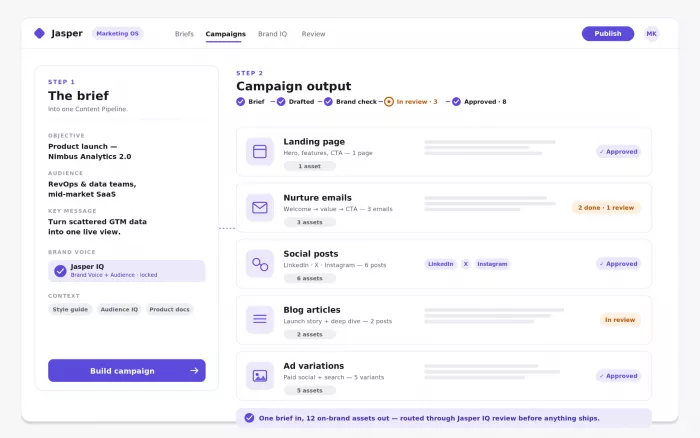
Jasper. This is home turf. A Content Pipeline takes the brief and produces the full spread of assets, each shaped by the same Jasper IQ brand profile, then routes them through review before anything is published. Work that would occupy a small writing team for days is compressed into hours, and the governance around it means the output survives a brand check rather than needing to be rewritten to pass one.
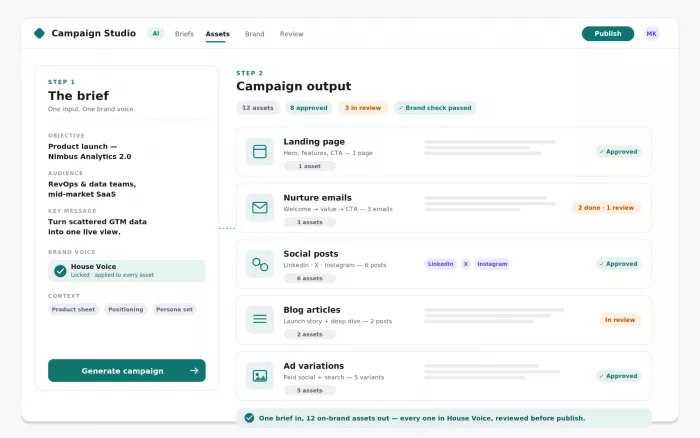
Copy.ai. It can produce every one of those assets, and its templates will generate publishable material after a round of editing. What it is not built to prioritize is the campaign as a governed, on-brand set moving toward publication. The assets are a means to an end here; the platform’s instincts pull toward what happens after the content exists: distribution, sequencing, feeding a pipeline.
TASK 02
Run personalized outbound to 200 named accounts
The request: research 200 target companies, find the right contacts, and send outreach specific enough that each message reads as though it were written for that account.
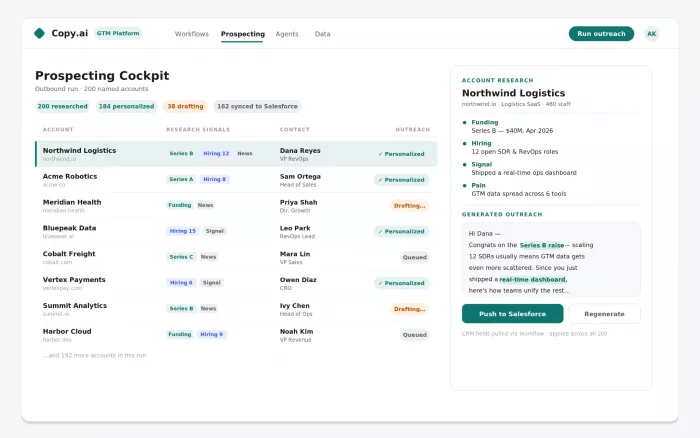
Copy.ai. This is the task the 2026 product was rebuilt around. The Prospecting Cockpit researches each account and contact before drafting pulling news, funding activity, hiring signals, and likely pain points and Workflows draw structured data from the CRM to generate genuinely differentiated outreach at volume, then push it into the sales stack. Reps arrive with context rather than a name and a title.
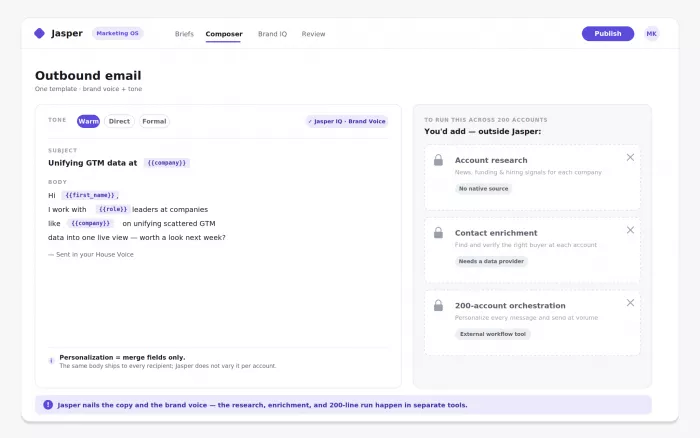
Jasper. It can write an excellent outbound template and vary the tone, but it does not research accounts, enrich contact data, or orchestrate a 200-line personalized run. This task sits outside its category; forcing it here means bolting on the exact separate tools that Copy.ai set out to absorb.
Neither run-through is a knock on the losing tool. Each task simply belongs to one platform’s world and is a visitor in the other’s.
Where each one genuinely struggles
A comparison that names no weaknesses is an advertisement. Both tools have real limits, and they are the limits most likely to surface after the purchase, not before.
Copy.ai
• Core writing quality is widely described as having stalled, so teams that want polished, ship-ready prose will edit more than they expect.
• The pricing has a cliff, not a ramp; the gap between the entry plan and the first real team tier is wide enough to strand mid-market buyers.
• Credit burn, not output quality, is the top complaint in reviews; workflow runs consume credits quickly and spend is hard to forecast month to month.
• For a team that only needs occasional writing help, most of the platform sits unused while still being paid for.
Jasper
• It carries one of the highest entry prices among major AI writing tools, which is a hard sell against cheaper general-purpose models.
• The features that make the 2026 platform compelling the agent layer and the visual canvas are locked behind the top-tier Business plan.
• Output still hallucinates, so brand-safe does not mean fact-checked; human review remains non-negotiable.
• There is no native real-time retrieval, which limits how current unaided output can be without an external step.
What it actually costs
Sticker price is the least interesting part of this decision, and the two tools mislead in opposite ways. Copy.ai looks cheap until the workflow features the entire reason to choose it come into view. Jasper looks expensive per seat but scales predictably. The honest metric is total cost of ownership: not the price of a login, but how many separate tools a platform replaces.
| Tier | Copy.ai | Jasper |
| Entry | Chat plan around $29/mo (5 seats, unlimited chat, no workflow credits) | Creator plan around $39–49/mo per seat |
| Team | Growth tier, metered, from roughly $1,000/mo (annual only) | Pro / Teams around $59–99/seat per month |
| Top | Expansion, Scale, then custom Enterprise | Business, custom-priced, unlocks agents and canvas |
| Metering | Workflow credits one run consumes one credit | Per-seat, with unlimited word generation |
Two structural facts deserve to be pulled out. First, Copy.ai’s self-serve pricing was consolidated over the past year; older Starter and Advanced tiers were retired leaving a striking gap between a roughly $29 entry point and a first workflow tier near $1,000 a month, with essentially nothing in between. A team that outgrows chat but is not ready for a four-figure commitment has no natural next step, which is a genuine planning problem for the mid-market. Second, Jasper’s per-seat model is simple to forecast but climbs directly with headcount, and the features that justify the platform in 2026 live on the tier that requires a sales conversation.
The consolidation argument is where Copy.ai’s cost becomes defensible: at platform tier it can absorb several sales and marketing point tools, and a team reporting saved hours each week can recover the outlay quickly. Jasper’s cost is defensible on a different basis than the price of keeping a large content operation on-brand and out of legal trouble, which is cheap relative to the cost of a brand-safety failure.
Not a winner, a match
Crowning one tool would betray the entire premise. These platforms no longer occupy the same category, so the useful answer is conditional. The right choice falls out of the questions raised at the top of this piece.
Choose Copy.ai when
• The team is sales- or RevOps-led and the constraint is moving accounts through a pipeline, not producing content.
• Personalized outbound at scale, with account research baked in, is a recurring need.
• The goal is to consolidate a sprawl of GTM point tools into one automated system.
• The go-to-market process is already well defined and simply needs to run faster and more reliably.
Choose Jasper when
• The team is content- or brand-led and the work is producing a lot of on-brand material across channels.
• Brand consistency and approval workflows are requirements, especially in a regulated or enterprise setting.
• SEO and organic content are central, making the integrated scoring worth paying for.
• Publish-ready prose with minimal editing is a genuine priority.
Choose neither when
• A solo marketer or small team just needs strong drafts a general model is usually cheaper and writes as well or better.
• The real bottleneck is data quality or deliverability, which neither platform repairs.
• There is no defined process or brand system yet; automation would only scale the disorder.
• Budget is tight and only a fraction of either platform would ever be used.
Where both are heading
Both companies are racing toward the same frontier from their separate corners: agents that do not just draft but act. Copy.ai is pushing deeper into autonomous go-to-market execution workflows that research, decide, and reach out with progressively less human intervention. Jasper is pushing deeper into agentic content operations that stay inside brand and compliance guardrails by design.
Which means the question this comparison answers is already shifting. A year from now the decision will have less to do with which tool writes better and more to do with which kind of work an organization is willing to hand to an agent: the orchestration of revenue, or the production of a brand. The two tools have spent 2026 preparing to answer that question in different languages. The right one for any given team is still the one that speaks the language of the work already on its desk.
Comments