AI has made decent copy cheap. Almost any capable model can produce a polished headline, sales email, product description, or CTA. The harder question is whether that copy gives the buyer a convincing reason to act.
For sales copy, that distinction matters. A sentence can be concise, on-brand, and grammatically perfect while doing almost nothing to address the buyer's problem, differentiate the offer, answer an objection, or create urgency. The tools worth paying attention to in 2026 are therefore the ones that contribute something beyond fluent writing: performance data, customer context, prospect research, personalization, structured workflows, or better message testing.
What I Looked For
I did not rank these tools according to how many templates they offer or how quickly they can produce a paragraph. Those things are useful, but they tell us little about whether a tool is genuinely useful for sales.
The stronger indicators are:
● Can the tool work with real customer and product context? Sales copy becomes noticeably better when AI knows who is buying, what problem they are trying to solve, what objections appear during the buying process, and why the offer differs from alternatives.
● Can it produce meaningfully different sales angles? Twenty versions of “save time and increase productivity” are still one idea. Useful AI should help marketers explore different motivations, pains, proof points, and offers.
● Does it fit the actual sales channel? The requirements of a paid ad, cold email, ecommerce product page, and enterprise landing page are different. A tool that understands the workflow around the copy is often more useful than a general writer.
● Can humans control and test the output? AI-generated copy should be treated as a hypothesis. Predictive scores, analytics, workflow controls, and easy iteration can help, but real clicks, replies, qualified leads, and purchases still decide whether the message worked.
Quick Comparison
| Tool | Best for | What makes it different | Starting price |
| Anyword | Performance ads and conversion copy | Predictive performance scoring | $49/month |
| Jasper | Multi-channel marketing campaigns | Brand, product, and audience context | $69/seat/month |
| Copy.ai | B2B sales and GTM workflows | Combines research, workflows, and generation | $29/month |
| Lavender | Cold emails | Reply-focused email coaching | Free |
| Regie.ai | AI-assisted prospecting | Research, enrichment, and message drafting together | Free |
| Hypotenuse AI | Ecommerce product copy | Bulk generation from structured product data | Custom |
1. Anyword
Best for: Performance Ads and Conversion-Focused Copy
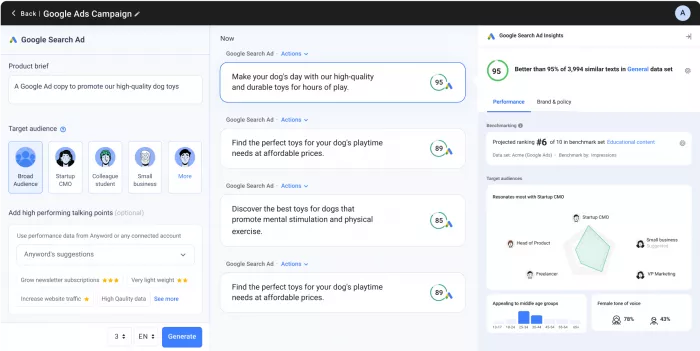
Anyword stands out because it tries to answer a question most AI writers leave entirely to the marketer: which version of this copy has the better chance of performing?
The platform generates marketing copy but also attaches predictive performance information to variations. Anyword says its scoring system evaluates content using historical marketing-performance data, while Business users can connect their own channels and compare new messaging against previous campaigns.
That makes it especially relevant when the problem is not producing more headlines but choosing which headlines deserve budget.
Key Sales-Copy Features
● Predictive Performance Scores help filter large batches of variations. If a marketer creates fifteen ad headlines, the tool can rank their predicted performance before those versions are sent into live testing. This does not remove the need for experiments, but it can make the first round of selection less arbitrary.
● Audience information can influence both generation and evaluation. Marketers can work with customer personas and assess how copy may resonate with different audience groups rather than treating one universal message as suitable for everyone.
● Business accounts can bring historical campaign data into the process. Anyword can connect marketing channels, identify high-performing talking points, and benchmark new copy against previously published campaigns. That makes the system more interesting for established advertisers than for someone starting with no performance history.
What Works vs. What to Watch
| What works well | What to watch |
| Gives marketers another signal for choosing between similar copy variations | Predicted performance is still a forecast, not evidence that a particular campaign will convert |
| Particularly useful when teams produce large amounts of ad and landing-page copy | The value drops if you rarely test multiple creative variations |
| Higher plans can learn from a company's own campaign history | A strong score cannot rescue an unattractive offer or unclear positioning |
Pricing
| Plan | Monthly price | Annual equivalent |
| Starter | $49/month | $39/month |
| Data-Driven | $99/month | $79/month |
| Business | Custom | Custom |
Starter currently includes 50 monthly performance predictions on monthly billing, while Data-Driven adds more predictions, additional seats, and real-time scoring during manual edits. Business adds considerably deeper performance-data capabilities.
Practical Use
Imagine a subscription meal-delivery company testing three different arguments: lower weekly food spending, less meal-prep time, and healthier portion control.
Instead of merely generating ten versions of the same “make dinner easier” headline, the marketer could build separate copy around all three motivations, use Anyword to narrow the stronger candidates, and then test those messages with real traffic.
The important part is not the score itself. It is that the workflow encourages marketers to compare sales arguments, rather than endlessly rewriting individual sentences.
2. Jasper
Best for: Multi-Channel Sales Campaigns
Jasper is a stronger fit for businesses where sales copy needs to remain coherent across many assets.
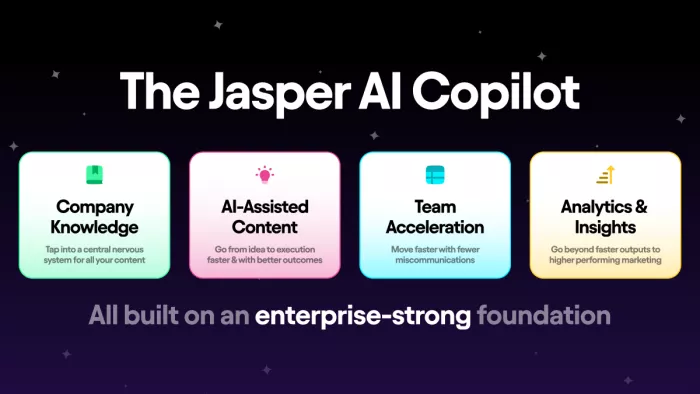
A campaign might start with a landing page, then move into paid ads, email sequences, sales collateral, social posts, and product pages. The risk is that every AI-generated asset starts selling the product differently. Jasper addresses this through its brand and knowledge layer rather than relying solely on prompt-by-prompt instructions.
Its Pro plan currently supports Brand Voices, Knowledge assets, Audiences, marketing agents, and other customization tools designed to carry company context into generation.
Key Sales-Copy Features
● Brand Voice controls how the message sounds, while Knowledge helps determine what the copy can say. This distinction matters. Tone alone will not make sales copy specific; supplying actual product information, approved claims, terminology, and company knowledge gives the model stronger material to work with.
● Audience profiles let teams adjust the argument for different buyers. Software sold to an IT manager, CFO, and small-business owner may be identical, but each buyer cares about different consequences. Carrying audience context into the writing process is more useful than generating a single generic “ideal customer” message.
● Marketing agents and workflows make Jasper useful beyond individual drafts. Current plans include agents for marketing workflows, while Business expands into custom agents, Jasper Grid, unlimited IQ customization, API access, and more advanced execution.
What Works vs. What to Watch
| What works well | What to watch |
| Keeps brand, audience, and product information available across different assets | Consistent messaging can still be weak messaging |
| Useful when several marketers contribute to the same campaign | The system performs better when teams already have clear positioning |
| Better suited to campaign production than isolated prompting | Solo writers needing a handful of sales emails may not use enough of the platform |
Pricing
| Plan | Price |
| Pro, monthly | $69/seat/month |
| Pro, annual | $59/seat/month |
| Business | Custom |
Pro currently includes one seat, two Brand Voices, five Knowledge assets, and three Audiences. Jasper also offers a seven-day Pro trial.
Practical Use
Suppose an HR software company is launching a payroll product. Its product team has detailed functionality. Its sales team knows that prospects worry about migration. Customer-success teams know where onboarding usually becomes difficult.
Putting those facts into a reusable knowledge layer gives Jasper much better material than a prompt asking it to “write persuasive payroll software copy.”
The campaign can then keep the same core argument while changing the execution: a concise paid ad, a more detailed landing page, an objection-handling email, and a sales enablement document. Here, AI's value is message continuity, not merely writing speed.
3. Copy.ai
Best for: B2B Sales and GTM Workflows
Copy.ai is now better understood as a GTM automation platform than as the simple AI copy generator many people first encountered.
That shift matters for sales copy because B2B outreach rarely begins with writing. A seller might first research the account, identify a trigger, find the right contact, understand the company's situation, choose a relevant angle, and only then draft the message.
Copy.ai's current plans combine chat with larger workflow capabilities intended to automate those kinds of repeatable GTM processes. Its inexpensive Chat plan and its workflow-oriented plans are therefore quite different propositions.
Key Sales-Copy Features
● Workflows can connect information gathering with copy generation. Instead of repeatedly asking a salesperson to research an account and transfer the useful findings into another tool, a structured workflow can use that context as part of the generation process.
● The platform is suited to repeatable sales processes. If a team has developed a strong sequence for researching, qualifying, and contacting accounts, AI can help reproduce that process across a much larger prospect list.
● Access to multiple major model providers gives teams flexibility. The Chat plan currently includes OpenAI, Anthropic, and Gemini models, while larger plans add Workflow credits and considerably more automation capacity.
What Works vs. What to Watch
| What works well | What to watch |
| Can connect research and sales messaging inside repeatable processes | Requires more setup than a straightforward AI writer |
| Useful for larger B2B GTM operations | Automation makes bad processes faster too |
| Stronger value comes from workflows rather than basic text generation | There is a very large price jump between Chat and workflow-focused plans |
Pricing
| Plan | Price |
| Chat | $29/month |
| Chat, annual | $24/month |
| Growth | $1,000/month, billed annually |
| Expansion | $2,000/month, billed annually |
| Scale | $3,000/month, billed annually |
| Enterprise | Custom |
Growth currently includes 75 seats and 20,000 monthly Workflow credits. Expansion and Scale increase both seats and monthly Workflow capacity.
Practical Use
Consider a B2B cybersecurity company targeting recently funded businesses.
The useful workflow is not to write: “Congratulations on your funding. Would you like to improve cybersecurity?”
A stronger process could research the company, determine whether headcount and infrastructure are expanding, identify the relevant security role, choose an appropriate risk angle, and only then build an email around the evidence found. That illustrates Copy.ai's real advantage. It is most useful when research and message creation are treated as one sales process, rather than two separate jobs.
4. Lavender
Best for: Cold Sales Emails
Lavender deliberately solves a narrower problem than Jasper or Copy.ai: helping people write better sales emails.
That focus is useful because cold email has its own constraints. The sender has seconds to establish relevance. Long explanations are expensive. Weak personalization is obvious. And a beautifully written message that receives no replies is still unsuccessful.
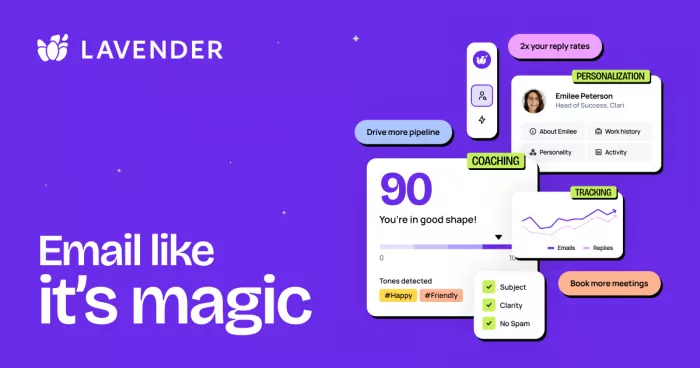
Lavender's Email Coach works inside the writing process, scoring messages and recommending changes based on patterns it has learned from large volumes of sales-email data.
Key Sales-Copy Features
● Real-time coaching examines the email while it is being written. Lavender looks at elements that can affect replies rather than simply rewriting everything in a more polished tone.
● Its Personalization Assistant puts prospect information beside the draft. That can reduce the amount of manual tab switching salespeople do while researching recipients, although the rep still needs to decide whether a particular detail is commercially relevant.
● Team plans turn individual writing behavior into measurable coaching data. Sales managers can identify patterns across reps, inspect effective templates, and use team-specific scoring models rather than relying entirely on general advice.
What Works vs. What to Watch
| What works well | What to watch |
| Built specifically around sales-email behavior | Too specialized for landing pages, product descriptions, or broad campaign work |
| Feedback appears where reps are already writing | A good email score does not prove the prospect wants the offer |
| Combines personalization help with email coaching | Research details can become forced personalization if used without judgment |
Pricing
| Plan | Monthly | Annual equivalent |
| Free | $0 | $0 |
| Starter | $29 | $27 |
| Individual Pro | $49 | $45 |
| Team | $99/seat | $89/seat |
The free plan currently limits users to five analyzed and five personalized emails per month. Starter removes those limits, while Pro and Team expand integrations, support, and coaching capabilities.
Practical Use
Suppose an account executive writes:
I noticed your company is growing rapidly and thought our platform could help streamline your sales process. Would you have 30 minutes this week?
AI could make that sentence smoother, but smoothness is not the main problem. A useful email coach should push the rep toward questions such as: What evidence shows the company is growing? What part of its sales process is likely affected? Why does that create a reason to talk now? Is 30 minutes too large an initial commitment?
That kind of editing moves closer to sales thinking rather than cosmetic rewriting.
5. Regie.ai
Best for: AI-Assisted Prospecting
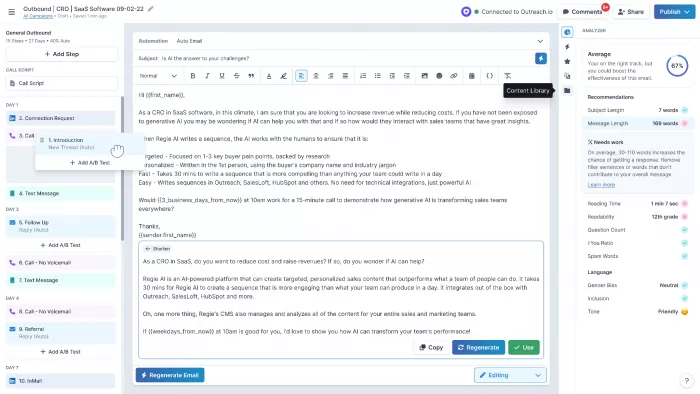
Regie.ai approaches sales copy from the prospecting side. Its RegieGO product combines account research, enrichment, message drafting, dialing, agents, and sending through connected Gmail or Outlook accounts. Researching accounts, drafting messages, enriching contacts, and dialing consume platform credits.
This setup makes sense for sellers whose biggest problem is not wording a single email but moving from “Which account should I contact?” to “What should I say to this person?”
Key Sales-Copy Features
● Account research feeds directly into drafting. The message can begin with information discovered during prospecting rather than forcing the rep to perform research elsewhere and manually transfer it into a writing tool.
● Contact enrichment and verification sit alongside message creation. This is useful because sophisticated copy is wasted if a seller is targeting irrelevant roles or working with poor contact information.
● The workspace covers more of the outbound process. RegieGO can research, enrich, draft, dial, and use agents from one environment, making the copy one component of a broader prospecting system rather than an isolated output.
What Works vs. What to Watch
| What works well | What to watch |
| Grounds outreach in prospect information before drafting | Not designed for general marketing content |
| Reduces handoffs between research and writing tools | Credit usage increases with prospecting activity |
| Free entry point makes the core workflow easier to evaluate | Automated research still needs judgment before it becomes personalization |
Pricing
| Plan | Price |
| Free | $0 |
| Pro | $49/month |
| Enterprise | Custom |
Free currently provides 250 one-time credits. Pro provides 5,000 credits each month, while Enterprise adds team workspaces, volume credits, CRM synchronization, advanced analytics, and other organizational features.
Practical Use
A salesperson targeting logistics companies could research an account for expansion activity, hiring patterns, technology changes, or other relevant signals before drafting anything.
The important step is then deciding whether the signal genuinely connects to the product being sold. If it does, the resulting message can explain why this company, why this problem, and why now.
That is far stronger than the superficial personalization often produced by inserting a company name and recent LinkedIn post into a generic sales template.
6. Hypotenuse AI
Best for: Ecommerce Product Copy at Scale
Ecommerce creates a different kind of sales-copy problem. A fashion retailer with 15,000 SKUs cannot realistically treat every product description like a handcrafted landing page. The challenge becomes maintaining accuracy, differentiation, brand standards, search requirements, and useful product detail across an enormous catalog.
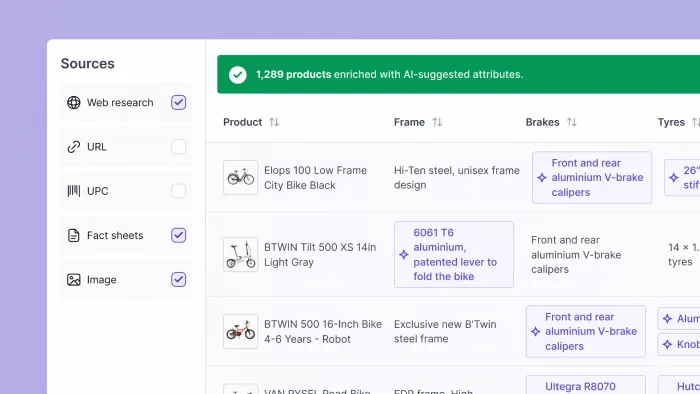
Hypotenuse AI is designed around that production environment. Its ecommerce tools support bulk product-description generation, custom brand voice and formatting, product-data enrichment, review workflows, and exports back into commerce or product-information systems.
Key Sales-Copy Features
● Descriptions can start with structured product data. Attributes such as materials, dimensions, technical details, style, and other product information can feed the generated description rather than depending entirely on free-form prompting.
● Bulk generation is built into the workflow. Teams can create or rewrite content for hundreds or thousands of products at once, review the output, and export it again without individually opening every SKU.
● Brand and formatting controls help standardize large catalogs. Hypotenuse supports brand voice, custom formatting, SEO-oriented content, and multiple ecommerce content types, which becomes increasingly important as catalog size grows.
What Works vs. What to Watch
| What works well | What to watch |
| Designed around product data rather than generic copy prompts | Much less relevant for B2B outreach or sales emails |
| Bulk workflow is useful for very large catalogs | Bad source data can create inaccurate copy at large scale |
| Can preserve brand and formatting requirements across thousands of items | Every generated claim still needs to be supported by actual product information |
Pricing
| Plan | Price |
| Basic | Custom |
| Ecommerce Enterprise | Custom |
Hypotenuse currently uses custom pricing for its ecommerce plans. Its Basic offering targets smaller catalogs with fewer than 100 products, while Ecommerce Enterprise is designed for larger operations with more complex requirements. A free trial is available.
Practical Use
Imagine a furniture retailer importing 600 new products from several manufacturers. Supplier feeds may contain dimensions, materials, colors, assembly information, and technical specifications, but the raw descriptions differ wildly in style and usefulness.
AI can turn that structured information into standardized customer-facing descriptions while maintaining the retailer's required format.
The conversion advantage here does not come from a magical persuasive phrase. It comes from making product information clearer, more complete, and easier to compare across hundreds of buying decisions. This becomes especially important when comparing AI tools for product descriptions, where structured product data and bulk-generation features can matter more than general writing flexibility.
Good Copy and Good Selling Are Different
One of the easiest mistakes to make with AI is assuming that improved prose means improved persuasion.
Consider this line:
Elevate your team's productivity with an innovative solution designed to simplify workflows and help your business achieve more.
It reads smoothly. It also communicates almost nothing.
Compare it with:
Route purchase requests automatically, set approval limits by department, and give finance a complete record of every approval before month-end.
The second version is not more persuasive because the AI used better vocabulary. It is better because the writer supplied specific product capabilities connected to a recognizable business problem.
This distinction matters with every tool on this list. Anyword can rank messages, Jasper can maintain brand context, Copy.ai can automate research workflows, Lavender can improve emails, Regie.ai can research prospects, and Hypotenuse can process catalog data. None of them can reliably invent a strong product position when the business itself does not know why customers buy.
Start With Better Inputs
Before asking AI for sales copy, collect the information a salesperson would need to make a convincing argument.
A useful brief should contain:
● The buyer's situation before purchasing. What is slow, expensive, frustrating, risky, or difficult right now?
● The concrete outcome being sold. Avoid vague goals such as “better productivity” when a more measurable or observable outcome exists.
● How the product produces that outcome. Connecting the promise to an actual mechanism makes the claim more credible.
● Reasons customers hesitate. Price, migration, training, trust, implementation time, security, contractual commitment, and switching costs can all change the copy dramatically.
● Real proof. Customer results, technical capabilities, guarantees, demonstrations, certifications, reviews, or credible data give AI something more persuasive than adjectives.
● What should happen next. A cold prospect may need a low-friction reply, while a high-intent product visitor may be ready to purchase. The CTA should reflect that difference.
AI cannot extract this information from a blank prompt.
Choose by Sales Task
Buying an AI sales-copy tool based on an overall “best” ranking misses an important point: different conversions require different systems.
| Your main job | Tool that fits it best | Why |
| Producing and testing paid ads | Anyword | Adds predictive performance information to copy selection |
| Running coordinated marketing campaigns | Jasper | Carries product, audience, and brand context across assets |
| Automating B2B GTM processes | Copy.ai | Connects AI generation with repeatable workflows |
| Improving individual cold emails | Lavender | Focuses directly on email quality and reply behavior |
| Researching and contacting prospects | Regie.ai | Combines account intelligence with message drafting |
| Producing ecommerce copy in bulk | Hypotenuse AI | Uses structured product data and catalog-scale workflows |
The table also explains why simply comparing output quality is misleading. A beautifully written product description does not make Lavender a useful ecommerce platform, just as excellent ecommerce bulk generation does not make Hypotenuse the right tool for an SDR writing ten carefully researched emails.
Where AI Sales Copy Still Fails
AI has made it easier to produce copy. It has also made it easier to produce large amounts of weak copy very quickly.
Several problems deserve particular attention.
It Confuses Variation With Strategy
Changing: Reduce administrative work.
To: Spend less time on administration. is technically a new variation, but it is not a new sales angle.
A meaningful test might compare reduced labor costs against faster turnaround times, fewer errors, easier compliance, or lower training requirements. Those are different hypotheses about what the buyer values.
Marketers should ask AI for different arguments, not merely different sentences.
Personalization Can Become Pointless
AI research tools can find enormous amounts of information about a prospect.
That does not mean all of it belongs in the email. “Congratulations on your latest podcast appearance” is personalization, but unless that appearance creates a legitimate reason for the sales conversation, it may simply prove that the sender searched the person's name.
Relevant personalization changes the argument.
AI Can Invent the Strongest Part
Specificity improves sales copy, which makes fabricated specificity particularly dangerous.
An AI system may create a convincing percentage improvement, customer quote, case-study result, competitive comparison, technical claim, or guarantee if the prompt leaves gaps.
Those are often exactly the statements that make the copy persuasive. They are also the statements that require the strongest verification.
Copy Cannot Fix the Offer
Marketers sometimes keep rewriting the landing page because rewriting is easier than questioning the product, price, trial structure, guarantee, demo process, or incentive.
AI makes that temptation worse because another rewrite is always one click away. Sometimes the headline is not the problem.
A Better AI Sales-Copy Workflow
The strongest process is not:
Prompt → generate → publish.
It is: Customer evidence → positioning → selling angle → AI draft → factual review → human edit → live test → performance data → next iteration.
Each tool on this list fits somewhere in that chain. Anyword contributes more heavily around selection and performance. Jasper helps maintain context during production. Copy.ai and Regie.ai bring research closer to generation. Lavender concentrates on the email itself. Hypotenuse connects structured product information to large-scale ecommerce copy.
That is a more useful way to think about AI sales tools than asking which one writes the most impressive paragraph.
Final Words
Anyword is the most distinctive option for performance marketers because prediction and historical campaign data give it a role beyond simple generation.
Jasper is better suited to marketing teams that need one commercial message to remain coherent across many campaign assets.
Copy.ai becomes more interesting when sales copy is part of a repeatable B2B workflow rather than an isolated writing task, although its serious automation tiers are priced accordingly.
Lavender is the most focused choice here for cold email because its product is built around the realities of getting replies rather than producing general marketing prose.
Regie.ai is useful where prospect research and message creation need to happen together, while Hypotenuse AI solves the very different problem of producing useful, accurate ecommerce copy across large catalogs.
The larger lesson is simple: do not judge AI sales-copy software by how well the demo copy reads. Judge it by what useful information the tool brings into the decision.
Sales copy converts because the message understands the buyer, presents a meaningful reason to act, supports its claims, handles uncertainty, and asks for an appropriate next step. AI can make all of those jobs faster. It still needs real customer knowledge to make them convincing.
Comments