Table of Contents
- Flashka AI at a Glance
- Signing Up and Getting Started
- Inside the Flashka Dashboard
- How Flashka AI Creates Flashcards
- Core Features That Define the Platform
- What the Platform Does Well
- Pricing Structure
- What Students and Teachers Can Use It For
- Safety and Privacy Considerations
- Flashka Compared With Other Study Platforms
- Who Might Prefer Other Tools
- Final Thoughts
For decades, studying meant highlighters, notebooks, and a stubborn pile of flashcards that somehow multiplied the night before an exam. Many students still spend hours manually turning lecture notes into study cards. The process works, but it is painfully slow.
Flashka AI steps into this familiar routine with a promise that sounds almost suspiciously convenient. Upload lecture notes, highlight key concepts, and within seconds the platform generates flashcards, quizzes, and explanations automatically. The idea is simple. Instead of spending hours creating study material, students can focus on actually learning it.
The platform was launched in 2023 by David Djokovic, Stefan Djokovic, and Simone De Marchi through their company Flashka OÜ in Tallinn, Estonia. Early traction has been strong. The startup secured €1 million in pre-seed funding in January 2026 and reports more than one million users globally, particularly among university students in Europe.
Flashka belongs to a growing category of AI learning tools attempting to automate study workflows. Unlike traditional flashcard apps that rely on manual input, this system focuses on generating learning material directly from PDFs, notes, and images. The result is a tool that aims to compress hours of preparation into a few minutes.
Flashka AI at a Glance
Before diving into the platform’s workflow and features, it helps to understand the fundamentals of the product and company.
| Attribute | Details |
| Product | Flashka AI |
| Website | https://www.flashka.ai |
| Founded | 2023 |
| Company | Flashka OÜ |
| Founders | David Djokovic, Stefan Djokovic, Simone De Marchi |
| Headquarters | Tallinn, Estonia |
| Funding | €1M Pre-seed (Jan 2026) |
| Users | 1M+ global users |
| Platforms | Web, iOS App, Android (rolling out) |
| Free Plan | 50 AI credits per day |
| Target Users | Students, educators, visual learners |
Flashka focuses primarily on AI flashcard creation, spaced repetition learning, AI tutoring, and automated quizzes. The platform markets itself as a way to accelerate exam preparation by turning raw study material into structured memory tools almost instantly.
Signing Up and Getting Started
Opening the Flashka website presents a simple promise. Upload notes, generate flashcards, and study faster. The registration process reflects that same simplicity.
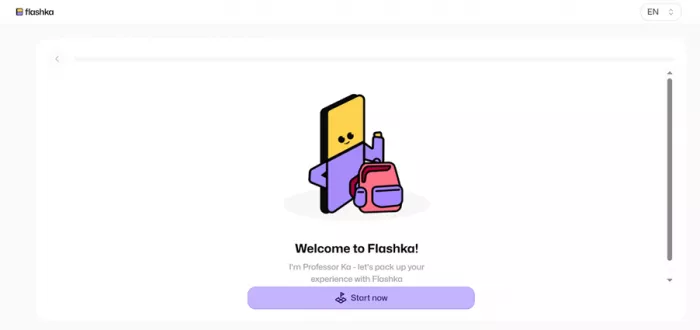
Account creation typically takes less than a minute. Email registration is available alongside Google and Apple sign-in options. The platform avoids long onboarding forms or verification barriers, which lowers the friction for first-time users exploring the tool.
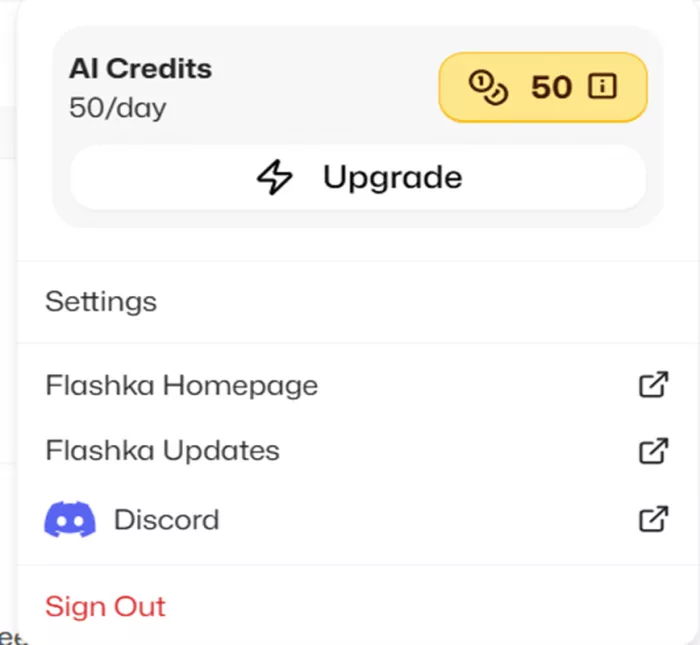
After signing in, the system immediately assigns 50 daily AI credits under the free plan. This allows beginners to test flashcard generation before considering a subscription. The platform also avoids aggressive paywalls during the first interaction, which helps maintain a smooth onboarding experience.
Within minutes, most users are already generating their first deck of flashcards. Compared with traditional tools like Anki, which require manual card creation and formatting, the initial workflow feels dramatically faster.
Inside the Flashka Dashboard
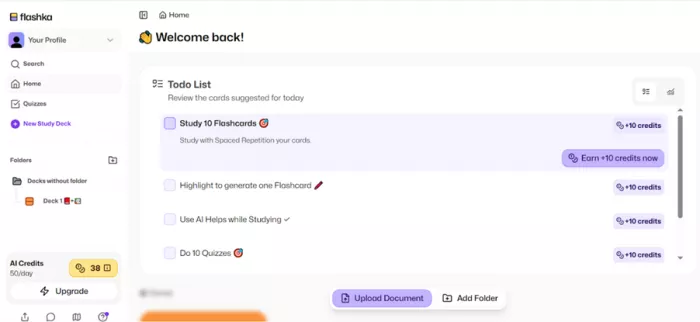
Once inside the platform, the interface resembles a hybrid between a note-taking application and a learning management tool.
The layout divides the workspace into three primary zones. The left sidebar organizes decks, folders, and learning statistics. The center panel focuses on document uploads and flashcard editing. The right side integrates AI tools such as tutoring and quiz generation.
Navigation is organized through four major sections.
• Study: Access spaced repetition review sessions and image occlusion exercises.
• Create: Upload notes or documents to generate flashcards automatically.
• Tutor: Ask AI questions about specific cards or concepts.
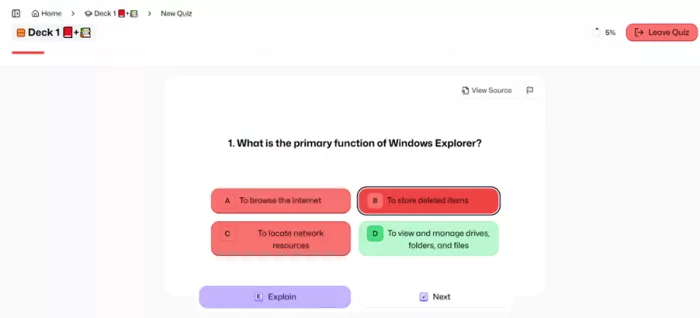
• Quizzes: Generate practice tests based on study material.
The overall interface prioritizes clarity. Students can move from uploading material to studying within a few clicks, and the system supports more than 100 languages for multilingual learning.
How Flashka AI Creates Flashcards
The core workflow of Flashka revolves around turning source material into structured flashcards.
| Step | Action | Result |
| Upload | Add PDFs, lecture notes, or images | AI reads and extracts concepts |
| Highlight | Select key information | Flashcards generated automatically |
| Customize | Edit questions or answers | Cards refined for clarity |
| Generate | AI creates a full deck | Additional cards and variants appear |
| Study | Spaced repetition schedules reviews | Retention improves over time |
The most popular feature is the highlight-to-card conversion. Instead of manually writing flashcards, users simply highlight text within a document. The AI then converts that segment into a question-and-answer format.
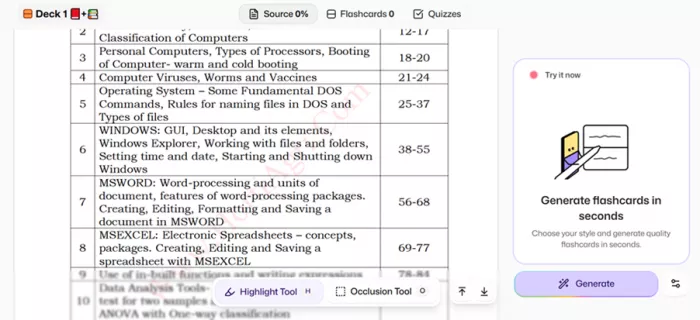
Deck generation usually takes one to two minutes. That time difference becomes noticeable when compared with manual flashcard creation, which can take hours for large lecture notes.
Core Features That Define the Platform
Flashka includes several tools that work together to support learning.
AI Flashcard Generation
The main capability allows users to upload documents and automatically generate flashcards. The AI identifies important concepts and converts them into question-answer cards.
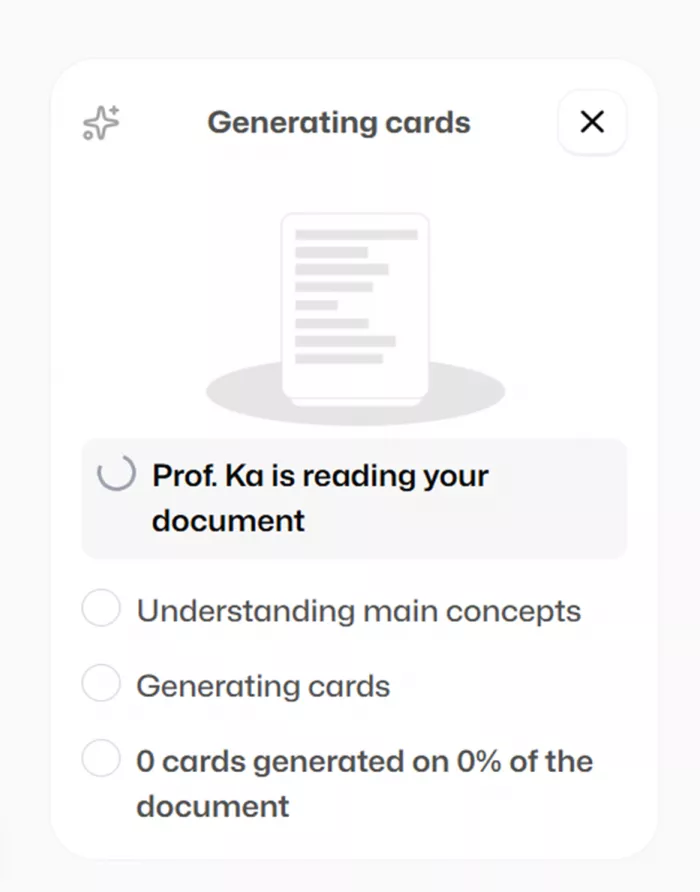
Spaced Repetition System
The platform integrates a spaced repetition algorithm similar to those used in memory research. Cards reappear at intervals designed to maximize long-term retention.
Image Occlusion Learning
Visual learners benefit from the ability to hide parts of diagrams or images. This feature is commonly used in subjects such as biology, anatomy, and geography.
AI Tutor Assistance
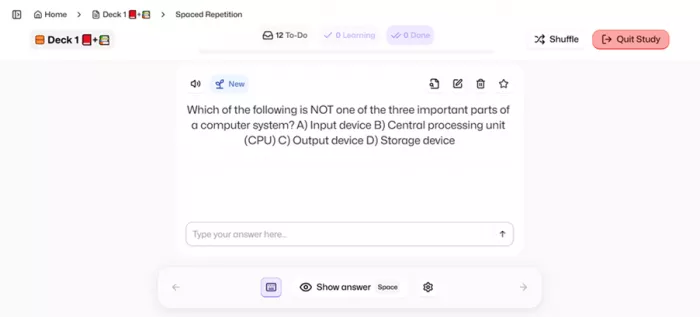
An integrated chat system allows users to ask questions about flashcards or study material. The tutor can clarify explanations or break down complex concepts.
What the Platform Does Well
Several aspects of Flashka stand out when compared with traditional flashcard tools.
• Flashcards can be generated almost instantly from uploaded notes.
• Visual learning features help with diagram-heavy subjects.
• AI explanations reduce the need to search external sources.
• Study scheduling improves retention without manual planning.
Students preparing for exams often appreciate the reduction in preparation time. Instead of creating cards first and studying later, the tool compresses both tasks into a single workflow.
Where the Tool Still Has Limits
Despite its speed, the system is not flawless.
• AI-generated cards occasionally require editing for accuracy.
• Free credit limits restrict heavy usage.
• Some cards may contain more detail than necessary.
Because the platform relies on automated content generation, reviewing cards before studying them remains important. AI can accelerate the process, but verification still matters when accuracy is critical.
Pricing Structure
Flashka uses a freemium model designed to remain accessible for students.
| Plan | Price | Credits | Key Features |
| Free | $0 | 50/day | Basic flashcards, SRS study |
| Basic | £3.99/month | Unlimited | Full AI generation |
| Boost | £12/month | Unlimited | AI tutor, faster processing |
| Annual Boost | £59.99/year | Unlimited | Discounted Boost plan |
| Annual Wizard | £119.99/year | Unlimited | Priority support and features |
The free plan allows light usage, typically enough for one or two subjects. Paid tiers remove credit limits and unlock faster processing for large documents.
What Students and Teachers Can Use It For
Flashka is designed primarily for students but also offers useful capabilities for educators.
Students
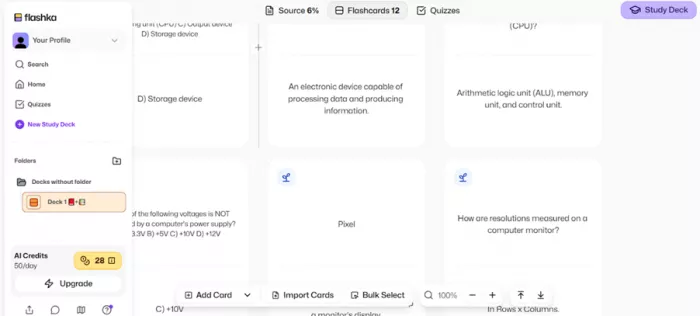
• Convert lecture notes into flashcards quickly
• Prepare for exams using spaced repetition
• Study diagrams using image occlusion
• Generate quizzes automatically
The platform fits especially well for subjects that rely on large volumes of memorization.
Teachers and Educators
• Create study decks from lesson material
• Generate quizzes for class practice
• Provide visual learning resources
• Build differentiated learning materials
Teachers can use Flashka to prepare learning materials faster, particularly when dealing with multiple classes or subjects.
Safety and Privacy Considerations
Flashka operates through its parent company Flashka OÜ in Estonia. As an EU-based company, the platform follows GDPR privacy regulations.
User data such as device information may be collected for analytics and service improvement. Uploaded materials are processed by the AI system to generate flashcards and quizzes.
No major security incidents have been publicly reported. As with any cloud-based study tool, users should avoid uploading highly sensitive personal documents.
Flashka Compared With Other Study Platforms
| Feature | Flashka | Anki | Quizlet | RemNote |
| AI Flashcard Creation | Yes | No | Limited | Partial |
| Spaced Repetition | Yes | Yes | Basic | Yes |
| Image Occlusion | Yes | Yes | No | Yes |
| Automation | High | Low | Medium | Medium |
| Customization | Moderate | High | Low | High |
Flashka focuses on speed and automation, while tools like Anki remain stronger for advanced customization.
Who Might Prefer Other Tools
Certain users may prefer alternative platforms depending on their study style.
• Learners who prefer manual card creation
• Users who need heavy customization features
• Collaborative teams sharing decks frequently
Flashka prioritizes simplicity and automation rather than deep customization.
Final Thoughts
Flashka AI represents a shift in how digital learning tools approach studying. Traditional flashcard apps required users to manually build their entire study system. Flashka attempts to automate that process by converting notes into structured learning material within minutes.
The platform works particularly well for students dealing with large amounts of information, such as medical, biology, or language courses. Educators can also benefit from the ability to generate learning resources quickly.
AI may not replace careful studying anytime soon. Exams still require actual knowledge rather than clever software. But when it comes to transforming messy lecture notes into organized flashcards, Flashka certainly makes the process far less painful.
And if studying could ever use a little automation, it is probably the night before finals.
Comments