TheSindi.com presents itself as a multi-niche information blog publishing on technology, finance, business, education, health, lifestyle, law, and sports. The site has been running since at least 2024 under WordPress, with active posting through mid-2026 and content authored under a single contributor name across most articles. This review examines what the site actually delivers, how its content reads, and which readers are likely to find genuine value there.

Snapshot Verdict
The table below summarizes the assessment in one screen. Each row reflects an attribute confirmed against the live site rather than secondhand description.
| Attribute | Detail |
|---|---|
| Site type | Multi-niche general information blog |
| Primary categories | Technology, Finance, Business, Education, Health, Lifestyle, Law, Sports |
| Platform | WordPress 6.9.4 |
| Active since | 2024, with consistent posting through 2026 |
| Access model | Fully free, no registration or paywall |
| Content depth | Light to medium, explainer-style articles |
| Best suited for | Casual readers seeking quick context on everyday topics |
| Less suited for | Researchers, specialists, or anyone requiring deeply cited sources |
About TheSindi.com
The About page describes the site as a portal aiming to publish informative content across topics that affect daily life, with a stated focus on plain language over technical depth. The mission centers on accessibility, explaining ideas in terms a non-specialist can follow without prior expertise.

The categories visible in the main navigation match the standard general-interest verticals common across content-heavy WordPress blogs, and recent posts confirm the site continues to publish across all of them rather than narrowing into a single niche. The overall framing reads as audience-broad rather than topic-deep, which has implications for both strengths and limitations covered later in this review.
Positioning matters here because the multi-niche general blog format competes against three different content categories at once: vertical specialists like Healthline or NerdWallet, explainer-led publishers like The Conversation, and broader aggregator-style content sites. TheSindi.com sits closer to the third group in form, while the About page rhetoric reaches for the framing of the first two. Understanding that gap is the single most useful lens for reading the rest of this assessment.
What the Site Covers
The category breakdown below maps each navigation entry to the kinds of articles that actually appear under it, based on post listings observed on the live site.
| Category | Example beats observed on the site |
|---|---|
| Technology | Threat intelligence, app builders, full-stack hiring, productivity tools |
| Finance | Bitcoin purchasing in USD, banking system failures, prescription savings |
| Business | Dealership data practices, fragile-goods shipping logistics |
| Education | Boarding school assessment, US study consultants, learning management software |
| Health | Plant-based omega 3 supplements, natural shampoo selection |
| Lifestyle | Interior doors, personal growth habits, home improvement |
| Law | Legal rights explainers and process overviews |
| Sports | Casino income reporting, crypto casino reviews, content delivery APIs |
Editorial Approach
Articles follow a recognizable explainer structure. Most posts open with a short framing paragraph, then break the body into subheadings that walk through definitions, considerations, and practical takeaways. The writing prioritizes readability over technical precision, which works well for readers approaching a topic cold but limits depth for anyone already familiar with the material.
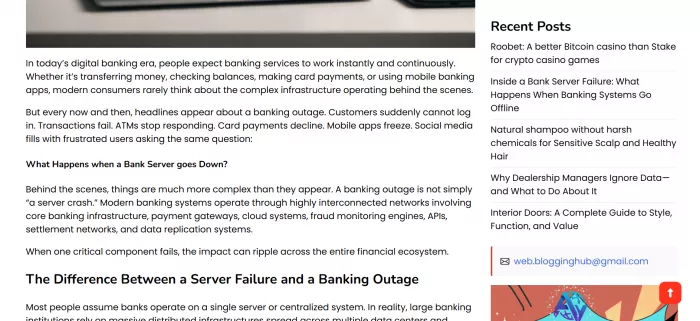
Citations to external research, primary data sources, or named experts appear infrequently. Most assertions rest on the article author's framing rather than verifiable references, which is a meaningful trust ceiling for stakes-heavy decisions in finance, health, or law. The site does not publish opinion pieces attributed to named contributors beyond a single byline visible across the majority of posts.
A noticeable share of articles in the Sports and Finance categories cover gambling-adjacent topics, including crypto casino comparisons and casino income reporting. Readers approaching the homepage for a general topic will encounter this content mix in trending and recent post listings, which is worth knowing in advance for anyone filtering by family-safe criteria.

Headlines tend toward title-case capitalization with descriptive subtitles after a colon, a format that signals SEO-aware article framing rather than newsroom-style writing. Paragraphs run short, sentences stay simple in structure, and lists appear sparingly inside articles. The result reads as digestible but lacks the texture of a strong editorial hand, which is consistent with the broader multi-author or guest-contribution patterns that the sidebar marketplace banner hints at.
Publishing Cadence and Site Profile
Several operational signals are visible on the live site, including pagination depth, archive timestamps, and the CMS identifier exposed in page metadata. The values below come from direct observation rather than third-party traffic estimators, which keeps the numbers grounded.
| Metric | Value |
|---|---|
| Total post archive pages | 58 pages of paginated posts on the site |
| Earliest visible archive | March 2024 |
| Most recent post observed | May 2026 |
| Posting frequency | Multiple posts per month across categories |
| Primary author signature | Single contributor name across visible bylines |
| CMS | WordPress 6.9.4 |
| Image hosting | CDN-served via a third-party subdomain |
| Monetization signals | Guest post marketplace banner present in sidebar |
Pagination indicates roughly 58 archive pages of posts, which points to a substantial content footprint built up over a multi-year window. The presence of a sidebar guest post marketplace banner also suggests the site participates in the paid placement ecosystem common across multi-niche blogs of this profile.
Strengths in Practice
•Plain-language explanations make the site approachable for readers who find specialist publications dense or jargon-heavy.
•Topic spread is genuinely wide, so a single visit can answer surface-level questions across very different subjects without bouncing between separate sources.
•No paywall, registration gate, or aggressive popup intrusion was observed across the homepage and category index pages during research.
•Mobile-friendly WordPress layout with standard category navigation makes browsing predictable for casual users.
•Article length sits in a comfortable middle range, long enough to cover a topic in basic terms without overstaying the visit.
Where It Falls Short
•Sourcing is thin. Most articles do not reference peer-reviewed research, named experts, or primary data, which limits trust for decisions that involve money, health, or legal stakes.
•Editorial voice across categories reads uniform rather than specialized, which suggests generalist content production rather than topic-expert authorship.
•A meaningful share of content sits in gambling-adjacent territory under Sports and Finance, which mismatches the family-friendly framing the About page sets up.
•The visible guest post marketplace banner signals that the site likely accepts paid contributions, which means individual posts should be treated as potentially marketing-adjacent until proven otherwise.
•Image hosting through a separate CDN domain is fine technically, though it does mean asset trust depends on a third-party infrastructure rather than the publisher itself.
Reader Fit Across User Types
Different visitors arrive with different jobs to do. The matrix below maps common reader profiles against the kind of value the site can realistically deliver, based on the editorial pattern observed.
| Reader type | Fit | Reasoning |
|---|---|---|
| Casual reader exploring a new topic | Strong | Plain explanations work for quick orientation |
| Student writing an academic paper | Weak | Sourcing too thin to cite responsibly |
| Professional researching a market | Weak | Depth and specificity fall short of trade publications |
| Health decision-maker | Weak | Medical claims lack consistent sourcing |
| Reader scoping crypto casino options | Moderate | Several explainers exist, though tone reads promotional |
| Hunting a quick how-to overview | Strong | Article structure matches the use case |
| Wanting a distinctive editorial voice | Weak | Generalist tone rather than authorial viewpoint |
The pattern across these profiles is consistent. Wherever the job is orientation or curiosity, the site can serve as a quick first read. Wherever the job involves consequence, including health choices, money moves, or legal action, the site is not built to be the load-bearing source. Reading TheSindi.com with that boundary in mind tends to produce the best experience for both groups.
Is TheSindi.com Trustworthy?
TheSindi.com shows some basic reliability signals. The site has been active since 2024, loads without aggressive ads or popup interruptions, and requires no registration to read. These are reasonable baseline indicators for a general information blog.
However, the trust ceiling is visible. Articles across finance, health, and law categories rarely cite named experts, peer-reviewed sources, or primary data. A guest post marketplace banner in the sidebar indicates the site accepts paid contributions, which means not every article carries the same editorial standard. No named owner or contact route exists to raise concerns or verify claims.
TheSindi.com is trustworthy enough for casual reading and general orientation on a topic. It is not a reliable standalone source for decisions involving money, health, or legal matters. Cross-checking with specialist publications is recommended for anything consequential.
Final Read
TheSindi.com is a classic multi-niche WordPress blog built for broad search traffic across Technology, Finance, Business, Education, Health, Lifestyle, and Law. Its biggest strength is accessibility: articles are simple, quick to read, and easy for non-expert readers to follow.
The site feels smooth on the surface, with fast loading pages and predictable category routing. But the trust signals are weaker. As of 26 May 2026, the latest visible post is from 22 May 2026, leaving a small freshness gap. The About page invites feedback and collaboration, yet provides no email, form, or clear contact route.

The deeper concern is editorial depth. Sourcing is thin, the voice is generalist, and gambling-adjacent posts sit beside lifestyle and education content. A guest post marketplace banner also suggests a monetization layer readers should factor in.
TheSindi.com works as a casual starting point, not a final authority. For health, finance, or legal topics, its content should be checked against stronger sources. Its real value is as a clean example of the multi-niche blog model: wide reach, easy reading, visible monetization, and the trust trade-offs that come with covering too much at once.
Comments