I've spent more hours than I care to admit sitting beside behavioral health clinicians while they wrestle with their software. You learn a lot watching a psychiatrist click through a dozen screens to finish one note, or watching a practice owner stare at an invoice nobody warned them about. The lesson is always the same. The best EHR isn't the one with the longest feature list. It's the one your team quietly stops complaining about.
Valant is a genuinely good platform. A psychiatrist built it, it handles prescribing and higher-acuity programs well, and plenty of practices are perfectly happy on it. But it isn't for everyone. Some people find the pricing hard to pin down, some want a more modern feel, and a few simply outgrow it in one direction or the other. If any of that sounds like you, think of this guide as the conversation we'd have over coffee. Here are the six alternatives I'd point a real practice toward, who each one fits, and exactly where each one will let you down.
⏱ THE 30-SECOND VERSION Best all-rounder: TherapyNotes, with structured workflows, dependable insurance billing, and predictable per-clinician pricing. Easiest for solo & small practices: SimplePractice, the most polished, beginner-friendly experience. Closest match for prescribers and psychiatry: ICANotes, the fastest path to thorough, audit-ready psychiatric notes. Tightest budget: TheraNest (Ensora), with client-volume pricing that starts low. Mixed disciplines under one roof: Jane App, with lovely UX for multidisciplinary clinics (just note there's no e-prescribing). Enterprise, CCBHC, or multi-site IOP/PHP: Qualifacts (CareLogic or InSync), with deep compliance and billing at scale. |
First, what is Valant, and why look elsewhere?
Valant (valant.io) is a cloud-based EHR and practice-management platform built specifically for behavioral and mental health. It was founded back in 2005 by a psychiatrist, which shows in the product: more than 100 clinical templates (DBT, CBT, MFT, TMS, eating-disorder protocols), integrated e-prescribing with controlled-substance support, a measurement-based-care engine that auto-assigns assessments, and the MYIO patient portal for intake, payments, secure messaging, and telehealth. It also handles higher-acuity programs like Intensive Outpatient (IOP) and Partial Hospitalization (PHP) that most lightweight tools can't touch.
In plain terms: Valant is a serious, prescriber-friendly system aimed at group practices and growing organizations, not a quick weekend setup for a solo counselor.
So why do people search for alternatives? A few recurring themes show up in reviews and comparison sites:
• Pricing isn't published. Valant uses custom quotes, and third-party listings estimate roughly $100 to $300 per provider per month before add-ons like e-prescribing, fax, or API access, plus implementation costs. There's also no free trial, so it's hard to "try before you buy."
• Support and responsiveness. Several independent reviews mention occasional glitches and slower support turnaround than newer competitors.
• Flexibility and modern feel. The platform is powerful, but some clinicians find it less flexible and less modern than tools designed in the last few years.
• Overkill for solos. If you're a one-person cash-pay therapy practice, you're paying for prescriber and program-management muscle you may never use.
⚖️ A fair word about Valant None of this makes Valant a “bad” EHR, it's genuinely strong for psychiatry, group practices, and IOP/PHP programs, and it holds a respectable rating on review sites. The goal here isn't to bash it. It's to help you find a tool that fits your size, specialty, and budget more comfortably. |
Valant in short
| Valant EHR Suite | ★★★★☆ 4.1/5 |
| Best fit | ★★★★½ 4.3 |
| Documentation depth | ★★★★½ 4.4 |
| Ease of use | ★★★★☆ 3.9 |
| Support & responsiveness | ★★★½☆ 3.7 |
| Value & pricing transparency | ★★★½☆ 3.7 |
Overall ~4.1/5 across public review platforms (a few hundred reviews). Sub-scores above are a blended, representative read, not exact vendor figures.
How we picked these alternatives
This isn't a list of whoever paid the most for placement. Every tool below was chosen because it overlaps with a real Valant use case, and each entry is judged on the same five things:
1. Behavioral-health fit. Templates, treatment planning, and workflows built for therapy and psychiatry, not generic medical charting bolted on.
2. Clinical depth. Documentation speed, e-prescribing/EPCS where relevant, measurement-based care, and group/IOP/PHP support.
3. Billing & compliance. Insurance claims, ERA posting, and the HIPAA/42 CFR Part 2 guardrails practices actually need.
4. Pricing transparency & value. Published pricing earns trust; hidden add-ons lose it.
5. Real-world sentiment. What verified users on Capterra, Software Advice, and similar say after living with the tool.
📌 About the numbers in this guide Pricing and star ratings reflect publicly available information as of mid-2026 and are approximate. EHR pricing changes often, add-ons stack up fast, and review scores drift month to month. Always confirm current pricing and run a demo or trial before committing. This guide is informational and isn't legal, financial, or clinical advice. |
The contenders at a glance
Here's the whole field side by side. Use it to shortlist two or three, then read the deep dives that follow.
| Platform | Best for | Starts at* | e-Rx / EPCS | Rating |
| Valant | Psychiatry, groups, IOP/PHP (baseline) | ~$100 (quote) | Yes | ★★★★☆ 4.1 |
| TherapyNotes | Best all-round therapy + billing | $69 | Yes (add-on) | ★★★★½ 4.7 |
| SimplePractice | Solo / small, easiest to use | $49 | Yes (add-on) | ★★★★½ 4.6 |
| ICANotes | Psychiatry & prescribers | $75 / $155 | Yes (EPCS) | ★★★★½ 4.5 |
| TheraNest | Tight budgets, small groups | $29 | Add-on | ★★★★½ 4.4 |
| Jane App | Multidisciplinary clinics | $54 CAD | No | ★★★★★ 4.8 |
| Qualifacts | Enterprise / CCBHC / SUD | Custom | Yes (EPCS) | ★★★★½ 4.5 |
*Lowest published per-provider tier, USD unless noted. Add-ons (e-prescribing, AI notes, claims, telehealth) cost extra. Valant and Qualifacts are quote-based.
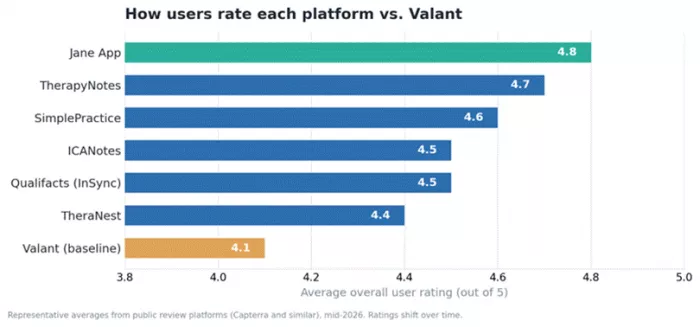
Average overall user ratings. Every alternative outscores the Valant baseline, though by varying margins.
TherapyNotes: Best all-round alternative
If you want the closest thing to a “safe default” when leaving Valant, TherapyNotes is it. It's a behavioral-health EHR that prizes consistency over flash: documentation, scheduling, and billing all follow clear, repeatable workflows that are easy to learn and hard to mess up. That structure is exactly why solo clinicians and small-to-mid group practices love it: fewer errors, less training, reliable insurance claims.
What stands out
• Prebuilt note templates and treatment plans tuned for one-on-one outpatient therapy.
• Genuinely dependable insurance billing and claims, a frequent highlight in reviews, even through industry disruptions like the Change Healthcare outage.
• Predictable per-clinician pricing and a full 30-day free trial (no credit card).
• Support that users repeatedly describe as responsive and human.
• Newer AI scribe (TherapyFuel) for clinicians who want help drafting notes.
Pricing
| Plan / item | Approx. price |
| Solo (one clinician) | $69 / month |
| Group | $79 / mo first clinician + $50 / mo each additional |
| Enterprise (30+ users) | $79 / mo first clinician + $50 / mo each additional |
| Electronic claims / ERA | $0.14 each |
| Premium telehealth | $15 / clinician / month |
| TherapyFuel AI scribe | $40 / provider / month |
| Free trial | 30 days |
| 👍 What people like | 👎 Where it falls short |
| • Reliable, well-respected insurance billing | • Prices tend to creep up year over year |
| • Predictable pricing, easy to learn | • Less deep customization than power tools |
| • Strong, responsive customer support | • Weaker for heavy psychiatric med management |
| • Great fit for traditional outpatient therapy | • Telehealth video can be glitchy at times |
| TherapyNotes user scorecard | ★★★★½ 4.7/5 |
| Ease of use | ★★★★½ 4.7 |
| Customer service | ★★★★½ 4.7 |
| Features | ★★★★½ 4.5 |
| Value for money | ★★★★½ 4.6 |
🎯 Pick it if… You run a therapy-first solo or group practice, bill insurance, and want a dependable, low-drama system. Skip it if your work is psychiatry- or medication-heavy. The prescribing side is thinner than Valant or ICANotes. |
SimplePractice: Easiest for solo & small practices
With 250,000+ practitioners, SimplePractice is the most popular name in this space competing with Valant IO, and it earns that reach with polish. The client portal, scheduling, telehealth, and even a built-in website builder feel modern and approachable. For a brand-new private practice that wants to be running this week, nothing here is intimidating.
The catch is the à la carte model: the headline price looks friendly, but the features that make it shine (AI notes, e-prescribing, extra clinicians) are add-ons that stack on top.
What stands out
• Clean, beginner-friendly interface that clients and clinicians both find intuitive.
• Integrated telehealth, secure messaging, online booking, and a free website builder.
• Monarch directory to help new clients find you.
• 30-day free trial with no credit card required.
• Huge ecosystem, deep help center, and lots of community know-how.
Pricing
| Plan / item | Approx. price |
| Starter | ~$49 / month |
| Essential | ~$79 / month |
| Plus (only tier that adds clinicians) | ~$99 / month |
| AI Note Taker | $35 / clinician / month |
| e-Prescribe | $49 / clinician / month + $89 one-time setup |
| Free trial | 30 days, no credit card |
| 👍 What people like | 👎 Where it falls short |
| • Best-in-class ease of use and onboarding | • Add-ons inflate the “real” monthly cost |
| • Polished client experience + portal | • Reporting is fairly basic |
| • Website builder and directory included | • Only the top tier lets you add clinicians |
| • Massive community and documentation | • Value-for-money reviews are mixed |
| SimplePractice user scorecard | ★★★★½ 4.6/5 |
| Ease of use | ★★★★½ 4.4 |
| Customer service | ★★★★½ 4.4 |
| Features | ★★★★½ 4.3 |
| Value for money | ★★★★½ 4.3 |
🎯 Pick it if… You're a solo therapist or small team that values a smooth, modern experience over deep configurability. Do the math on add-ons first. Once you bolt on AI notes and e-prescribing for several clinicians, the bill climbs quickly. |
ICANotes: Best for psychiatry & prescribers
If the reason you liked Valant was its psychiatric muscle, ICANotes is the alternative to test first. Founded in 1999 and built by a practicing psychiatrist, its signature is a menu-driven content engine with 75,000+ clinical phrases that lets prescribers click their way to a thorough, narrative psychiatric note in roughly three minutes. EPCS-capable e-prescribing, labs, telehealth, billing, and a patient portal are all integrated.
It's also one of the few behavioral-health EHRs that has stayed independently owned rather than getting swallowed by private equity, a quiet plus for long-term stability.
What stands out
• Fastest path to detailed, audit-ready psychiatric and medication-management notes.
• Integrated EPCS e-prescribing (ScriptSure / DrFirst) for controlled substances.
• Specialty templates for SOAP, DAP, BIRP, group therapy, case management, and more.
• Strong onboarding and unlimited behavioral-health-savvy support at no extra cost.
• Per-clinician pricing that's published up front.
Pricing
| Plan / item | Approx. price |
| Full-time, non-prescribing clinician | ~$75 / month |
| Full-time prescribing clinician | ~$155 / month |
| Part-time & notes-only options | Lower, scaled rates |
| e-Prescribing / EPCS | Included in prescriber plans |
| Free trial | Demo available (no open free trial) |
| 👍 What people like | 👎 Where it falls short |
| • Unbeatable documentation speed for prescribers | • Interface feels dated next to newer tools |
| • Built-in EPCS e-prescribing | • Real learning curve at the start |
| • Excellent training and support | • Prescriber pricing is on the higher side |
| • Works for solo through large practices | • Less “modern” client-facing polish |
| ICANotes user scorecard | ★★★★½ 4.5/5 |
| Documentation speed | ★★★★★ 4.8 |
| Behavioral-health fit | ★★★★½ 4.7 |
| Ease of use | ★★★★☆ 4.0 |
| Support & training | ★★★★½ 4.6 |
🎯 Pick it if… You're a psychiatrist or PMHNP (or a practice full of them) who lives in the chart and wants to chart faster. Look elsewhere if a sleek, contemporary UI is a deal-breaker for you or your front-desk staff. |
TheraNest (Ensora Health): Best for tight budgets
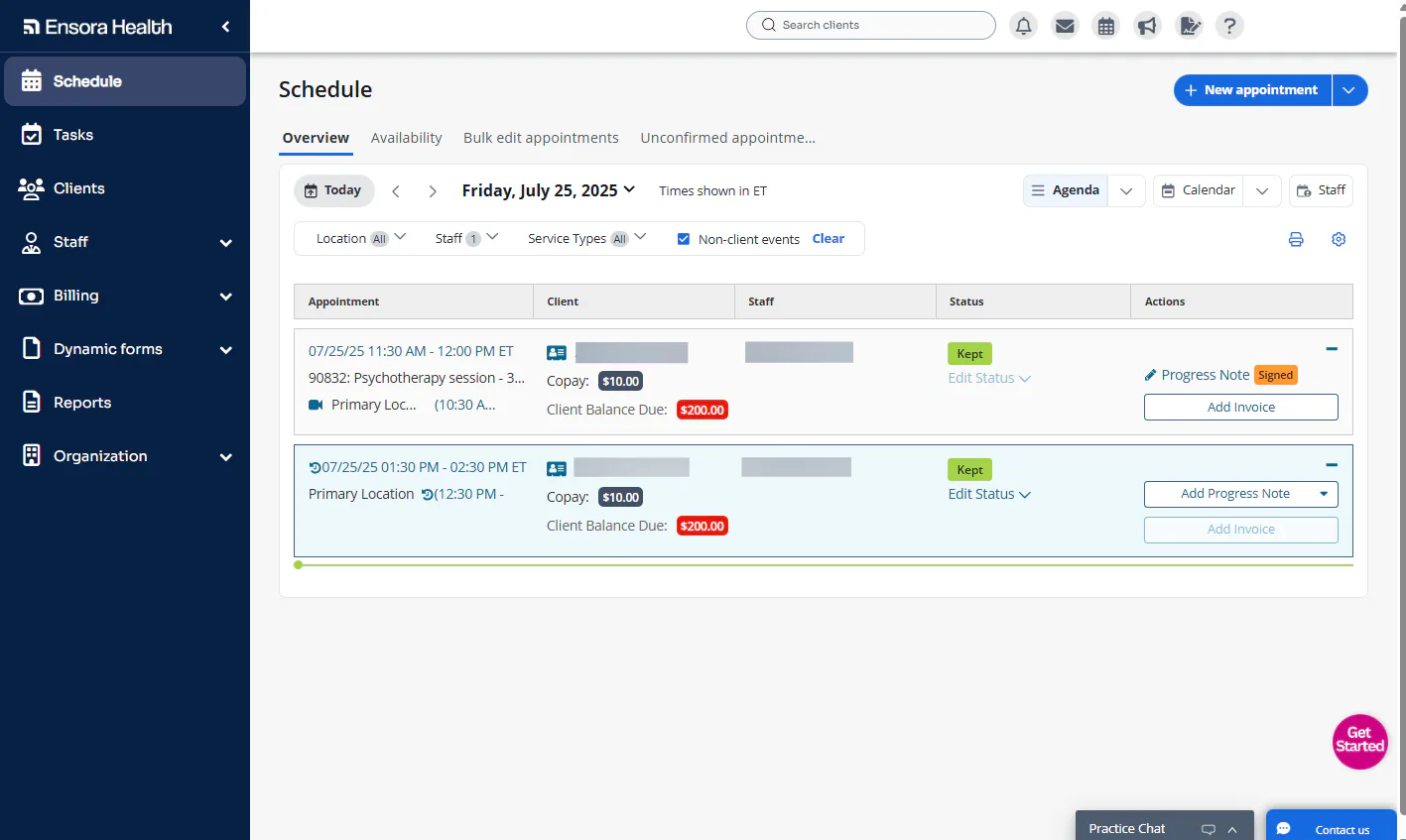
TheraNest, now part of Ensora Health, wins on the one metric some practices care about most: a low entry price. Instead of charging strictly per clinician, it prices around your active client count, so a small or seasonal practice can start cheap and scale spend as the caseload grows. It still covers the essentials: scheduling, documentation, billing, telehealth, and a client portal.
What stands out
• Client-volume pricing that starts around $29/month, friendly for new or small practices.
• Solid core toolkit: notes, scheduling, billing, telehealth, client management.
• Popular with small group practices, interns, and lean nonprofits.
• Lower commitment to get started than enterprise-grade systems.
Pricing
| Plan / item | Approx. price |
| Entry tier | from ~$29 / month (based on active clients) |
| Scales | Cost rises as your active-client count grows |
| Add-ons | Telehealth, billing extras, and more available |
| Free trial | Available |
| 👍 What people like | 👎 Where it falls short |
| • Low starting cost, easy to justify | • Costs can climb as clients increase |
| • Client-based pricing suits small caseloads | • Interface feels dated vs. newer rivals |
| • Covers the everyday essentials well | • Fewer advanced/psychiatry features |
| • Good stepping-stone from pen-and-paper | • Recent rebrand (Ensora) adds some flux |
| TheraNest user scorecard | ★★★★½ 4.4/5 |
| Ease of use | ★★★★½ 4.3 |
| Customer service | ★★★★½ 4.4 |
| Features | ★★★★☆ 4.1 |
| Value for money | ★★★★½ 4.3 |
🎯 Pick it if… You're cost-sensitive with a modest or variable caseload and need the basics done reliably. Re-run the numbers as you grow. Once your active-client count is high, the price advantage can shrink. |
Jane App: Best for multidisciplinary clinics
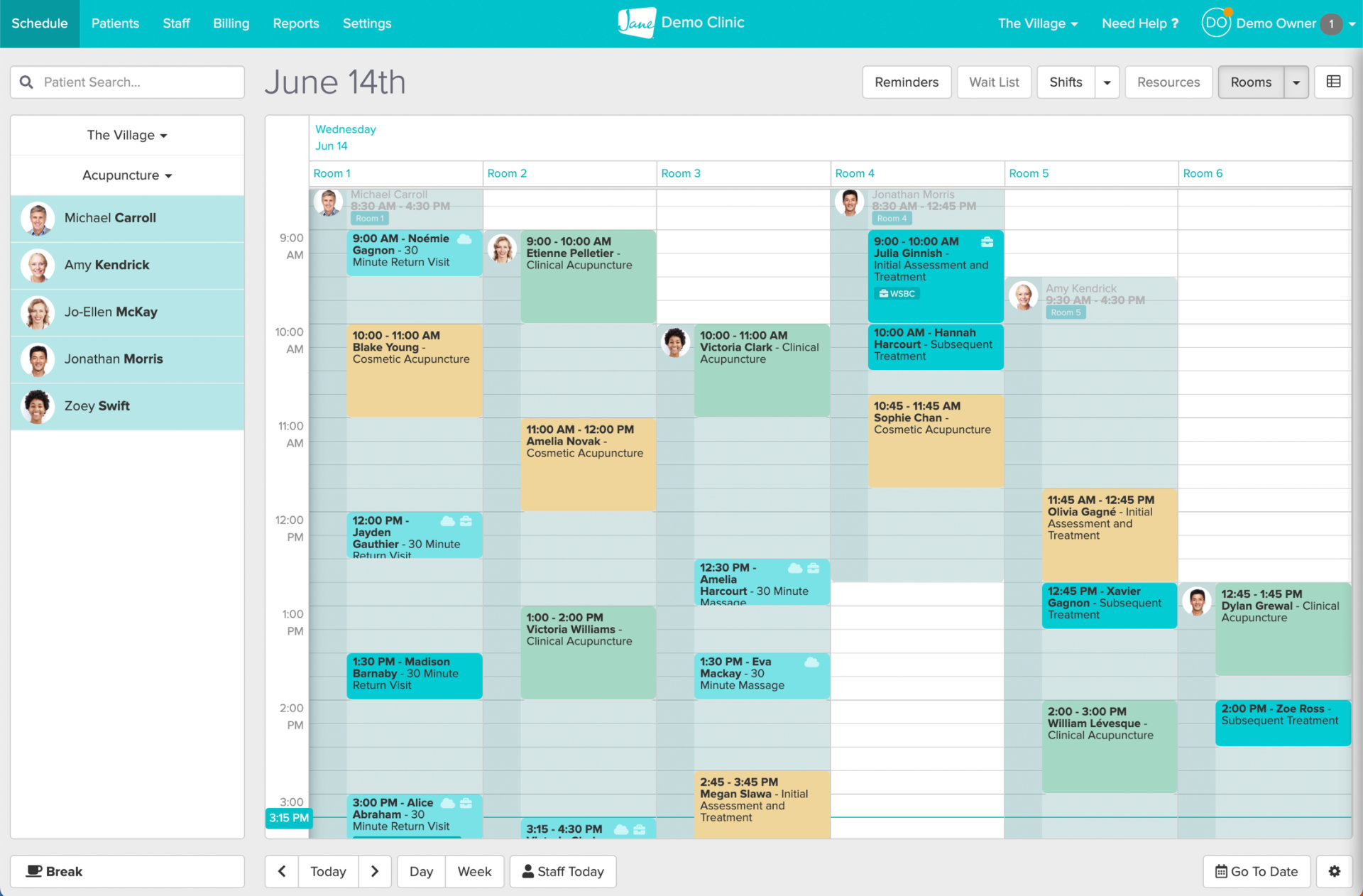
Jane is the crowd favorite for clinics that aren't only mental health. It was designed for interdisciplinary teams, so one account can serve counsellors alongside physios, massage therapists, dietitians, and more. The interface is genuinely lovely, the scheduling is excellent, and the template library runs into the thousands. Among practice-management tools, Jane consistently posts some of the highest user-satisfaction scores around.
One crucial caveat for behavioral health: Jane is not purpose-built for psychiatry. There's no e-prescribing, it isn't ONC-certified, and it lacks substance-use-specific tooling (ASAM workflows, 42 CFR Part 2). For complex, insurance-heavy or prescriber-led work, that's a real gap versus Valant.
What stands out
• Beautiful, modern UX that staff learn quickly.
• True multidisciplinary support, with one system for a mixed-discipline clinic.
• Huge community template library (10,000+), strong scheduling and online booking.
• Integrated telehealth (1:1 and group) and a patient-facing booking app.
• Famously responsive, friendly support.
Pricing
| Plan / item | Approx. price |
| Balance (solo, capped appointments) | CAD $54 / month |
| Practice | CAD $79 / month + per-practitioner fees |
| Thrive | CAD $99 / month + per-practitioner fees |
| AI Scribe / Group telehealth | $15 / practitioner / month each |
| Insurance billing add-on | $20 / month (+ per-practitioner) |
| Note | Prices listed in CAD, convert for USD comparisons |
| 👍 What people like | 👎 Where it falls short |
| • Outstanding interface and ease of use | • No e-prescribing, a dealbreaker for prescribers |
| • Perfect for mixed-discipline clinics | • Not ONC-certified; lacks SUD/Part 2 tooling |
| • Excellent scheduling + template library | • Insurance billing less robust than rivals |
| • Top-tier customer support | • Per-practitioner fees + CAD pricing add friction |
| Jane App user scorecard | ★★★★★ 4.8/5 |
| Ease of use | ★★★★★ 4.8 |
| Scheduling & booking | ★★★★★ 4.8 |
| Customer support | ★★★★★ 4.8 |
| Behavioral-health depth | ★★★★☆ 3.8 |
🎯 Pick it if… You run a multidisciplinary or allied-health clinic where therapy is one of several services, and you don't need e-prescribing. If you're a prescriber or an insurance-heavy behavioral-health practice, Jane will frustrate you. Choose ICANotes, TherapyNotes, or stay with a purpose-built system. |
Qualifacts (CareLogic / InSync / Credible): Best for enterprise, CCBHC & multi-site programs
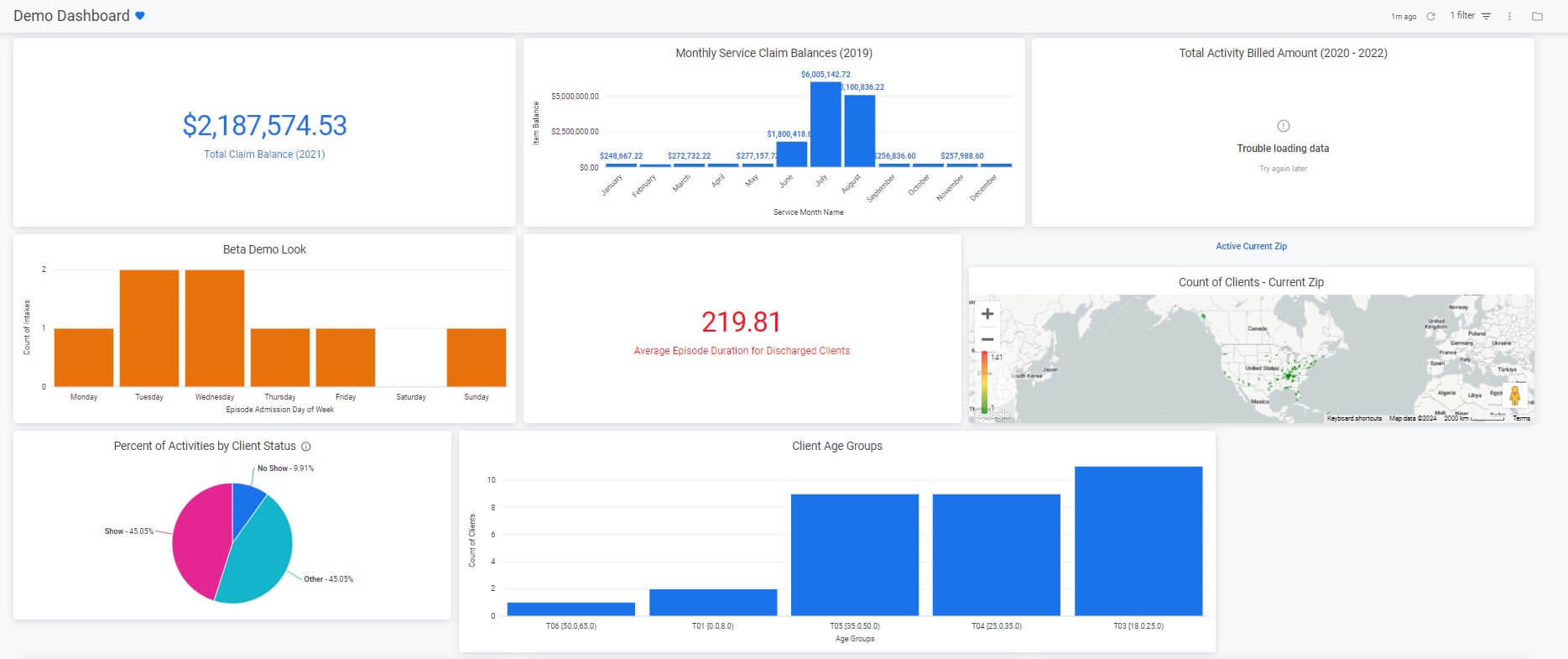
If you outgrew Valant in the other direction (multiple sites, dozens of clinicians, Medicaid-heavy billing, CCBHC certification, IOP/PHP and residential levels of care), Qualifacts is the enterprise answer. Founded in 2000, it runs several platforms: CareLogic and Credible for large community mental-health organizations, and InSync for small-to-mid practices. Expect deep configurability, EPCS e-prescribing, measurement-based care (PHQ-9, GAD-7, AUDIT, C-SSRS and more), electronic visit verification, and serious state-reporting and compliance muscle.
That power comes with enterprise realities: custom quote-based pricing, longer implementations, and a multi-platform portfolio that can confuse buyers. It's overkill for a solo therapist, and exactly right for a 100-clinician agency.
What stands out
• Built for scale: multi-location, multi-state, multi-program organizations.
• Deep Medicaid billing, value-based-care, and CCBHC compliance support.
• EPCS e-prescribing and integrated measurement-based care.
• Highly configurable workflows, dashboards, and reporting for big teams.
• InSync option for small-to-mid practices that still want room to grow.
Pricing
| Plan / item | Approx. price |
| CareLogic / Credible (enterprise) | Custom quote |
| InSync (small to mid practices) | Custom quote |
| Implementation fees | Significant, often $5k to $100k+ at scale |
| Free trial | Demo only (enterprise sales process) |
| 👍 What people like | 👎 Where it falls short |
| • Enterprise-grade depth and configurability | • Quote-only pricing; no transparency |
| • Strong Medicaid/CCBHC compliance & reporting | • Complex, longer implementations |
| • EPCS e-prescribing + measurement-based care | • Multi-platform lineup can confuse buyers |
| • Scales across sites, programs, and states | • Far too heavy for solo/small practices |
| Qualifacts (InSync) user scorecard | ★★★★½ 4.5/5 |
| Enterprise depth | ★★★★½ 4.7 |
| Compliance & billing | ★★★★½ 4.6 |
| Ease of use | ★★★★☆ 4.2 |
| Implementation effort | ★★★★☆ 3.9 |
🎯 Pick it if… You're a CMHC, CCBHC, or multi-site treatment network that needs compliance and billing at scale. Running addiction/SUD programs specifically? Also shortlist Kipu Health (below), which specializes in detox, residential, PHP/IOP workflows. |
Price reality check
Headline prices can be misleading because behavioral-health EHRs love add-ons. The chart below shows lowest published starting tiers, but remember to add e-prescribing, AI notes, claims fees, and extra clinicians to get your true monthly cost.
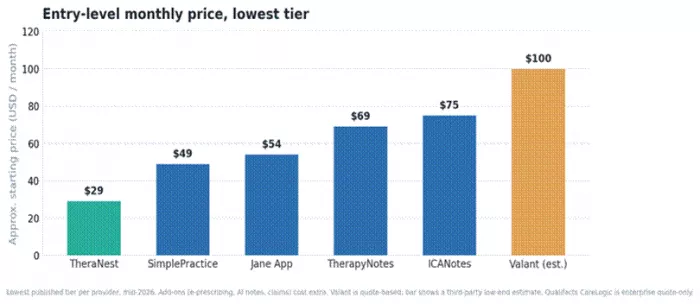
Entry-level monthly pricing. Valant is a third-party estimate, and Qualifacts CareLogic is enterprise quote-only.
How to actually choose (a quick decision guide)
Skip the spreadsheet paralysis. Start with what kind of practice you are, then match to the obvious fit:
| If you are… | Start your shortlist with… |
| A solo therapist who wants the easiest setup | SimplePractice, then TheraNest |
| A therapy group that bills insurance | TherapyNotes (top pick), then SimplePractice |
| A psychiatrist / PMHNP or prescriber-heavy team | ICANotes, then stay-and-compare with Valant |
| Cost-sensitive with a small or variable caseload | TheraNest, then SimplePractice |
| A multidisciplinary / allied-health clinic | Jane App (if no e-prescribing needed) |
| An enterprise, CCBHC, or multi-site org | Qualifacts (CareLogic/InSync) |
| Running addiction / SUD programs | Kipu Health, then Qualifacts |
Five questions to ask every vendor on your demo
1. Do you prescribe? If yes, confirm EPCS e-prescribing is included (or what it costs). This rules out Jane immediately.
2. What's my all-in monthly cost with my real clinician count and the add-ons I need (AI notes, claims, telehealth)?
3. How are insurance claims and ERA posting handled, and what are the per-claim fees?
4. What does implementation and data migration from Valant actually involve, including timeline, cost, and who does the work?
5. Is there a real trial, and can I test my own workflow (not just a scripted demo) before signing?
Switching without the chaos
Changing an EHR feels scary, but a little planning keeps it boring (the good kind). A few field-tested tips:
• Pick a slow season. Migrate during a lower-volume stretch so a hiccup doesn't collide with a packed schedule.
• Name an internal owner. One person who shepherds data export, training, and go-live decisions prevents finger-pointing.
• Audit your data first. Active clients, open claims, prior authorizations, and credentials, know what's moving before you move it.
• Run them in parallel briefly. A short overlap window catches gaps before you fully cut over.
• Budget for the hidden costs. Implementation, training, data migration, clearinghouse and e-prescribing fees add up, so get them quoted in writing.
• Tell clients early. A short heads-up about a new portal or booking link cuts confusion and no-shows.
My verdict
If you made it this far, you probably just want me to tell you what to do. Fair enough.
If I were opening a typical therapy practice tomorrow, I'd start with TherapyNotes and only look further if something specific pushed me off it. It's the one I've seen the fewest people regret six months in. For a brand-new solo therapist who wants to feel competent on day one, I'd hand over SimplePractice and gently warn them to keep an eye on the add-ons before the bill quietly doubles. And if the practice lives and breathes psychiatry, I'd send them to ICANotes, dated screens and all, because when you're writing twenty notes a day, charting speed beats pretty every single time.
Working on a shoestring? TheraNest lets you start lean and grow into the cost. Running a clinic that mixes physios, dietitians, and counsellors under one roof? Jane is a joy to use, as long as nobody on the team needs to prescribe. And if you're managing a multi-site agency buried in Medicaid and CCBHC paperwork, you've already outgrown the simple tools, so Qualifacts is the grown-up answer (with Kipu worth a serious look if addiction treatment is your world).
Here's the honest advice I give every practice I sit down with: please don't buy off a comparison table, not even a nice one like this. Shortlist two, book real demos, and make each system run your actual Tuesday. Bring a messy intake, a stubborn claim, a last-minute no-show. The software that handles your worst day without making you sweat is the one worth paying for. The longest feature list almost never is.
✅ Before you sign anything Pick two finalists, demo them with your own workflow, and price out the true all-in monthly cost using your real clinician count and the add-ons you'll actually turn on. Then trust the tool your team enjoys using on a busy day, not the one that wins on paper. |
Comments