There is a particular kind of quiet panic that arrives around 11 p.m., when a calculus worksheet refuses to make sense and the assignment is due before first period. For a whole generation of students, the instinct now is not to flip frantically through a textbook but to grab a phone, point the camera at the problem, and wait for an answer to surface. Two names keep showing up in that moment: Goth AI and Gauth. They sound nearly identical, their icons lean on the same friendly-robot look, and both promise the same relief, which is homework that finally stops feeling impossible.
That resemblance is not an accident, and untangling it matters before anyone hands over a card number. One of these apps is a polished, heavily backed product trusted by millions. The other is a cluster of look-alike apps that showed up to ride its wave. Spending real evenings bouncing between the two makes the line between marketing and actual studying surprisingly clear. What follows is an honest comparison across accuracy, price, features, and trust, so the smarter pick becomes obvious rather than confusing.
Quick Verdict Best overall: Gauth, for genuine step-by-step depth, accuracy, and a live tutor network across nearly every subject. Best on a tight budget: A Goth AI app, but only for quick, low-stakes scans, and only after confirming the developer first. Biggest trap: Installing a look-alike by mistake, or missing the moment Gauth’s free trial flips to a paid plan. |
Goth AI vs Gauth at a Glance
Before the deep dive, here is the short version for anyone scanning between classes. The snapshot below shows where each app actually stands today.
| Gauth | Goth AI | |
|---|---|---|
| Developer | GauthTech Pte. Ltd. (a ByteDance company) | Several developers using the “Goth AI” name |
| Origin | Began as Gauthmath, rebranded to Gauth in 2024 | Recent, surfaced after Gauth’s brief U.S. removal in early 2025 |
| Core method | Photo scan, step-by-step AI solutions, live tutors | Photo scan and GPT-style chat answers |
| Subjects | Math, physics, chemistry, biology, coding, writing, more | Math, science, literature, writing (varies by version) |
| Free tier | Around 11 questions per day | Limited scans, often paywalled quickly |
| Standout strength | Depth, live tutor network, large practice library | Low upfront price, simple interface |
| Main watch-out | Aggressive trial-to-paid billing | Name confusion and uneven quality |
That split, deep but pricey versus cheap but hard to pin down, runs through everything below. The detail underneath each row is where the real decision lives.
What Is Gauth?
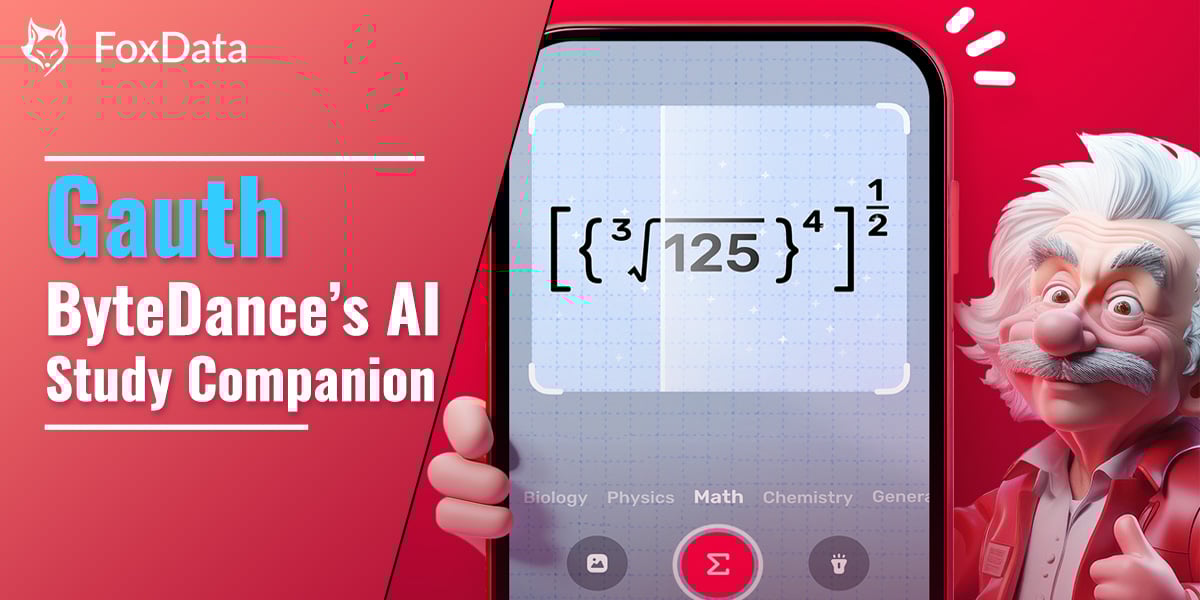
Gauth is the established name here, and arguably the most recognised homework-scanning app in the world. It started life as Gauthmath, a photo-based math solver, before broadening into a full study companion and rebranding to Gauth in 2024. The app is built by GauthTech, a company under the ByteDance umbrella, the same parent behind TikTok. The name itself nods to the mathematician Carl Gauss, and that studious origin shows up in how the product behaves.
The pitch is simple. Snap a photo of a printed or handwritten question, or type it in, and Gauth returns a structured, step-by-step solution within seconds. The explanations focus on the reasoning behind each step rather than only the final number, and follow-up questions work through conversational chat. A student stuck on a method can ask why a particular factoring approach was used, or what changes when a variable goes negative, without starting the whole problem over.
Features that set Gauth apart
Beyond the scanner, Gauth has grown into something closer to a full study system. The standout pieces:
• AI Live Tutor that answers by voice and works through problems on a virtual whiteboard, close to a one-to-one session.
• DeepThinking mode that blends several AI models for tougher, multi-step questions.
• A huge practice library, with more than 20 million tutorial videos and over 100 million questions on premium plans.
• Round-the-clock human experts for the small share of questions the AI cannot confidently handle.
Coverage spans math, physics, chemistry, biology, coding, economics, and writing, which is what makes Gauth feel less like a calculator and more like a tutor on a phone.
| Strengths | Watch-outs |
|---|---|
▪ Explains the reasoning, not just the final answer ▪ Real human tutors as a backup when the AI stalls ▪ One app stretches across nearly every subject | ▪ Premium pricing that adds up over a full year ▪ Free trial converts to paid the moment one subscribes ▪ Cancelling works best through app-store billing |
What Is Goth AI?

Goth AI is harder to sum up in one line, because Goth AI is not a single app. The name appears across several different App Store and Google Play listings published by unrelated developers, with the spelling sitting just one letter away from Gauth. The timing is telling. Many of these listings gained traction in early 2025, right after ByteDance apps were briefly pulled from U.S. stores and confused students went searching for a replacement that looked like the tool their friends used.
On paper, the stronger listings read familiarly, with a feature set close to Gauth’s:
• Instant photo answers across most subjects, often in well under ten seconds on a clean photo.
• GPT-style chat for follow-up questions and quick explanations.
• A quiz generator that turns notes into practice questions, plus basic writing and summarising tools.
The name-confusion problem
The trouble is consistency. Because no single team owns the Goth AI label, quality swings sharply from one listing to the next. App store reviews mix glowing five-star praise with blunt warnings. One widely shared review describes downloading what looked like Gauth, getting pushed toward a $3.99 unlock after a single scan, and then receiving the wrong answer anyway. None of this makes every Goth AI app unsafe, but it does turn the experience into a lottery in a way Gauth’s is not.
| Strengths | Watch-outs |
|---|---|
▪ Low upfront cost on many listings ▪ Fast, clean answers on simple textbook problems ▪ Familiar, no-frills interface | ▪ Quality swings sharply between developers ▪ Paywall can appear after a single scan ▪ Stumbles on messy handwriting, shadows, and dense diagrams |
How to Tell the Two Apps Apart
Because the names differ by a single letter and the icons borrow the same look, the biggest risk arrives at the download stage, long before any homework gets solved. A few quick checks settle which app is actually on the screen.
• Check the developer name. The genuine Gauth is published by GauthTech Pte. Ltd. A study app with a similar appearance from any other developer is a separate product, not an update of it.
• Read the review count, not just the score. Gauth carries a very large volume of ratings built up over years. Many Goth AI listings show far fewer, which makes a high average far less meaningful.
• Watch the paywall timing. A demand for payment after a single scan is a recurring Goth AI complaint, whereas Gauth allows a daily batch of free questions before asking for anything.
Thirty seconds spent reading the listing avoids most of the frustration that fills the harshest reviews. The right app rewards that small effort, while the wrong one tends to announce itself with an immediate request for $3.99.
Feature-by-Feature Comparison
Marketing copy aside, the two apps separate most on depth and reliability. The comparison below lines up the features that matter to a student who actually has to learn the material, not just submit it.
| Feature | Gauth | Goth AI |
|---|---|---|
| Photo problem solver | Yes, with auto-cropping and step-by-step output | Yes, quality varies by version |
| Conversational follow-ups | Yes, with prompts like “be brief” or “dive deeper” | Limited, depends on the app |
| Live human tutors | Yes, 24/7 expert network | Generally not offered |
| AI voice tutor and whiteboard | Yes | No |
| Subject breadth | Very broad: STEM, coding, writing, economics | Moderate, mostly math and science |
| Practice library | 20M+ videos, 100M+ questions (premium) | Basic question generator |
| Extra study tools | Reading, writing, focus timer, flashcards, note converter | Summariser, writing helper, quiz maker |
| Platforms | iOS, Android, web | Mainly iOS, scattered web variants |
| Brand consistency | Single, established developer | Fragmented across several developers |
The shape of the table is hard to miss. Gauth wins almost every row on capability, while Goth AI keeps pace only on the basics. For a student who simply needs the occasional answer checked, that gap may not matter much. For anyone leaning on an app all term, it matters a great deal.
Pricing Compared
For most students, the decision eventually comes down to money. Here Gauth is the pricier but far more transparent option, while Goth AI is cheaper at the door yet harder to track because its terms shift from one listing to the next.
| Plan | Gauth (2026) | Goth AI (reported) |
|---|---|---|
| Free tier | Around 11 questions per day | A few free scans, then a quick paywall |
| Entry premium | $9.99 first month, then $11.99/mo | Around $3.99 for an unlock (varies) |
| Quarterly | $31.99 (about $10.66/mo) | Not consistently offered |
| Annual | $99.99 (about $8.33/mo) | Not consistently offered |
| Live tutor add-on | About $19.99/mo on top | Not available |
| Free trial | 3 days, card required up front | Varies, some versions paywall almost at once |
Gauth’s pricing carries a well-documented catch, and it is worth knowing before the card comes out.
Before subscribing to Gauth ▪ The three-day trial needs a card and converts the moment one taps subscribe. ▪ Most one-star Trustpilot reviews trace back to that surprise first charge. ▪ Cancel through Apple or Google billing, not the in-app flow, which often errors out. |
Even so, that monthly rate works out to a fraction of a cent per problem for a heavy user, and still less than a single hour with a private tutor, which is the math that keeps families subscribing despite the friction.
Is Either App Safe for Students?
For an app pointed at homework, the real user is often a teenager, and the real decision-maker is a parent reading over their shoulder. That changes what "safe" has to mean. It is not just whether the answers are right, but who is collecting the data behind them.
Gauth is the easier of the two to evaluate, simply because there is one company to look at. GauthTech publishes a single privacy policy, operates under ByteDance, and handles account data, scanned photos, and payment details through standard app-store billing. The ByteDance connection gives some families pause, fairly or not, but at minimum the data practices are documented and attached to a name that can be held to them.
Goth AI is where the picture blurs. With several unrelated developers sharing the label, there is no single privacy policy to read, and what one listing promises says nothing about the next. Some versions ask for little beyond camera access; others bundle permissions and payment prompts that deserve a closer look before a student taps accept.
| Metric | Gauth | Goth AI |
|---|---|---|
| Developer accountability | One named company, GauthTech (ByteDance) | Varies by listing, several unrelated developers |
| Privacy policy | Single, published, consistent | Differs from one version to the next |
| Data collected | Account, scans, billing via app stores | Unclear, depends on the developer |
| Billing transparency | Documented, though trial converts fast | Paywalls and charges vary sharply |
| Best habit | Review the policy once, cancel via app store | Read the listing's policy before every install |
The short version: neither app is a parental-control product, but Gauth's risks are at least written down. With Goth AI, the safety check has to be repeated for every single listing that carries the name.
Accuracy and Real-World Performance
Numbers on a feature sheet say little about what happens when a real problem meets a real deadline. After working through a mix of algebra, calculus, and physics questions on both, a clear pattern emerges. Gauth is the more dependable solver, especially on standard K-12 and early-college material, and its step-by-step layout makes it easier to spot exactly where a personal mistake crept in. It is not flawless. Independent testers have watched it handle ACT-style diagram questions confidently and correctly, then produce irrelevant output on a similar visual problem moments later.
A five-second answer counts for little when the solution that lands is confidently, quietly wrong.
Goth AI performs respectably on clean, textbook-style problems but grows shaky as questions get visually dense or demand reasoning across several concepts at once. Typical scan-to-answer times stay under about ten seconds when the photo is clear, which keeps the rhythm of a problem set intact. The bigger issue is trust, and that is where the ratings tell a story worth seeing for itself.
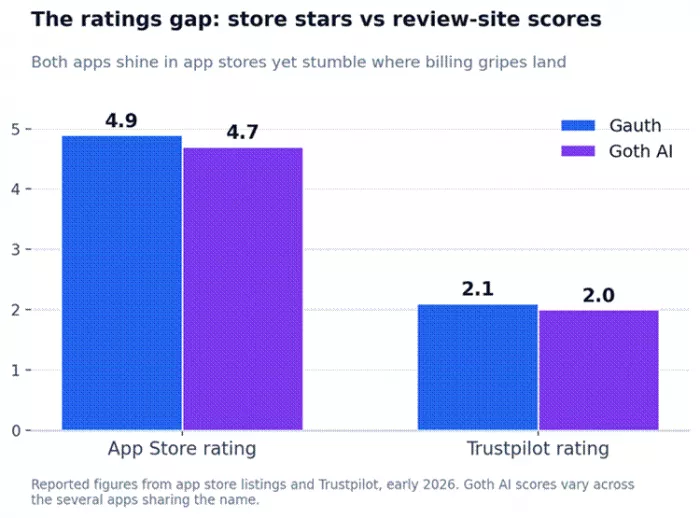
App store stars and review-site scores diverge sharply for both apps.
The gap is striking. Both apps earn warm scores on the mobile app stores, where ratings often capture a first, frictionless impression, yet both fall hard on Trustpilot, where people tend to write only after a billing dispute or a wrong answer. Gauth sits near 4.9 on the App Store but around 2.1 on Trustpilot, and the reported Goth AI figures follow the same shape. The lesson is not that the apps are secretly terrible, but that a glossy store average should never be the only data point before subscribing.
Where the Market Is Heading
This rivalry is playing out against a backdrop of explosive demand. AI has moved from novelty to study-desk staple at a speed few technologies ever match. The clearest signal comes from the Pew Research Center, which found that the share of U.S. teenagers using ChatGPT for schoolwork doubled in a single year.
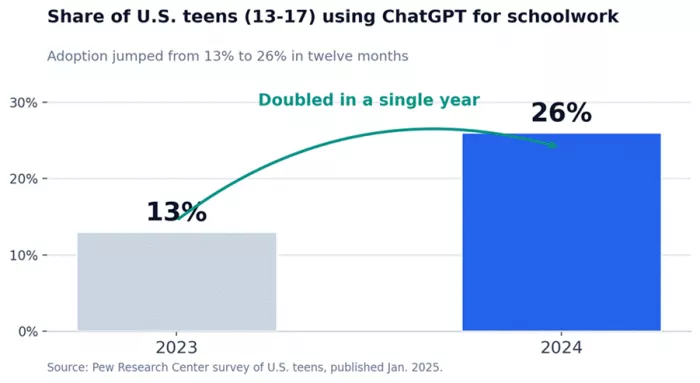
Teen adoption of AI for schoolwork doubled between 2023 and 2024.
Behind that headline are details that explain why apps like Gauth and Goth AI keep multiplying.
13% to 26% U.S. teens using ChatGPT for schoolwork, 2023 to 2024 | 31% vs 20% Use among 11th and 12th graders vs the youngest students | Over 50% Teens using chatbots for schoolwork, 2026 Pew study |
Adoption skews toward older students facing high-stakes exams, the very group most willing to pay for a tool that explains its work rather than only printing an answer. Demand on this scale is exactly why a successful app spawns imitators, and exactly why knowing which name is on the screen matters.
Who Should Choose Which
The right answer depends on the student rather than the marketing. A quick guide:
• Pick Gauth for serious, multi-subject study, especially in STEM, where step-by-step depth, a live tutor fallback, and a huge practice library justify the higher price.
• Consider a Goth AI app only for occasional, low-stakes scans on a tight budget, and only after confirming the exact developer and reading the most recent reviews.
• Look elsewhere for niche needs: Photomath or Symbolab for pure math precision, Wolfram Alpha for advanced calculus and engineering, and a human tutor for proof-heavy or deeply conceptual work.
Whatever the pick, the healthiest way to use any of these tools is the same. Treating a solver as a way to check reasoning and learn the steps builds real skill, while copying final answers quietly erodes it. Pew’s own data hints at the tension. Among teens who use chatbots for schoolwork, roughly three-quarters say classmates use them to cheat at least sometimes, which is exactly the habit a step-by-step explanation is meant to prevent.
The Verdict
Rating table:
| Category | Gauth | Goth AI |
|---|---|---|
| Accuracy | 4.5 / 5 | 3 / 5 |
| Features & depth | 4.5 / 5 | 2.5 / 5 |
| Pricing & billing | 3 / 5 | 3 / 5 |
| Trust & safety | 4 / 5 | 2 / 5 |
| Support | 4 / 5 | 1.5 / 5 |
| Overall | 4 / 5 | 2.5 / 5 |
Strip away the near-identical names and the contest is not especially close. Gauth is the stronger, safer, and more capable study assistant, and it is the one to install for anyone planning to lean on AI through a full semester. The depth of its explanations, the breadth of subjects, the voice tutor, and the human expert network add up to a genuine learning tool rather than a quick-answer machine. The price does sting, and the trial-to-paid billing deserves a calendar reminder and a healthy dose of caution, but the core product earns its place.
Goth AI is best understood as exactly what it is, a budget-friendly echo of a better app, useful in small doses but undermined by a fragmented identity and uneven results. The five-second convenience is real, yet so is the risk of paying for an answer that turns out to be wrong. When a grade is on the line, that trade rarely makes sense, because a wrong answer delivered quickly is still a wrong answer, and it can cost far more than the dollars it saved.
The honest bottom line, after living with both, is simple. Test the free tiers before spending a cent, read recent reviews rather than the star average, and when the work matters, trust the established name over the look-alike that copied it. Put plainly, the right pick is the one that still makes sense at 11 p.m. with a deadline looming, and that app is the one whose name was there first.
Comments

Ron David
2 months agookay the name thing is actually so shady lol. my sister downloaded what she thought was gauth for her algebra homework and ended up with this random goth ai app that charged her $4 immediately. the icon looks identical and the name is one letter off. that's not a coincidence that's literally designed to confuse people. apple needs to do something but they don't care apparently.
Login To Reply ↪
Ron David
2 months agookay the name thing is actually so shady lol. my sister downloaded what she thought was gauth for her algebra homework and ended up with this random goth ai app that charged her $4 immediately. the icon looks identical and the name is one letter off. that's not a coincidence that's literally designed to confuse people. apple needs to do something but they don't care apparently.
Login To Reply ↪