A few months ago, one line in a song I had played a hundred times refused to make sense, and the itch would not go away. So every time a lyric puzzled me, I ran it through both SongTell and Genius to see which one actually explained it. After weeks of this, a clear pattern emerged. Both chase the same question, what does this song really mean, but they answer in almost opposite ways. One hands over a tidy AI essay. The other opens the door to a crowd arguing in the margins.
The short answer
For a fast, readable meaning on almost any track, SongTell wins on speed. For accuracy, depth, and the real story behind a lyric, Genius remains the reference.
| At a glance | SongTell | Genius |
|---|---|---|
| Best for | A fast, readable meaning in seconds | Accuracy, depth, and the real backstory |
| Core method | One AI-written interpretation | Line-by-line human annotations |
| Catalog | 800,000+ AI interpretations | Millions of songs, near-universal |
| Verification | Not artist-verified (educated reads) | Verified artists annotate their own lyrics |
| Speed and friction | Instant, no login, one clean page | Slower, ad-supported, several notes to read |
| Standout extra | Multilingual meanings and song posters | Verified-artist notes and a huge community |
| Price | Free to browse, credits to generate | Free, ad-supported |
Table 1. The quick contrast between SongTell and Genius.
What SongTell and Genius actually are
SongTell in brief
Built by developer Flavio Livolsi and, despite a common myth, unconnected to OpenAI, SongTell reads a full lyric and returns an essay-style explanation rather than a bare lyric page.
● How it reads: breaks a song into verses, choruses, and bridges before interpreting each part.
● What it returns: a quick summary, a deeper thematic reading, and context sections rather than one vague paragraph.
● Catalog: more than 800,000 AI interpretations, strongest on mainstream music.
● Access: most existing meanings open with no account, while new ones run on credits.
● Extras: meanings in multiple languages, a developer API, printable song posters, and the r/songtell community.
Genius in brief
Genius launched in 2009 as Rap Genius, founded by three friends from Yale, rebranded in 2014, and was acquired by MediaLab in 2021 for $80 million. Its engine is human rather than automated.
● How it reads: tapping a highlighted line reveals a note on the reference, sample, or wordplay.
● Scale: more than 2 million contributors, and the company reports over 100 million monthly visitors.
● Authority: verified artists annotate their own songs, and upvotes push the strongest notes to the top.
● Rewards: contributors earn Genius IQ points for approved notes, and the platform has shaped the wider lyric world, notably a 2019 dispute accusing Google of lifting its transcriptions.
● Reach: full iOS and Android apps with lyric sync that follows a song as it plays.
The core difference: one voice or a whole crowd
The real gap is not about features. It is about who does the explaining: SongTell speaks in a single AI voice that reads like a fast critical essay, while Genius assembles meaning from a crowd, layered with references, samples, and often the songwriter's own words.
Head-to-head on the things that matter
The specifications below show where each platform earns its keep.
| Feature | SongTell | Genius |
|---|---|---|
| Launched and owner | Built by Flavio Livolsi (independent) | Founded 2009; owned by MediaLab since 2021 |
| What it returns | Essay-style read: themes, emotions, metaphors | Tap-to-read notes on individual lines |
| Catalog depth | Strong on mainstream; thin on niche and new | New releases annotated within minutes |
| Source of meaning | A single AI model's best-effort reading | Over 2 million contributors, plus artists |
| Cultural context | Often generalizes; can miss slang and irony | Crowd decodes samples, references, and disses |
| Languages | Meanings offered in multiple languages | Lyrics plus community translations |
| Apps and links | Web and API; Spotify, YouTube, Shazam | iOS and Android apps; streaming lyric sync |
| Pricing | Free browsing; about $0.99 / 10 or $9.99 / 200 | Free, supported by ads |
| Best use | A quick first read or a foreign-language track | Confirming a reference or an artist's words |
Table 2. A closer feature-by-feature comparison.
● Coverage: Genius annotates major releases within minutes, and HUNTR/X's Golden, the most-searched song on Genius in 2025, was covered almost immediately, while SongTell can miss very new or obscure tracks.
● Verification: a verified-artist note on Genius is about as close to truth as a lyric explanation gets, whereas SongTell offers thoughtful guesses with no official stamp.
● Friction: SongTell delivers one clean page, while Genius asks readers to sift through ads and several notes to assemble the full picture.
● Global reach: SongTell markets meanings in many languages from one interface, while Genius leans on community translations that favor depth over sheer breadth.
Accuracy and trust: the real dividing line
Speed is easy to feel, but trust is what separates a fun tool from a dependable one. SongTell is upfront that its readings are AI-generated and not artist-approved, strong on the emotional read but weaker on dense references, slang, and irony.
| Reading the meaning | SongTell | Genius |
|---|---|---|
| Emotional core | Strong; catches the mood fast | Strong, with sourced context |
| Central theme | Reliable on clear lyrics | Reliable, plus cited detail |
| Slang and references | Can generalize or miss them | Crowd decodes the specifics |
| Sarcasm and irony | Sometimes read literally | Human context catches the joke |
| Confirmed fact | No artist verification | Verified-artist notes and sources |
Table 3. Where each tool is strong when reading a lyric's meaning.
So anyone using a lyric for schoolwork, journalism, or a serious argument is safer leaning on Genius, with SongTell as the tool that frames the question.
A hands-on scorecard
Scoring both across the dimensions that matter turns the trade-offs into something easier to see.
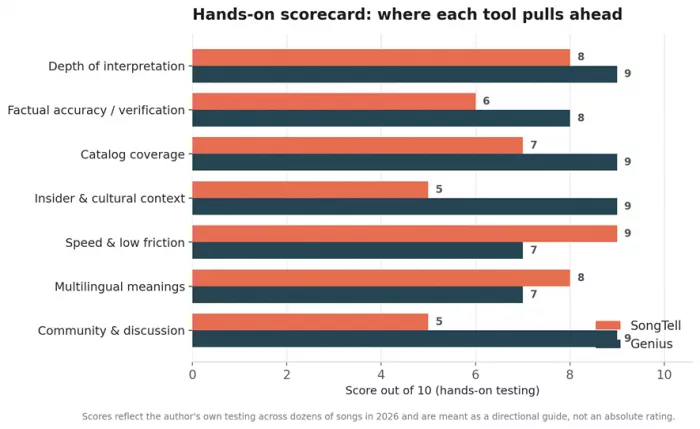
Figure 1. A hands-on scorecard across the dimensions that matter most.
Genius pulls ahead on depth, factual accuracy, coverage, insider context, and community, the payoff of a two-million-strong contributor base. SongTell leads on raw speed and multilingual meanings, though these scores reflect hands-on judgment rather than a lab test.
What the numbers say about each
Popularity is not the same as quality, but with these two tools the audience gap is revealing.
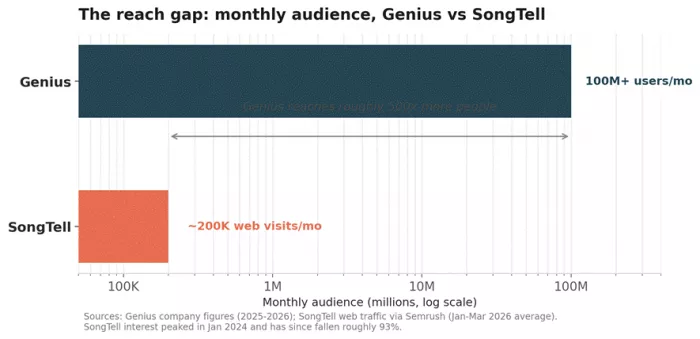
Figure 2. Monthly audience, Genius versus SongTell. Sources: Genius company figures; SongTell traffic via Semrush, early 2026.
Set against the wider field of lyric sites, the scale gap is even clearer.
| Lyric platform | Monthly audience | Source |
|---|---|---|
| Genius | Over 100 million | Genius company figures |
| letras.com | About 44.9 million | Similarweb, Dec 2024 |
| Last.fm | About 33.6 million | Similarweb, Dec 2024 |
| Musixmatch | About 11.1 million | Similarweb, Dec 2024 |
| AZLyrics | About 10 million | Similarweb, Dec 2024 |
| SongTell | About 181,000 to 244,000 | Semrush, early 2026 |
Table 4. Monthly audience across popular lyric platforms.
After a novelty spike that peaked around January 2024, SongTell's traffic has fallen roughly 93 percent, and its sessions average under four minutes with a high single-page share, the mark of a quick, one-and-done lookup. None of that means SongTell failed, since a steady niche audience is still an audience. It does show that the depth of Genius is a direct byproduct of its scale.
What real users say
User sentiment lines up closely with the hands-on experience.
| Reviews | SongTell | Genius |
|---|---|---|
| Rating | About 4.0 / 5 independently; 4.8 self-reported | About 4.7 / 5 across tens of thousands of ratings |
| What fans love | Instant, structured reads; multilingual | Depth, verified-artist input, unmatched scale |
| Common gripes | No verification; generic on niche context | Ads interrupt playback; crashes; moderation |
| Community size | Small (r/songtell); aggregator coverage | Over two million contributors |
Table 5. How each platform is received by its own users.
Independent coverage puts SongTell near 4.0 out of 5, with fans citing the instant, multilingual reads and critics flagging the missing verification, while its 4.8 Trustpilot figure is self-reported. Genius sits near 4.7 across tens of thousands of app ratings, and its gripes are practical rather than fundamental: ads, occasional crashes, and heavy-handed moderation.
Pricing and who each one is for
Neither tool needs a subscription. Genius is free and ad-supported, while SongTell is free to browse and charges credits only to generate a fresh interpretation, roughly $0.99 for 10 or $9.99 for 200.
| The goal | Best pick | Why |
|---|---|---|
| A quick vibe check | SongTell | Instant, structured read in seconds |
| Accuracy and cited sources | Genius | Verified notes and the real backstory |
| A meaning in another language | SongTell | Multilingual from one interface |
| A specific sample or reference | Genius | The crowd decodes the specifics |
| The artist's own explanation | Genius | Verified-artist annotations |
| The best of both | Both | Skim SongTell, then confirm on Genius |
Table 6. A quick guide to which tool fits which goal.
My verdict
After all those late-night lookups, the tool that stays open on my screen is Genius. When a lyric genuinely matters to me, I want the confirmed reference and the artist's own note, not a confident guess, and Genius delivers that far more often than not. Even so, SongTell earned a permanent spot in the rotation. When I only need the gist of a song before a long drive, or the meaning of a track in a language I do not speak, its instant, tidy read is hard to argue with. So the honest verdict is not a clean win for either. SongTell tells me what a song feels like in about ten seconds. Genius tells me what it means, and usually proves it. I reach for the first, and I trust the second.
Comments