The most instructive event in AI video this year was not a launch. It was a funeral. In March, OpenAI announced that Sora, the app that put text-to-video on magazine covers in 2025, would be shut down. The consumer app went dark on April 26, with the developer API set to follow in September. Reporting from The Wall Street Journal pinned the cause on brutal economics: a product reportedly burning millions of dollars a day while its user base slid from a launch peak of roughly a million to under half that.
That collapse is the backdrop every shortlist now has to reckon with. A model that dazzles in a demo is worthless if the company behind it cannot afford to keep the lights on. So the seven tools below were judged on three things at once: how good the footage looks, how honestly each one is priced once credits enter the picture, and whether the platform is stable enough to build a workflow on.
Quick picks
The short answer, for anyone who needs one before reading further:
| If the priority is | Reach for |
|---|---|
| Maximum realism | Kling AI 3.0 |
| Audio baked into the clip | Google Veo 3.1 |
| Editing and shot control | Runway Gen-4.5 |
| Lowest cost to start | Kling AI at $6.99 or Pika at $8 |
| A talking-head marketing video | HeyGen |
| Training at enterprise scale | Synthesia |
| Playful, stylized social clips | Pika or PixVerse |
Everything below is the evidence behind these calls: the test, the spec sheets, and the prices that decide them.
How these tools were tested
Every platform was run through the same drill, called the Three-Take Test. Each one received three identical prompts chosen to expose different weaknesses: a two-person dialogue scene with synced speech, a physics-heavy action shot of a glass shattering in slow motion, and a thirty-second brand explainer. Each prompt was generated three times, and the best of the three takes was scored. Nothing was salvaged from a tenth attempt.
Scoring weighted five signals: motion realism, prompt adherence, output fidelity at each platform's top resolution, native audio quality, and cost per usable clip after retries. Pricing and model versions were verified against each vendor's published plans in May 2026, and benchmark context such as the independent ELO rankings was cross-checked across multiple sources rather than any single review.
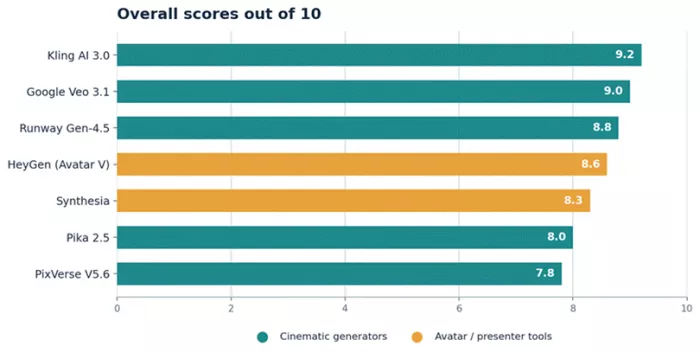
Overall Three-Take Test scores. Cinematic generators in teal, avatar tools in amber.
The shortlist at a glance
Two jobs dominate practical use in 2026. Cinematic generators turn a prompt or a still image into short footage. Avatar tools turn a script into a presenter speaking to camera, a different task with different buyers. The summary below is for fast scanning; each tool then gets a full spec sheet in the sections that follow.
| Tool | Best for | Starts at | Top model | Score |
|---|---|---|---|---|
| Kling AI | Photoreal motion and longer clips | $6.99 / mo | Kling 3.0 | 9.2 |
| Google Veo | Clips with built-in synced audio | $7.99 / mo | Veo 3.1 | 9.0 |
| Runway | Hands-on editing and shot control | $12 / mo | Gen-4.5 | 8.8 |
| HeyGen | Marketing and training avatars | $29 / mo | Avatar V | 8.6 |
| Synthesia | Enterprise learning content | $29 / mo | Express-2 | 8.3 |
| Pika | Fast, playful social clips | $8 / mo | Pika 2.5 | 8.0 |
| PixVerse | Stylized and viral-effect video | $10 / mo | V5.6 | 7.8 |
Entry pricing reflects the cheapest paid tier. Most platforms run on credits that deplete faster at higher resolution and longer duration.
Cinematic generators
Kling AI 3.0
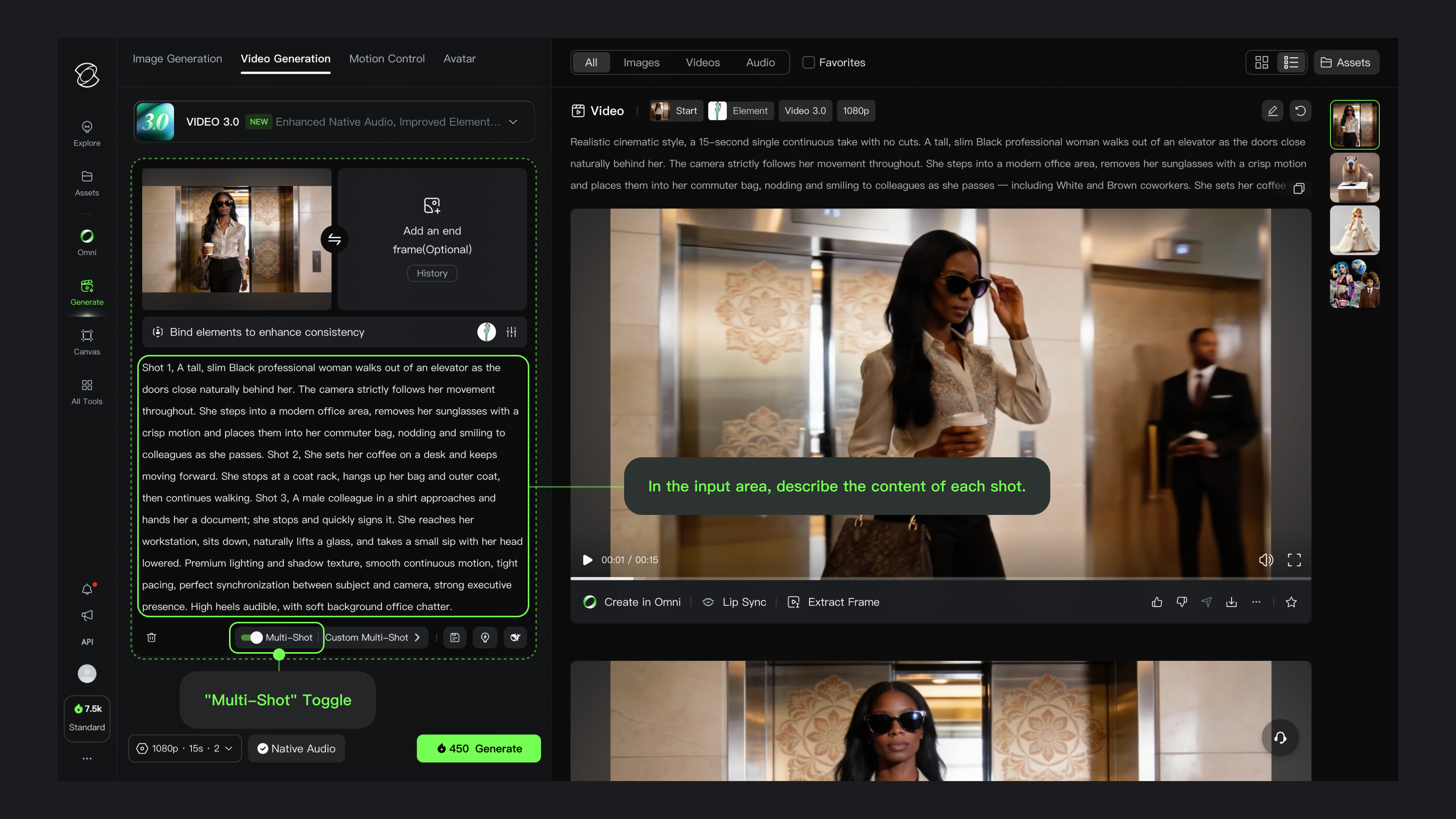
Built by the Chinese short-video giant Kuaishou, Kling spent 2025 quietly becoming the model serious creators reach for first, then made it official with Kling 3.0 in February. Independent ELO rankings place it at the top of the field on the strength of physics-accurate motion: where older models turned a sprinting figure into a smear of limbs, Kling keeps weight, balance, and inertia intact. Its weakness is service, not output. Support is slow and peak-hour queues drag. The top subscription tier has quietly climbed in price more than once.
| At a glance | Kling AI 3.0 |
|---|---|
| Maker and model | Kuaishou. Kling 3.0, released February 5, 2026, on the Omni One architecture |
| Benchmark rank | Number one by independent ELO score (about 1243), ahead of Veo 3.1, Runway, and Pika |
| Paid plans | Standard $6.99, Pro $25.99, Premier $64.99, Ultra near $180 per month; annual billing cuts 20 to 34 percent |
| Credit cost | Professional mode burns roughly 7 credits per second of video, and native audio nearly doubles that draw |
| Clip length | About 10 seconds per generation, extendable toward 3 minutes by chaining |
| Resolution and audio | Up to 4K, with native synchronized audio from version 2.6 onward |
| Free tier | 66 credits daily, watermarked 720p, personal use only |
| Scale | More than 60 million creators and 600 million videos generated to date |
Strengths Realism leads the field, and the free tier is genuinely usable. Commercial rights apply on every paid plan from $6.99.
Watch-outs Thin support, long queues at peak times, and a credit system prone to creeping price rises.
Google Veo 3.1
Veo's signature trick is sound. Where most generators hand back a silent clip that still needs scoring, Veo 3.1 produces synchronized dialogue, plus ambient noise and effects, in one pass. That removes an entire step from most workflows. The footage is clean and reliably cinematic. The catch is the cage: Veo has no standalone app and lives only inside Google's products, and clips stop at eight seconds, so anything longer means stitching shorter renders together.
| At a glance | Google Veo 3.1 |
|---|---|
| Maker and model | Google DeepMind. Veo 3.1, with a budget Veo 3.1 Lite tier added March 31, 2026 |
| Where it lives | No standalone app. Reached through the Gemini app, the Flow studio, and the Vertex API |
| Subscription plans | Google AI Plus $7.99 (Fast tier only), Pro $19.99 (1,000 credits, about 10 top-quality clips), Ultra $249.99 per month |
| API cost | Roughly $0.05 per second on Lite, rising to about $0.40 to $0.50 per second at top quality |
| Clip length | 8 seconds per generation; longer sequences require stitching |
| Resolution and audio | 720p and 1080p, 4K via API, with native synchronized dialogue and effects |
| Free tier | Limited Veo 3 access through the free Gemini plan |
| Perk | College students in eligible regions get the Pro tier free for one year |
Strengths Native synced audio competitors charge extra to fake, strong prompt adherence, and a $7.99 way in.
Watch-outs No standalone app, an eight-second ceiling, and top-quality credit allowances that vanish fast.
Runway Gen-4.5
Runway treats generation as one step in a pipeline rather than the whole show. Founded in New York in 2018 and valued near $5.3 billion after a February round, it has the balance sheet to outlast leaner rivals. Around the Gen-4.5 model sit the Aleph in-video editor and Act-Two motion capture. A built-in marketplace now pipes Veo, Kling, and Seedance into the same dashboard. The reference-image character consistency is a real draw for narrative work. The friction is the credit math.
| At a glance | Runway Gen-4.5 |
|---|---|
| Maker and standing | Founded New York, 2018. Valued near $5.3 billion after a February 2026 round |
| Paid plans | Basic $12, Standard $28 (625 credits), Pro $76 (2,250 credits), Unlimited $188 per month, plus Enterprise |
| Credit cost | Gen-4.5 video runs about 25 credits per second; 625 credits buys roughly 25 seconds of Gen-4.5 or 52 of Gen-4 |
| Models on tap | Gen-4.5 flagship, plus in-app Veo 3.1, Kling 3.0, and Seedance from one subscription |
| Signature tools | Aleph in-video editor, Act-Two motion capture, Motion Brush, reference-image character consistency |
| Clip length | 10-second generations, extendable, with up to 4K output and ProRes 4444 alpha export |
| Free tier | 125 one-time credits that never expire and never renew |
| Best suited to | Creators who want to direct shots, not just prompt them |
Strengths The deepest editing suite in the category, multi-model access on one plan, and compositing-ready exports.
Watch-outs A credit system complex enough to need a spreadsheet, and steep cost once 1080p renders pile up.
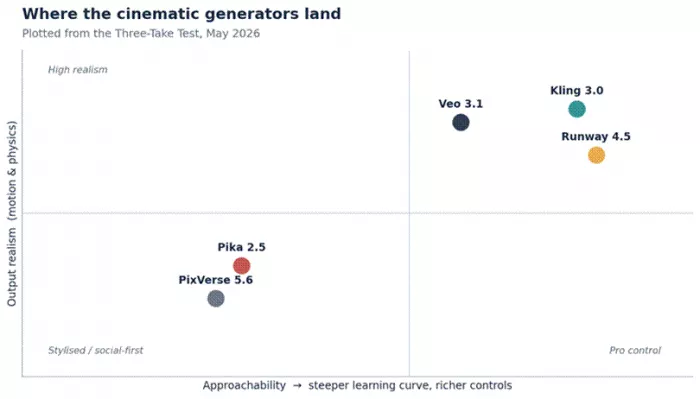
Positioning of the cinematic tools on realism against approachability, plotted from the Three-Take Test.
Pika 2.5

Pika, founded by two Stanford researchers and born as a Discord bot in 2023, never pretended to chase Hollywood. Its appeal is speed and play. The Pikaffects toolkit, which can melt, inflate, or explode a subject on command, fuels social clips no realism-first model would attempt, and most generations finish in under ninety seconds. The trade is fidelity: push Pika toward photoreal humans and the seams start to show.
| At a glance | Pika 2.5 |
|---|---|
| Maker | Founded by Stanford researchers Demi Guo and Chenlin Meng; launched as a Discord bot in 2023 |
| Paid plans | Standard $8 (700 credits), Pro $28 (2,300 credits), and a top tier at 6,000 credits per month, billed yearly |
| Credit cost | Around 80 credits for a single 10-second clip at 1080p |
| Signature features | Pikaffects, Pikascenes, and Pikaframes for effect-driven and scene-composed clips |
| Speed | Most generations complete in under 90 seconds |
| Clip length and resolution | Up to 10 seconds; 1080p on paid tiers |
| Free tier | 80 monthly credits at 480p, watermarked, no commercial use |
| Best suited to | Fast, playful, effect-led social video |
Strengths Fast, genuinely fun, cheap at $8 a month, and stocked with creative effects rivals do not offer.
Watch-outs Photorealism lags the leaders, and complex multi-element scenes drift out of coherence.
PixVerse V5.6
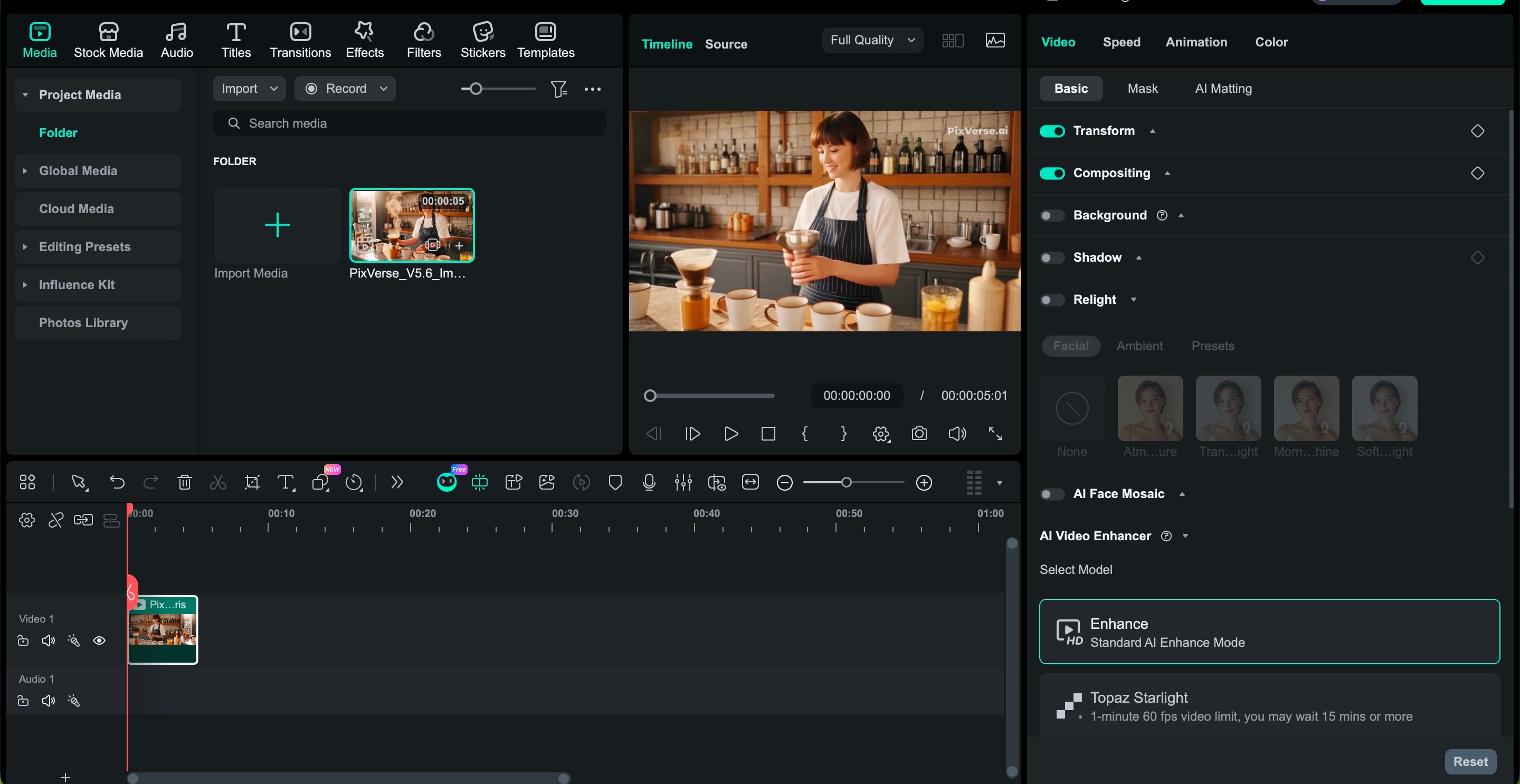
PixVerse, from Aishi Technology, serves a global audience across 177 countries with a focus on stylized output and viral templates. The V5.6 model added start-and-end frame control, letting creators pin both bookends of a shot and let the model fill the motion between. It is strongest with anime, 3D, and comic styles, where small motion errors hide inside the aesthetic. Realism is the soft spot, and the platform is candid that usable clips usually take a few attempts.
| At a glance | PixVerse V5.6 |
|---|---|
| Maker and model | Aishi Technology. V5.6 released January 2026 |
| Reach | Serves creators across more than 177 countries |
| Paid plans | Standard near $10 per month, scaling to higher creator and team tiers |
| Frame control | Pin a start and end frame, with up to 7 chained keyframes per clip |
| Clip length and resolution | 5 to 15 seconds, from 360p up to native 4K |
| Audio and styles | Native music, effects, and dialogue, with anime, 3D, clay, comic, and cyberpunk styles |
| Iteration reality | Expect 2 to 5 generations per usable clip; output is far from deterministic |
| Free tier | 90 sign-up credits plus 60 daily, watermarked at low resolution |
Strengths Excellent for stylized and social content, flexible keyframe control, and an accessible $10 entry.
Watch-outs Cinematic realism trails Kling, and retries push the real cost well above the sticker price.
Avatar and presenter tools
Generating a dragon over a city is a different problem from generating a person reading a quarterly update. The avatar category solves the second one, turning a typed script into a polished presenter. Two names own the space, and they look similar on the surface while diverging sharply on price model and buyer.
HeyGen
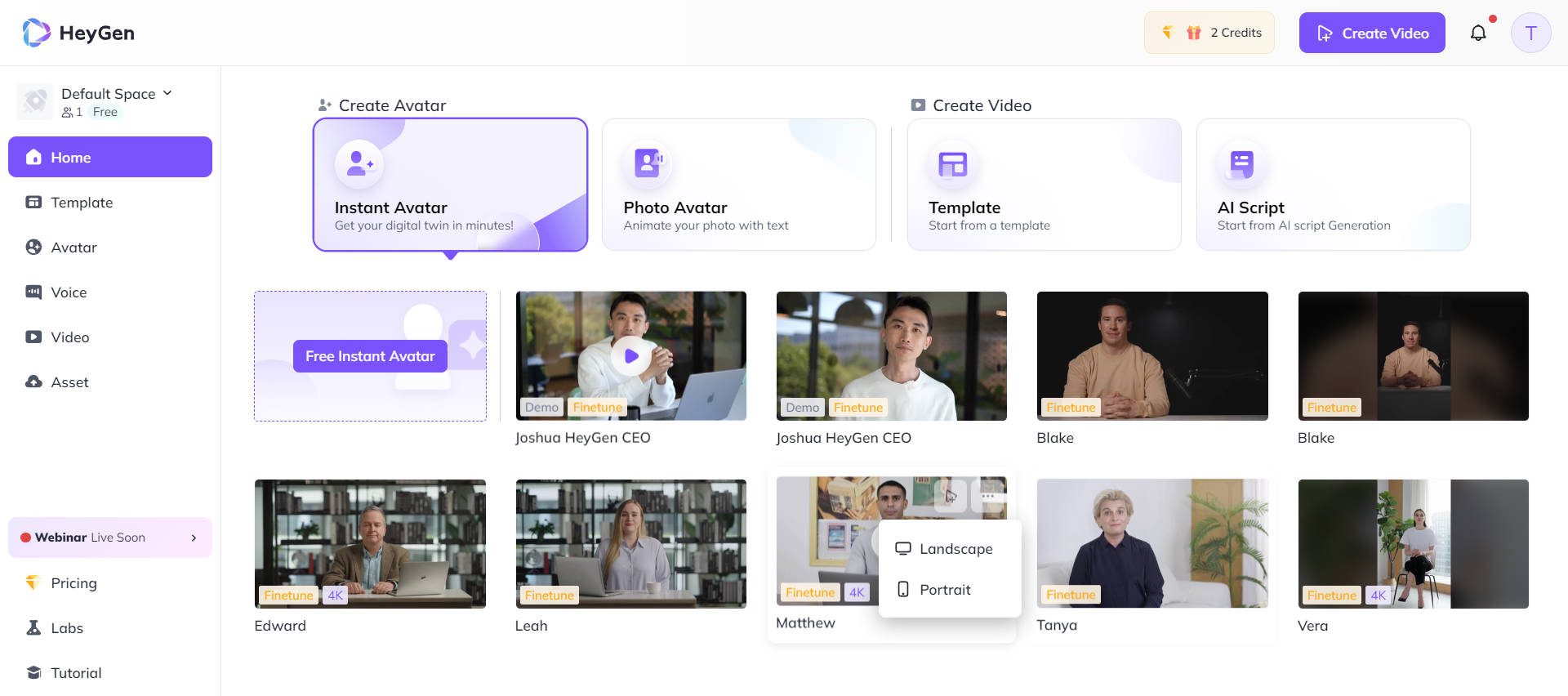
HeyGen aims at creators and marketing teams who need a talking-head video finished by lunch. Its Avatar V model posts the highest face-similarity score benchmarked in the category, and lip-sync holds across 175 languages. The asterisk lives in the premium credit pool: the entry plan advertises unlimited standard videos, but advanced features like Avatar IV burn through a capped monthly credit allowance that does not roll over.
| At a glance | HeyGen |
|---|---|
| Flagship model | Avatar V, the highest face-similarity score benchmarked in the category at 0.840 |
| Paid plans | Creator $29 ($24 annual), Pro $99, Business $149 plus $20 per seat, and custom Enterprise |
| Premium credits | Avatar IV and V cost 20 credits per minute; the Creator plan's 200 credits cover about 10 minutes of premium output |
| Languages | More than 175, with separate speed and precision translation modes |
| Resolution | Up to 1080p on Creator, 4K on Business |
| Add-ons | Extra credit packs at $15 for 300; native links to Zapier, HubSpot, and Make |
| Free tier | Three watermarked 720p videos per month |
| Best suited to | Marketing clips and training videos produced straight from a script |
Strengths Top-rated avatar realism and the widest language support, with production fast enough to ship from a plain script.
Watch-outs A two-tier credit model that makes unlimited feel conditional, and allowances that do not carry over.
Synthesia
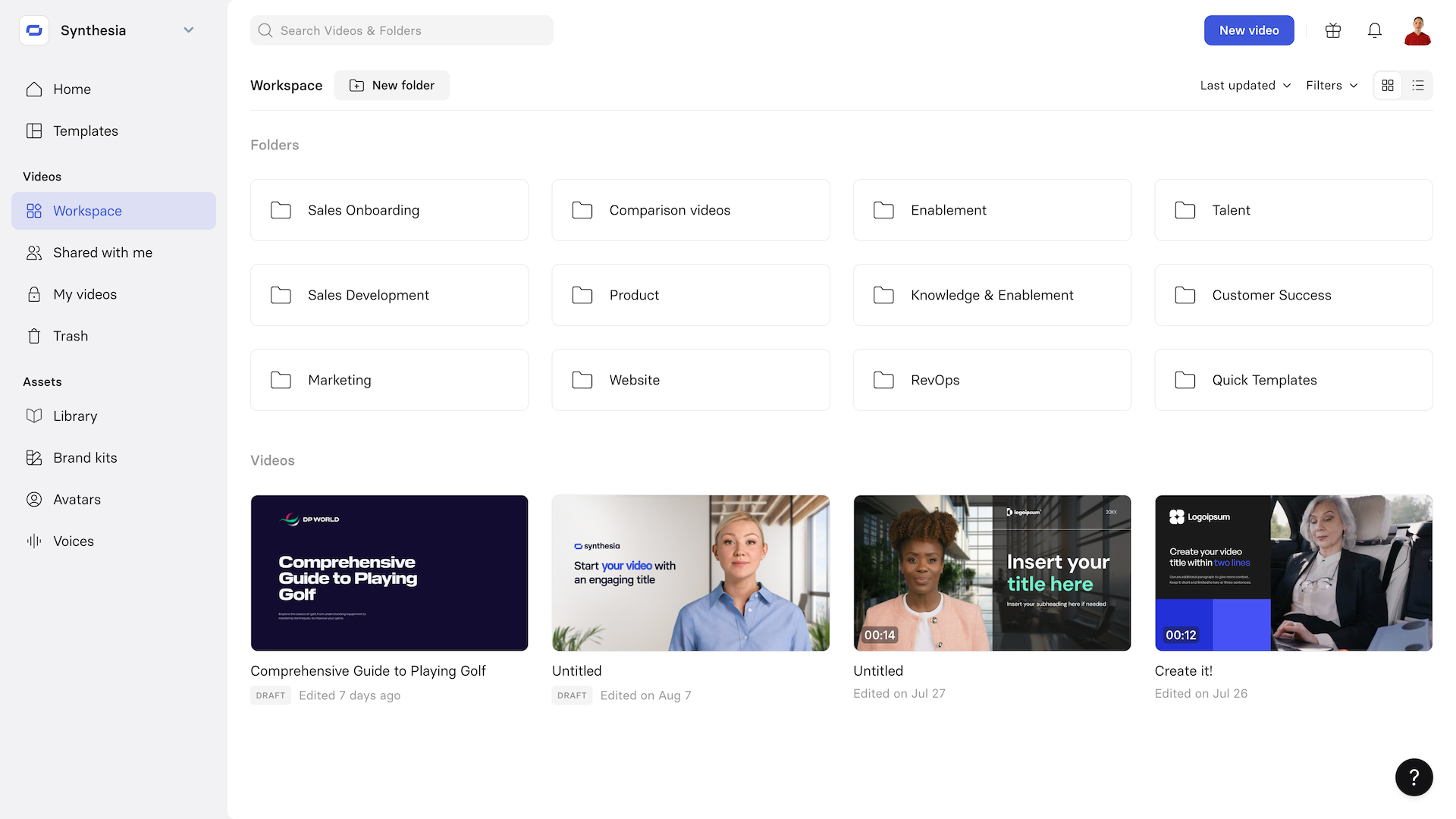
Synthesia points the same technology at the enterprise. Used by more than nine in ten of the Fortune 100 and over fifty thousand teams, it is built for training, onboarding, and internal communication at scale, with governance features procurement departments ask about. Its Express-2 engine renders full-body avatars that gesture like real presenters. The model is minutes, not credits, and the genuinely broadcast-grade custom avatars sit behind a separate annual add-on.
| At a glance | Synthesia |
|---|---|
| Flagship engine | Express-2, rendering full-body gesturing avatars at 1080p and 30fps with no length cap |
| Standing | Used by more than 90 percent of the Fortune 100 and 50,000-plus teams; valued near $4 billion |
| Paid plans | Starter $29 (about $18 to $22 annual), Creator $89 (about $64 annual), and custom Enterprise |
| Metering | One credit equals one minute of video; the Creator plan allows 30 minutes per month |
| Avatars and languages | More than 230 stock avatars and 140-plus languages, with frame-accurate dubbing on existing footage |
| Add-ons | Custom studio avatars cost about $1,000 per year; SCORM export is gated to higher tiers |
| Free tier | 10 minutes per month across 9 avatars, watermarked |
| Best suited to | Enterprise training, onboarding, and multilingual internal communication |
Strengths Enterprise-grade polish, deep language coverage, and predictable script-to-video output for learning teams.
Watch-outs Tight monthly minute allowances, and essentials like SCORM export reserved for the priciest tiers.
The pricing trap nobody mentions
A headline monthly price is the least reliable number on any of these pages. Almost every cinematic tool runs on credits that drain at wildly different rates depending on model, resolution, and clip length. A single ten-second clip at 1080p can swallow a meaningful slice of a month's allowance, and because output is rarely right the first time, the real cost is multiplied by every retry. The usage-based math sharpens the point: through developer APIs, Veo 3.1 ranges from roughly five cents a second up to half a dollar a second at top quality, while Kling sits near eight to fourteen cents. The honest way to compare these tools is cost per finished, approved clip, not cost per month, and on that measure the cheapest plan is frequently the most expensive choice.
The verdict
Kling 3.0 is the one to beat, and most realism-focused work can begin there. The other six earn their place by doing a single thing better. The bottom line on each:
| Tool | Score | Final word |
|---|---|---|
| Kling AI 3.0 | 9.2 | Category-best realism at $6.99. The default pick for most creators. |
| Google Veo 3.1 | 9.0 | The choice when synced audio has to come baked into the clip. |
| Runway Gen-4.5 | 8.8 | The deepest control suite, for directing full sequences. |
| HeyGen | 8.6 | Fastest route to a marketing talking-head from a script. |
| Synthesia | 8.3 | Enterprise training and onboarding that satisfies compliance. |
| Pika 2.5 | 8.0 | Cheap and fast for playful, stylized social clips. |
| PixVerse V5.6 | 7.8 | Stylized, effect-led video over photoreal realism. |
One caveat outlasts the rankings: judge cost per finished clip, not the monthly sticker, because credits drain on every retry.
Comments