Table of Contents
- Leonardo AI in 2026
- What the Free Plan Includes
- How Far Do 150 Tokens Go?
- Where the Free Plan Starts to Hurt
- How Good Are Leonardo's Images?
- Editing Adds More Value Than More Prompts
- Character Consistency Is Better, Not Perfect
- Leonardo AI Pricing in 2026
- What Paying Actually Unlocks
- Free vs Paid: What Really Changes?
- Ownership and Commercial Use
- Who Can Stay on Free?
- Who Should Pay for Essential?
- When Premium Makes Sense
- Do Most People Need Ultimate?
- Before Paying, Check the Alternatives
- Verdict: Is Leonardo AI Worth Paying For?
Leonardo AI gives free users 150 Fast Tokens every day, which already makes its free tier more useful than the short trials offered by many AI image generators. But token count alone does not tell you whether the free plan is enough.
The more useful question is what happens when you move beyond occasional experiments and start producing finished images. Public generations, daily token resets, limited advanced controls, and the lack of personal model training eventually matter more than the headline allowance. For some users, that point comes quickly. Others may use Leonardo for months without needing to pay.
Leonardo AI in 2026
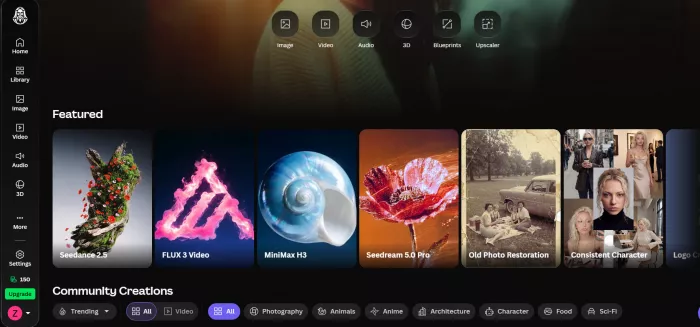
Leonardo has developed into a broader visual creation platform rather than a basic prompt-to-image generator. Alongside image generation, it now includes image guidance, editing, Realtime Canvas, upscaling, personal model training, video generation, presets, and tools for maintaining greater control over visual direction.
It also gives users access to Leonardo's own models alongside supported third-party models. Current plans include platform models and third-party model access even at the free level, although individual models and more demanding workflows can consume tokens at very different rates.
This wider toolkit is important when judging the paid plans. The subscription is not simply buying more images. It increasingly pays for privacy, higher production capacity, stronger control, consistency tools, and a less restrictive workflow.
What the Free Plan Includes
Leonardo's Free plan currently provides 150 Fast Tokens per day, with a token bank capped at 150. The balance refreshes daily rather than accumulating over time. Free accounts also have access to image and video generation, presets, Flow State, platform and third-party models, plus limited versions of Image Guidance, Realtime Canvas, Realtime Generation, Blueprints, Elements, and Ultra Quality.
For someone producing occasional blog images, illustrations, social graphics, concept art, or experimental visuals, this is enough functionality to use Leonardo as an ongoing creative tool rather than a temporary demo.
There are two important compromises. Free generations are public by default, and free users cannot train personal AI models. Leonardo says publicly generated content may be viewed by other users, appear in search results, and potentially be indexed by search engines.
How Far Do 150 Tokens Go?
Leonardo's token system needs some context because 150 tokens do not mean 150 images. Tokens are deducted according to the action being performed, including image generation, video generation, upscaling, background removal, and other processing tasks. More demanding operations naturally consume more.
If someone used the full allowance every day for 30 days, the free tier would theoretically provide around 4,500 tokens of monthly capacity. That is a substantial amount for a free service, particularly when compared with the 8,500 monthly Fast Tokens in Essential.
The difference is flexibility. Free tokens cannot be saved for later. If you only use 30 tokens today, the rest do not build into a larger balance for next week. Essential, by comparison, provides an 8,500-token monthly allowance and a rollover bank capable of holding up to 25,500 tokens.
Clearer prompts can stretch a limited token allowance further as well. Better AI image prompts often mean fewer throwaway generations before reaching a usable result.
What That Means for Real Work
For light image creation, 150 daily tokens can go surprisingly far. The limitations appear faster when the work requires repeated experimentation.
● Blog and editorial graphics fit the free plan well when you need one or two finished images and already have a clear idea of the composition or style you want.
● Marketing visuals require more iteration because small changes to lighting, framing, subjects, backgrounds, and positioning can mean generating several versions before getting a usable asset.
● Recurring characters and branded visuals are harder on a limited allowance because consistency usually requires references, repeated generations, and more deliberate refinement.
● Video consumes the allowance faster than ordinary still-image work, making the free tier much less comfortable if motion becomes a regular part of the workflow.
This means two users can have completely different experiences with the same 150-token allowance. Someone making a handful of straightforward images may rarely reach the limit, while a designer exploring several visual directions can burn through it during one working session.
Where the Free Plan Starts to Hurt
Token exhaustion is the obvious restriction, but it is not necessarily the most important one. Once Leonardo is being used for professional work, privacy, consistency, and workflow flexibility can become stronger reasons to upgrade.
1. Public Generations
Free-account creations are public by default. Leonardo says they can be viewed by other users, surface in search results, and be indexed by search engines.
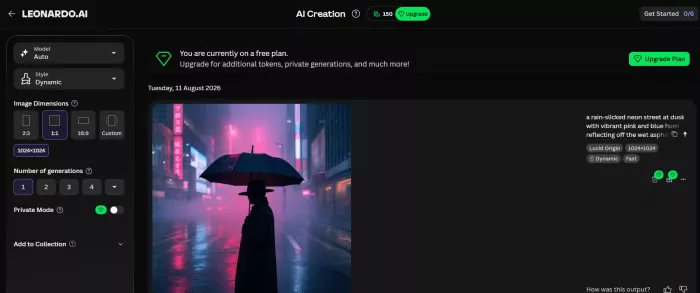
That is reasonable for personal artwork or publicly intended blog graphics. It is much harder to accept when working with unreleased campaigns, product concepts, client material, proprietary design ideas, or anything that should remain confidential during development.
2. Daily Tokens Cannot Be Banked
The free plan works best for steady, light usage. It is less convenient for bursty workloads. A creator who needs a few visuals every day may never feel heavily restricted. A designer producing an entire campaign on Monday cannot combine the unused allowances from the previous week to support that session.
Paid plans solve this with larger monthly pools and rollover banks, which makes production easier to schedule around actual workloads rather than Leonardo's daily reset.
3. Advanced Controls Are Limited
Free users receive limited access to tools such as Image Guidance, Realtime Canvas, Realtime Generation, Elements, Blueprints, and Ultra Quality. Essential expands these capabilities, provides enhanced quality settings, and supports up to six Image Guidance references in compatible workflows.
These differences matter once prompting alone stops being sufficient. The more specific the visual requirement becomes, the more useful references and editing controls become.
4. No Personal Model Training
Personal AI model training is unavailable on Free. Essential currently includes up to 10 personal model trainings per month, Premium 20, and Ultimate 50.
For unrelated one-off images, this may not matter. For recurring characters, branded aesthetics, product styles, or other repeatable visual systems, it can become one of the stronger reasons to move beyond the free plan.
How Good Are Leonardo's Images?
Leonardo's strongest quality is its range. It is capable of producing photorealistic images, illustrations, fantasy artwork, concept pieces, editorial visuals, product scenes, and stylized graphics without locking the user into one model or aesthetic.
That flexibility is useful, although it also means model selection matters. The model and guidance settings that work well for an illustrated character may not be the best choice for a realistic product shot.
1. Photorealism
Leonardo can produce convincing portraits, environments, lifestyle scenes, and product-style visuals, particularly when prompts clearly define lighting, camera perspective, materials, and composition.
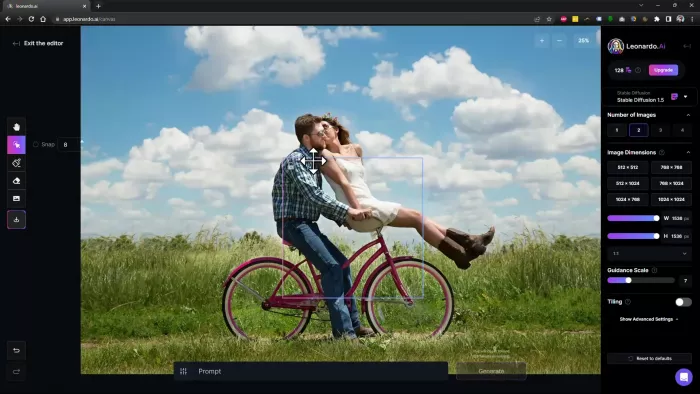
The harder part is maintaining precision across repeated generations. A realistic image can look excellent overall while still changing small product details, facial features, packaging geometry, or background elements. For marketing use, those inconsistencies matter more than whether the first image looks impressive.
2. Illustration and Concept Art
Illustration remains one of Leonardo's stronger areas. Character concepts, fantasy scenes, editorial artwork, environments, and game-inspired visuals benefit from the platform's combination of presets, models, references, and editing options.
The advantage is that you do not have to treat every generation as final. An existing image can become the starting point for further variations, references, or editing instead of sending you back to a blank prompt.
3. Product and Marketing Images
Leonardo can create polished concept visuals, campaign backgrounds, lifestyle imagery, and mockups, but exact brand representation still requires checking.
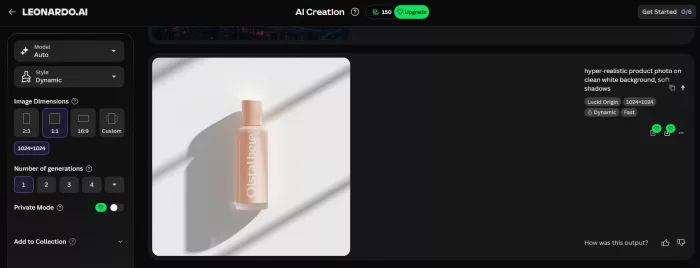
Logos, packaging text, small typography, product proportions, and other brand-specific details can drift between generations. AI can produce a strong creative foundation, but important commercial assets may still need conventional editing afterward.
Editing Adds More Value Than More Prompts
Image generation gets most of the attention, but Leonardo becomes more useful once you stop treating regeneration as the answer to every problem.
Its toolkit includes Image Guidance, Realtime Canvas, image-to-image workflows, reference controls, editing, and upscaling. These features can help preserve a good composition while changing a weaker part instead of repeatedly generating the entire image again.
That matters because a near-perfect image is often more valuable than another batch of completely new options. If the subject, lighting, and framing are correct but one object is wrong, targeted editing is usually a better workflow than hoping generation number twelve fixes the object without breaking everything else.
Leonardo also offers dedicated upscaling tools for improving final output when additional detail or resolution is required.
Character Consistency Is Better, Not Perfect
Character consistency is another area where Leonardo's wider workflow helps. Its Image Guidance system supports references that can influence character appearance, style, and composition, with adjustable strength depending on how closely the generation should follow the source material.
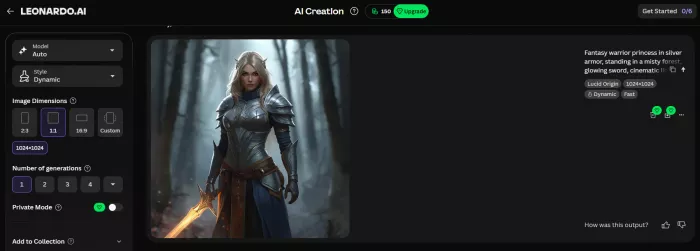
Leonardo itself makes clear that Character Reference is not equivalent to face swapping and does not guarantee an exact replica. This is an important limitation for anyone planning a comic, story series, advertising character, or other project that requires the same person across many scenes.
Paid access provides a better toolkit for handling the problem through expanded reference capabilities and personal model training. It does not eliminate visual drift, but it gives creators more control than repeatedly describing the same character through text prompts.
Leonardo AI Pricing in 2026
Leonardo currently offers four individual tiers. The prices below reflect monthly billing before applicable taxes.
| Plan | Monthly price | Fast Tokens | Main difference |
| Free | $0 | 150/day | Public creations, basic quality, no personal models |
| Essential | $12 | 8,500/month | Private generations, enhanced quality, 10 personal models |
| Premium | $30 | 25,000/month | Relaxed image generation on selected models, higher capacity |
| Ultimate | $60 | 60,000/month | Highest capacity plus relaxed image and video generation on selected models |
Essential supports a token bank of up to 25,500, Premium 75,000, and Ultimate 180,000. Paid users can also purchase additional top-up tokens when necessary.
For most individual users considering their first subscription, Essential is the plan that matters most. Premium and Ultimate become easier to justify only after generation volume increases substantially.
What Paying Actually Unlocks
The jump from Free to Essential is more meaningful than the difference between 150 daily tokens and 8,500 monthly tokens suggests.
Essential adds private creations, enhanced quality settings, unlimited personal collections, 10 personal model trainings per month, two simultaneous generations, a larger Image Guidance allowance, and access to token top-ups.
For freelancers and businesses, private generation can be more important than extra capacity. It changes whether Leonardo can comfortably be used for confidential concepts and client work.
Premium adds 25,000 Fast Tokens and unlimited relaxed image generation on selected supported models. Relaxed generations run at lower priority and may slow during periods of demand, but they allow eligible models to keep generating without continuing to drain Fast Tokens.
There is an important limitation: relaxed generation covers selected models such as Lucid Origin, Lucid Realism, Phoenix, FLUX Dev, and FLUX Schnell. It should not be interpreted as unlimited access to every third-party model inside Leonardo.
Ultimate extends the same idea to heavier production workloads, adding 60,000 Fast Tokens, greater queue capacity, additional personal model training, and relaxed generation for selected image and video models.
Free vs Paid: What Really Changes?
The difference becomes clearer when the plans are compared by workflow rather than raw feature count.
| Area | Free | Paid | Why it matters |
| Generation capacity | 150 tokens daily | 8,500–60,000 monthly | Better for larger production sessions |
| Token rollover | No | Yes | Useful when workload varies |
| Privacy | Public | Private option | Important for professional work |
| Quality controls | Basic | Enhanced | More useful for finished assets |
| Personal models | None | 10–50 monthly | Helps with recurring styles and characters |
| Image Guidance | Limited | Expanded | More control over reference-driven work |
| Relaxed generation | No | Premium/Ultimate on selected models | Useful for high-volume creation |
| Ownership position | Leonardo owns output as between the parties | Paid subscriber owns output as between the parties | Important for commercial projects |
This is why running out of free tokens should not be the only upgrade trigger. Someone may use fewer than 150 tokens per day and still need Essential because public generation is unsuitable for the work being produced.
Ownership and Commercial Use
Leonardo's ownership terms deserve attention because Free and paid users do not receive the same arrangement.
Under Leonardo's current Terms of Service, free users can use generated images commercially, but as between Leonardo and the user, intellectual-property rights in Free-plan output vest in Leonardo. Free users receive a non-exclusive, royalty-free licence to use their creations, including commercially.
Paid subscribers receive a different position. As between the parties and subject to Leonardo's terms, ownership of content created under a paid subscription vests in the subscriber. Paid users can also keep generations private, and Leonardo states that private content will not be used to train its models or develop new offerings without express written consent.
This does not automatically settle every copyright question surrounding AI-generated content, since legal treatment can vary by jurisdiction. It does mean the paid plan provides a considerably cleaner arrangement for proprietary and client-facing creative work.
Who Can Stay on Free?
Leonardo's Free plan is capable enough that many users do not need to upgrade.
● Bloggers producing occasional article graphics can get considerable mileage from a renewable daily allowance, particularly when only one or two final images are needed per article.
● Students, hobbyists, and people learning AI image generation can experiment continuously without dealing with an expiring trial or immediate subscription.
● Social creators with modest visual requirements may find 150 daily tokens sufficient as long as public generations are not a concern.
● Anyone still evaluating Leonardo can explore enough of the core workflow for free to determine whether its models and controls suit their work.
The free tier works best when output is relatively light, public, and spread across several days.
Who Should Pay for Essential?
Essential at $12 per month is the most sensible upgrade for users who have moved from experimenting to producing work that has practical value.
It becomes easier to justify when:
● Client work or unreleased concepts need to stay private, even if 150 daily tokens would otherwise be sufficient.
● Production happens in larger batches, making a monthly token pool and rollover bank more useful than a daily reset.
● Recurring characters, products, or visual styles matter, making personal model training and expanded reference tools more useful.
● Free-plan restrictions begin costing working time, especially when projects are delayed simply because today's allowance has run out.
At this level, paying is less about buying prettier images and more about making Leonardo easier to depend on.
When Premium Makes Sense
Premium costs $30 per month, so its value depends more heavily on volume. The main attraction is 25,000 Fast Tokens plus relaxed generation on selected image models.
This can be useful for creators who explore many variations rather than treating every token as something to conserve. Once the normal allowance is exhausted, eligible models can continue generating at a slower pace.
Premium is less compelling if most of your work relies on third-party models that continue consuming tokens normally. In that situation, the “unlimited relaxed” benefit may matter much less than the pricing page initially suggests.
Do Most People Need Ultimate?
Ultimate is built for much heavier usage. Its 60,000 Fast Tokens, larger queue, 50 personal model trainings, and relaxed image and video generation on selected models are useful when Leonardo has become part of a regular production pipeline.
For someone creating several blog or social images each week, that capacity is difficult to justify. Agencies, high-output creators, video-heavy workflows, and businesses producing large batches of campaign assets are more likely to benefit from it.
A lower cost per token does not represent better value if most of those tokens remain unused.
Before Paying, Check the Alternatives
Leonardo's breadth is one of its strengths, but a specialist tool may make more sense if your work revolves around one particular type of visual.
Ideogram is worth comparing for typography-heavy graphics. Recraft takes a more design-oriented approach for structured graphics and vectors. Adobe Firefly fits naturally into Adobe-centered editing workflows, while Canva can be more practical when an AI image is only one part of a finished social post, ad, presentation, or marketing design.
For creators choosing mainly on image quality and creative control, Midjourney vs Leonardo AI is a particularly useful comparison, since both take noticeably different approaches to generating and refining visuals
Leonardo makes the strongest case when you actually benefit from combining image generation, several models, references, editing, consistency controls, upscaling, and repeated iteration inside one platform. Paying for that breadth is harder to justify if you only need one specialist feature.
Verdict: Is Leonardo AI Worth Paying For?
Leonardo AI is worth paying for once its free restrictions start affecting how you work, but many casual users can comfortably stay on Free. The renewable 150-token daily allowance provides enough capacity for regular light image creation, and free accounts retain access to the core generation environment, multiple models, presets, Flow State, and limited advanced tools.
The case for Essential becomes stronger when the work is professional. Public generations, lack of token rollover, restricted advanced controls, no personal model training, and Leonardo's ownership position for Free-plan outputs are meaningful limitations for client or proprietary projects.
For bloggers, students, hobbyists, and occasional creators, the free plan goes surprisingly far. For freelancers, marketers, designers, or businesses, Essential is probably the best-value upgrade because it solves privacy and workflow problems without jumping to high-volume pricing. Premium makes sense once generation volume itself becomes restrictive, while Ultimate is better reserved for genuinely heavy production.
The simplest way to decide is to watch what starts slowing you down. If you are postponing work until tomorrow's tokens arrive, avoiding useful variations to conserve credits, putting confidential concepts into a public workflow, or struggling to maintain repeatable assets, paying has a practical benefit. If none of those problems exist yet, there is little reason to leave Leonardo's free tier.
Comments