I spent the better part of three weeks feeding the same four scripts into ElevenLabs, Murf, Speechify and Descript: a 900 word explainer for a course module, a 40 second ad read, a two voice dialogue, and a 6,000 word chapter I wanted read back to me while walking. I ran each one on the free plan first, hit the wall, then paid for the cheapest tier that removed the wall. The point was not to find the prettiest voice. It was to find out where the free plans stop being useful and whether the paid tier actually fixes that, or just moves the ceiling a bit higher.
What I came away with is less tidy than the marketing suggests. Some free plans are honest test drives. Others are so limited that the word free is doing a lot of work. And a couple of paid tiers unlock the wrong thing for most people who buy them. Here is what I found, with numbers.
The short version • Pay for ElevenLabs Creator ($22/month) if you publish narration, ads or podcasts and want the most natural voices plus a proper clone of your own voice. • Pay for Murf Creator ($19/month on annual billing) if you make training videos or slide decks and value a timeline editor and Canva or PowerPoint integrations more than raw realism. • Pay for Descript Creator ($24/month on annual billing) only if you record yourself and want to patch mistakes by typing. It is an editor first, a voice tool second. • Do not pay for Speechify Premium expecting voiceovers. It is a reading app. It is a good one, but the commercial voiceover product is Speechify Studio, priced separately. • Free is enough for listening to articles, testing voices, internal drafts, and anything where you can run an open source model on your own machine. |
How I judged each tool
I scored on four things: does the free plan let you export audio, does the cheapest paid plan include commercial rights, what does one finished hour cost once you are paying, and how much editing follows generation. That last one matters. A voice that needs three regenerations to nail a product name is not cheaper than one that gets it first time.
Free vs paid at a glance
| Tool | What the free plan gives you | Cheapest paid plan | What paying unlocks | Best fit |
|---|---|---|---|---|
| ElevenLabs | 10,000 credits a month (roughly 10 minutes of speech), personal use only, attribution required | Starter, $6/month monthly or about $5 on annual | Commercial licence, more credits; professional voice cloning arrives at Creator ($22) | Narration, ads, podcasts, anyone who wants their own voice cloned |
| Murf AI | 10 minutes of generation in total, no downloads, no commercial use | Creator, $19/month annual or $29 monthly | Downloads, commercial rights, 24 hours of generation a year, 200+ voices | E-learning, presentations, marketing teams |
| Speechify | Around 10 standard voices, playback capped near 1.5x, Chrome extension and mobile app | Premium, $139/year (about $11.58/month) or $29 monthly | 200+ voices, up to 4.5x speed, offline listening. No commercial voiceover export | Students, heavy readers, accessibility users |
| Descript | 60 media minutes a month, watermark on export, 100 one-time AI credits | Hobbyist, $16/month annual or $24 monthly | Clean 1080p export, 10 hours of media; full Overdub cloning and 4K arrive at Creator ($24 annual) | Podcasters and YouTubers who edit their own recordings |
The four tools, one at a time
ElevenLabs
Best voice quality Cloning from $22 Credit based

ElevenLabs is the one I kept coming back to when the script had any emotional range. The dialogue test, where two characters argue over a refund, sounded like two people rather than one voice with a pitch shift. Its pricing is built on credits, and on the standard Multilingual model one credit is about one character of text, so a 1,000 character paragraph costs 1,000 credits regardless of plan.
Free gets you • 10,000 credits a month, about 10 minutes of audio • Access to the voice library and up to 3 custom voices • No commercial use, and generated audio must credit ElevenLabs | Paying gets you • Starter ($6): commercial licence, 30,000 credits • Creator ($22, often half price the first month): about 100,000 credits and professional voice cloning • Pro ($99): 600,000 credits, higher quality export • Overage billed per model, around $0.10 per 1,000 characters on Multilingual and $0.05 on Flash |
What worked • First pass accuracy on names and numbers was the best of the four • The professional clone of my own voice passed a blind test with two colleagues | What did not • 10 free minutes vanishes in one afternoon of testing • Overages sneak up if you regenerate a lot; my Creator month came in at $34 with overage • Long form on the free plan is out of the question |
| Verdict: Worth paying for at Creator if you publish audio. Starter is the right buy if you only need the commercial licence and produce under 30 minutes a month. |
Murf AI
Best editor Hour based limits No cloning below Enterprise
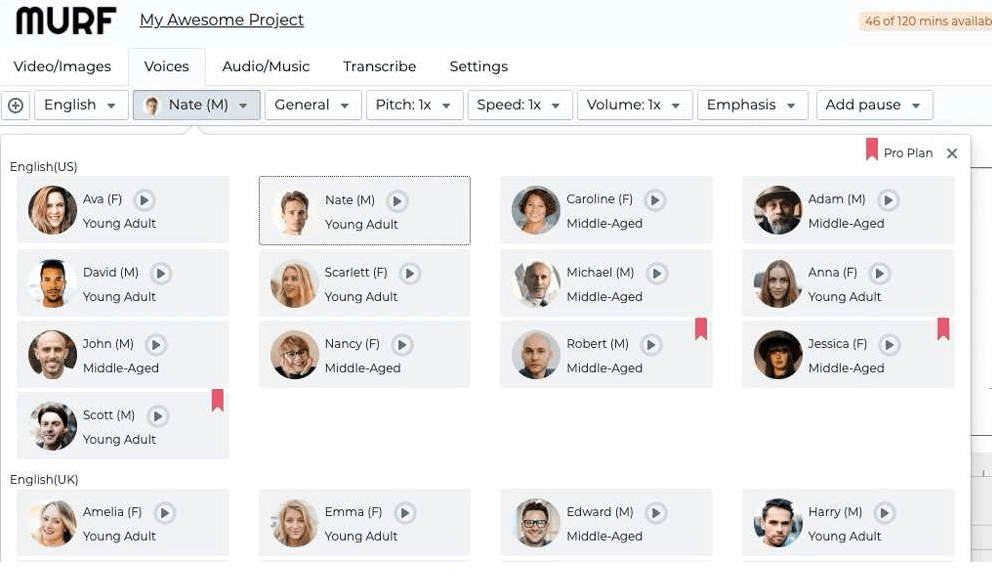
Murf meters by generation hours rather than characters, which makes budgeting simpler. The Creator plan gives you 24 hours a year, which works out to two hours a month, and commercial rights are included from the first paid tier. The timeline editor is the real reason to pick it. Syncing narration to slides, dropping in background music and nudging pauses between sentences all happen in one screen, and the Canva, PowerPoint and Google Slides integrations mean you rarely export and re-import.
Free gets you • 10 minutes of generation, total, not per month • Preview of all 200+ voices on your own script • No downloads and no commercial use | Paying gets you • Creator ($19 annual, $29 monthly): downloads, commercial rights, 24 hours a year • Business ($66 annual, $99 monthly): 96 hours a year on annual, or 20 hours a month if you pay monthly • Enterprise (custom): voice cloning, unlimited generation, API access |
What worked • The 900 word course module went from script to synced slides in under an hour • Pronunciation and emphasis controls are easier to use than ElevenLabs' tags • No surprise overage: when hours run out, generation stops | What did not • Voices are clean but flatter; the ad read sounded like a voicemail greeting • Cloning locked to Enterprise is a real gap in 2026 • The Business annual plan gives fewer hours than paying monthly, which is odd |
| Verdict: Worth paying for at Creator on annual billing if you make training or presentation content. Skip it if you need your own voice or expressive reads. |
Speechify
Reading app Studio is separate Annual is the real price
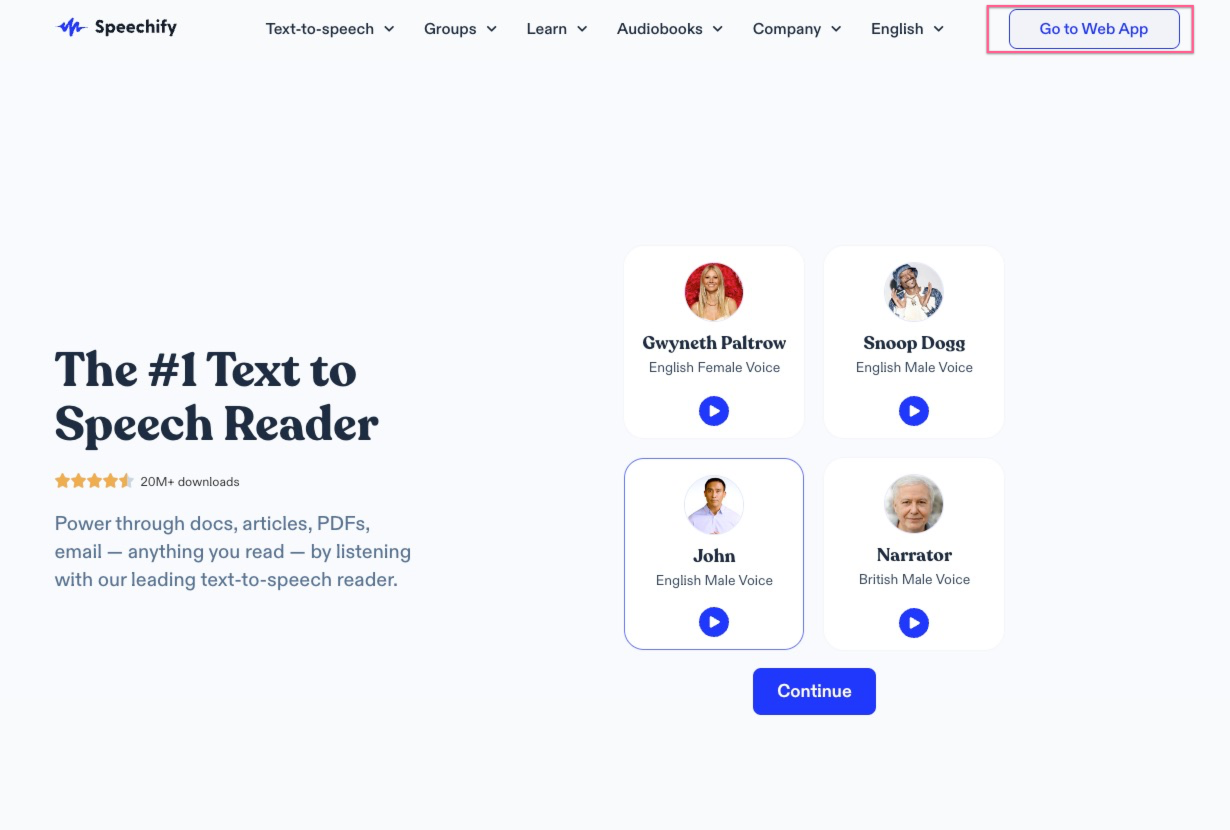
Speechify is the tool most people buy for the wrong reason. The Premium subscription is excellent for one job: reading long text to you at speed. My 6,000 word chapter played back at 2.5x with a voice that stayed listenable, and the PDF and Kindle handling beat everything else I tried. What Premium does not do is give you a commercial licence to export voiceovers. That lives in Speechify Studio, which has its own plans, and buying Premium for Studio work is the most common billing mistake I hear about.
Free gets you • Roughly 10 standard voices • Playback speed capped near 1.5x • Chrome extension, mobile app, basic PDF and web page reading | Paying gets you • Premium ($139 a year, about $11.58 a month; $29 if billed monthly): 200+ voices, up to 4.5x speed, OCR, offline listening • Studio Starter ($19/month): 12 hours of generation a year • Studio Creator ($49/month): 60 hours a year, commercial rights, voice cloning |
What worked • Best long form listening experience of the group • Speed controls actually stay intelligible above 3x | What did not • Monthly billing costs roughly 2.5x the annual rate • Studio Starter works out to about $19 per finished hour, the priciest here • Post-trial charges are a recurring complaint in reviews, so set a reminder |
| Verdict: Worth paying for Premium on annual billing if you listen to a lot of text. Not worth paying for as a voiceover tool unless you are already inside the Speechify ecosystem. |
Descript
Editor first Overdub clones your voice Credits since 2025
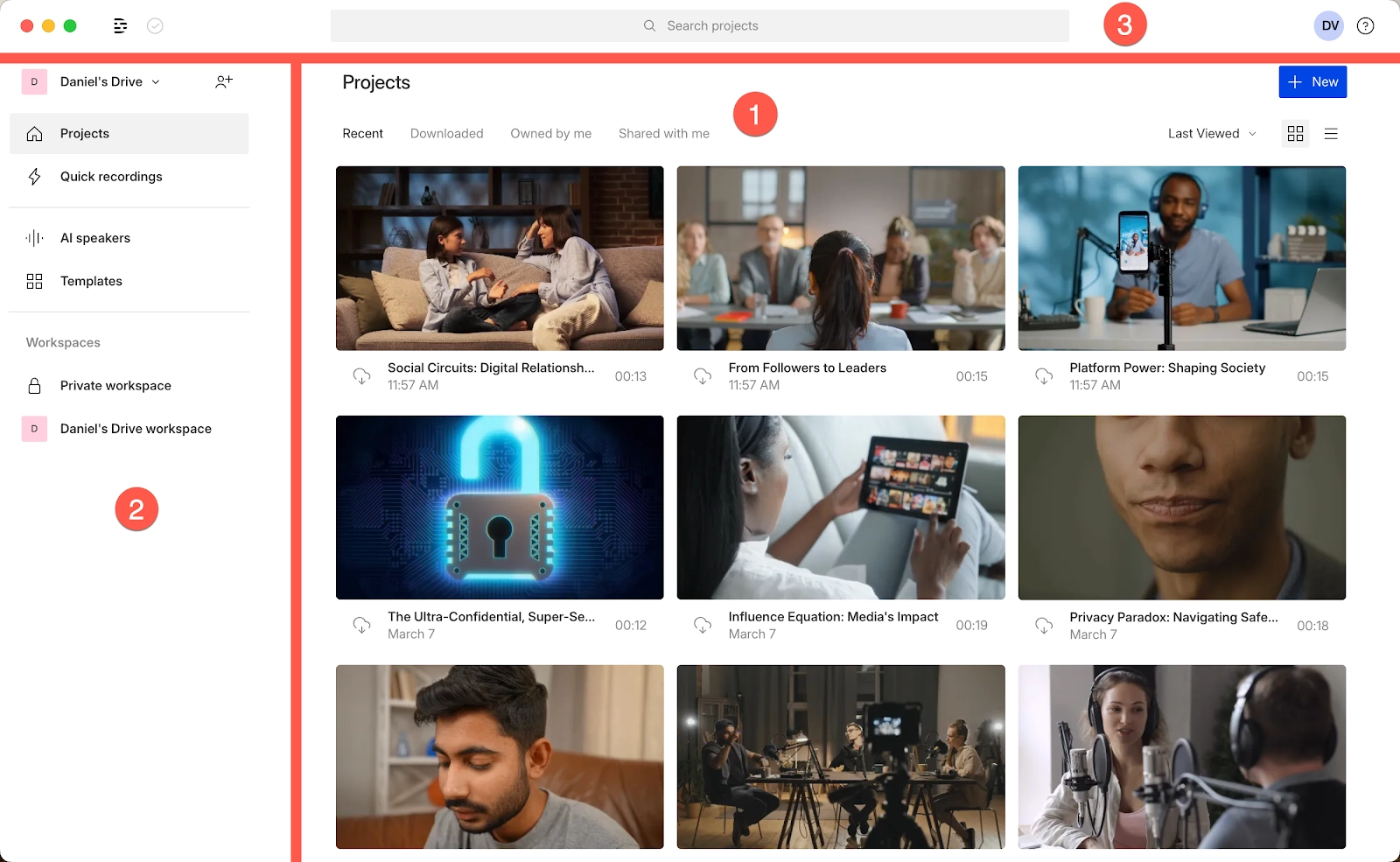
Descript is a different animal. You record yourself, it transcribes, and you edit the audio by editing the text. Its AI voice feature, Overdub, clones your own voice so you can fix a flubbed sentence by retyping it. That is a narrower use than the other three, and it is brilliant at it. Since the September 2025 pricing overhaul, AI features draw from a credit pool on top of the media minute limits, which has annoyed long time users but is workable once you understand it.
Free gets you • 60 media minutes a month and 100 one-time AI credits • Watermarked export | Paying gets you • Hobbyist ($16 annual, $24 monthly): 10 hours of media, 1080p, basic Overdub • Creator ($24 annual, $35 monthly): 30 hours, 4K, no watermark, full Overdub quality • Business ($50 annual, $65 monthly): 40 hours per seat, brand kits, SSO |
What worked • Fixing a mispronounced client name took 20 seconds instead of a re-record • Filler word removal and Studio Sound cleanup are still the best in class • Creator level Overdub was hard to spot on patches under a sentence | What did not • Hobbyist Overdub is audibly rougher on anything longer than a few words • Credit top-ups expire after 12 months • It cannot narrate a script from scratch with a library voice the way the others can |
| Verdict: Worth paying for at Creator if you already record and edit your own content. Wrong purchase if you want a text to speech generator. |
Real cost per finished hour
Sticker prices hide the number that matters. Assuming roughly 1,000 characters per spoken minute at a normal pace, here is what one hour of usable audio costs on each plan, before any overage or regeneration waste.
| Plan | Monthly price | Included audio per month | Cost per finished hour |
|---|---|---|---|
| ElevenLabs Creator | $22 | About 1.6 hours | About $13 |
| ElevenLabs Pro | $99 | About 10 hours | About $10 |
| Murf Creator (annual) | $19 | 2 hours | $9.50 |
| Murf Business (annual) | $66 | 8 hours | $8.25 |
| Speechify Studio Starter | $19 | 1 hour | $19 |
| Speechify Studio Creator | $49 | 5 hours | $9.80 |
Murf wins on raw cost per hour, ElevenLabs wins on hours you actually keep. In my testing I regenerated Murf output about twice as often as ElevenLabs output to get an ad read I would ship, which narrows that gap considerably for expressive content and leaves it wide open for flat instructional narration.
When free is enough
Plenty of voice work never needs a paid plan. These are the situations where I would not spend a cent.
You want to listen, not publish Microsoft Edge Read Aloud has no usage cap and the neural voices are close to what paid reading apps charge for. The catch is that you cannot export the audio, so it is strictly for reading to yourself. | You are testing which voice fits a brand The ElevenLabs free plan is the right sandbox. Ten minutes a month is enough to audition a dozen voices on a real paragraph of your copy before committing to a plan. |
You can run a model locally Kokoro is an 82 million parameter open source model under an Apache 2.0 licence that runs on a plain CPU and has ranked near the top of blind listening tests. No cap, no account, no data leaving your machine. | You are a developer prototyping Google Cloud Text to Speech and Amazon Polly both carry monthly free character allowances under normal commercial terms. The limits are generous for standard voices and tighter for the neural ones, so check the console for current figures before you build around them. |
Internal drafts and scratch tracks Placeholder narration for a storyboard or a temp track for timing does not need commercial rights. Any free tier will do. |
When paying is the right call
The audio will be sold or monetised Every free plan here forbids commercial use, and ElevenLabs additionally requires attribution. A YouTube channel with ads on, a paid course, or a client deliverable needs at least ElevenLabs Starter or Murf Creator. | You need your own voice Cloning that survives a close listen starts at ElevenLabs Creator or Descript Creator. Murf makes you go to Enterprise for it, and Speechify only offers it on Studio Creator. |
You regenerate a lot If a script needs five attempts to get pacing right, the free allowance is gone before you finish one video. A paid tier turns a rationing exercise back into normal work. | Your output is long form An audiobook chapter or a 40 minute training module simply does not fit in 10 free minutes. At that scale, the per hour table above is the number to shop on. |
Final verdict
After three weeks and a little over $90 in subscriptions, the tool still open on my machine is ElevenLabs on the Creator plan. It is not the cheapest per hour, but it was the only one where I trusted the first take often enough that the credit maths stopped mattering. Murf earned a place for the course module work, where the editor saved more time than the flatter voices cost me, and I would keep it on annual billing for that alone. Descript stays installed because I record a podcast, and nothing else patches a bad sentence as painlessly. Speechify Premium I kept for reading, which is exactly what it is for.
If you take one thing from this, make it the licence question. Ask what the audio is for before you look at a single price. If the answer is your own ears, stay free. If the answer involves an audience, a client or a monetised channel, pay for the cheapest tier that includes commercial rights and, if you need it, cloning. Everything above that line is a quality decision, and quality is the one thing I could not fake by rationing free minutes.
Comments